
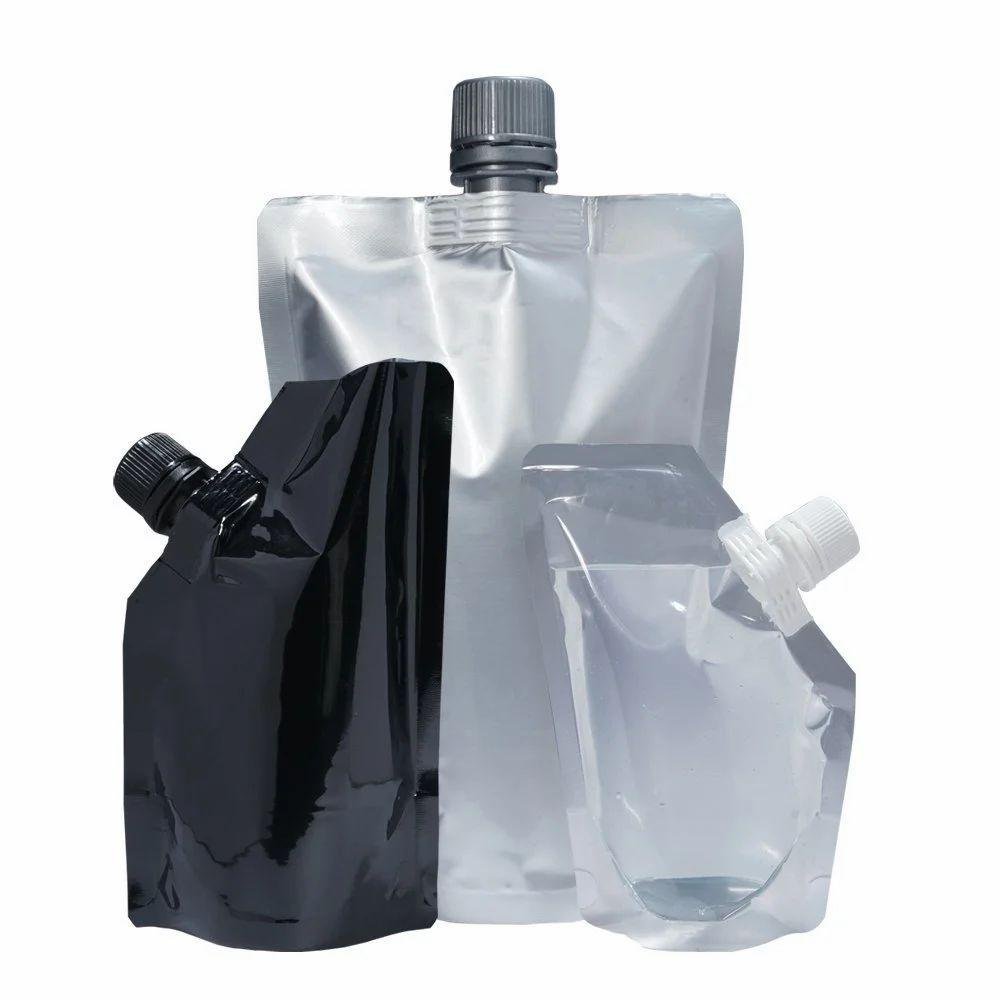
Custom Spout Pouches: Factory Direct - 3-Day Sampling
Semi-transparent PA+PE and frosted matte embossed spout pouches with colored spouts. Food-grade materials, FDA/SGS certified, gravure/flexo printing.
500+ clients served 50M+ annual output FDA . SGS certified 30+ countries exported
Custom Spout Pouches — Engineered Flexible Packaging for Liquid, Paste & Powder
A custom spout pouch is a flexible, stand-up laminate fitted with an integrated fitment (spout) and cap, engineered to replace rigid bottles, jars and cans for liquid, semi-liquid and flowable dry products. Unlike off-the-shelf stock pouches, a custom spout pouch is specified around your exact product — fill viscosity, thermal process, barrier requirement, shelf-life target and brand finish — then manufactured to repeatable tolerances on a dedicated converting line.
What you can expect from our factory
- ISO 9001:2015 certified factory with BRCGS-compliant food-contact production lines
- Film structures compliant with FDA 21 CFR, EU 10/2011, GB 9685 and REACH
- Retort (121°C), hot-fill (85–95°C), aseptic and cold-fill capable constructions
- Gravure printing up to 10 colours; digital proofing and 3D mock-ups in 24 hours
- Physical samples in 5–7 days; bulk production in 7–15 days
- Low MOQ from 5,000 pieces (digital) / 50,000 pieces (gravure)
1. Film Structure & Barrier Engineering
Shelf life is a direct function of the barrier the laminate delivers against oxygen, moisture and light. The structure you select — not the spout — usually determines whether your product oxidises, dries out or loses volatile flavour compounds before its best-before date. We engineer structures from four to seven layers, balancing barrier performance against cost, stiffness, drop resistance and recyclability. The table below gives typical barrier values for the structures we run most often (23°C / 0% RH, measured on finished laminate).
| Structure | Layers | OTR (cc/m²/day) | WVTR (g/m²/day) | Best for |
|---|---|---|---|---|
| High-barrier retort | PET / Alu foil / CPP | < 0.01 | < 0.01 | Retort baby food, ready meals, aggressive sauces |
| High-barrier cold / hot fill | PET / Alu foil / PE | < 0.01 | < 0.01 | Acidic sauces, oils, high-fat content |
| Transparent high barrier | PET / AlOx / PE or PET / EVOH / PE | 0.5 – 3 | 1 – 3 | Clear beverages, premium cosmetics |
| Metallised (VMPET) | PET / VMPET / PE | 0.5 – 2 | 0.5 – 2 | Powdered nutrition, coffee, dry mixes |
| Standard transparent | PET / PE | 50 – 120 | 5 – 10 | Short-shelf liquids, cleaning products |
| Recyclable mono-material | MDO-PE / EVOH / PE | 1 – 5 | 1 – 3 | Sustainability-led brands, PPWR compliance |
How to select the right structure
The correct structure is a trade-off between three variables: barrier, stiffness and recyclability. Start from your product chemistry, not from cost.
- Oxygen sensitivity: oils, vitamin-C juices, retort baby food and wine demand foil or EVOH/AlOx; plain water or soap does not.
- Moisture gain / loss: hygroscopic powders (infant formula, protein) need WVTR below 1 g/m²/day.
- Thermal process: retort (121°C) requires a CPP sealant layer and retort-grade inks/adhesives; hot-fill (85–95°C) needs a sealant that resists softening at fill temperature.
- pH and fat: high-acid or high-fat products attack certain inks and adhesives — specify acid- and fat-resistant laminating systems.
- End-of-life: if PPWR recyclability is a requirement, constrain the design to mono-material PE or PP from day one, and accept a modest barrier trade-off.
2. Spout & Fitment Options
The fitment is the mechanical heart of the package: it must seal hermetically to the laminate, survive your fill process, dispense cleanly in use, and re-close reliably for the life of the product. We source food-grade spouts from certified injection-moulding partners and validate seal integrity on every production batch.
| Spout type | Material | Common diameters | Cap / closure | Process compatibility |
|---|---|---|---|---|
| Standard round spout | PP (polypropylene) | 8.6 / 10 / 16 / 20 mm | Screw cap, flip-top | Cold fill, hot fill to 90°C |
| Wide-mouth spout | PP or PE | 20 – 30 mm | Screw, dispensing valve | Viscous pastes, purees, gels |
| Retort spout | Retort-grade PP | 10 – 16 mm | Screw cap, tamper-evident | Retort to 121°C |
| Aluminium spout | Aluminium + PE liner | 10 – 16 mm | Screw cap | Premium beverages, spirits |
| Child-resistant spout | PP (2-piece CR) | 10 – 16 mm | CR screw cap | Household chemicals, cannabis, pharma |
| Valve / non-spill spout | PP + silicone valve | 8.6 – 16 mm | Flip-top | Sports nutrition, baby food |
Spout placement & closure considerations
- Position: top-centre (standard), corner (angled pour), or side (wide-mouth) — driven by fill orientation and shelf geometry.
- Seal geometry: the spout flange must match your seal width; we run seal jaws calibrated to your specific fitment.
- Torque & opening force: specified and tested per batch; tamper-evident bands standard.
- Leak testing: every batch undergoes vacuum leak (ASTM D3078) and internal-pressurisation (ASTM F2096) sampling.
3. Filling & Thermal-Process Compatibility
A spout pouch is only as good as its compatibility with your fill line and thermal process. We specify the laminate and sealant around the harshest step in your process — usually retort or hot-fill — so the pouch survives it without delamination, seal creep or spout distortion.
| Process | Temperature | Required structure | Key considerations |
|---|---|---|---|
| Cold fill | Ambient | PET/PE, any standard | Lowest cost; fastest line speed |
| Hot fill | 85 – 95°C | Foil or EVOH + heat-stable PE sealant | Sealant must resist softening; panel absorption during cooling |
| Pasteurisation | 75 – 95°C | Foil or EVOH | Acidified foods; shorter exposure |
| Retort (steam) | 121°C / 30–60 min | Foil + CPP, retort inks/adhesives | CPP sealant mandatory; spout must be retort-grade |
| Aseptic | Ambient (sterile) | Foil or EVOH + sterilised spout | Requires sterile filling; longest unrefrigerated shelf life |
| Hot-fill-and-hold | 85 – 95°C + hold | Foil + CPP | Beverages with particles; headspace management |
4. Regulatory & Food-Contact Compliance
Compliance is table stakes for any qualified B2B supplier — but “FDA-approved” is not a blanket claim. Every layer, ink, adhesive and spout resin must be cleared for its specific end use and migration limit. We provide full compliance documentation — including a Declaration of Compliance (DoC) per EU 10/2011 and a written migration report on request — before your first production run.
| Standard / Regulation | Scope | What we provide |
|---|---|---|
| FDA 21 CFR 177.1520 / 177.1390 / 177.1630 | US food-contact resins & laminates | Written compliance letter per structure |
| EU 10/2011 + 2023/2006 GMP | EU plastics & GMP | DoC + overall migration (OML) test report |
| China GB 9685 / GB 4806 | China food-contact additives | Compliance documentation |
| REACH (EC 1907/2006) | EU chemicals | SVHC-free statement |
| California Prop 65 | US state warning labels | Compliance assessment |
| BRCGS Packaging / ISO 22000 | Food-safety management | Factory audit certificate |
| EN 13432 / ASTM D6400 | Compostable structures | Certificates where applicable |
5. Sustainability & Recyclable Mono-Material Structures
The EU PPWR (Packaging and Packaging Waste Regulation) and equivalent EPR schemes now penalise multi-material laminates that cannot be recycled. We have moved early into recyclable mono-material PE and PP spout pouches that meet “designed for recycling” guidelines while holding acceptable barrier performance. Sustainability is now a design input, not an afterthought.
| Structure | Recyclability | Barrier | Trade-off |
|---|---|---|---|
| Mono-PE (MDO-PE / EVOH / PE) | Fully recyclable (PE stream) | Good (OTR 1–5) | Slight cost premium; EVOH kept <5% to preserve recyclability |
| Mono-PP | Fully recyclable (PP stream) | Good | Best with PP spout for single-polymer package |
| PCR-content PE | Recyclable + recycled input | Standard | Up to 30% PCR without functional loss |
| Compostable (PLA/PBAT + paper) | Industrially compostable (EN 13432) | Low–moderate | Shorter shelf life; moisture-sensitive; premium cost |
| Conventional PET/ALU/PE | Not recyclable | Highest | Best barrier, worst end-of-life; phased out under PPWR |
6. Total Cost of Ownership vs Rigid Packaging
Procurement decisions should be made on total cost of ownership, not unit price. A spout pouch almost always wins on freight, storage and material weight; a rigid bottle sometimes wins on fill-line speed for very high volumes. The table below is a fair, engineering-grade comparison for a typical 500 ml liquid product (indicative values).
| Metric (per 1,000 units) | Spout pouch | HDPE bottle | Glass jar | Aluminium can |
|---|---|---|---|---|
| Package weight | ~12 g | ~38 g | ~230 g | ~45 g |
| Freight & storage volume | Lowest | Low | Highest | Medium |
| Material cost | Low | Low | High | Medium |
| Fill-line speed | Medium | High | Medium | Very high |
| Breakage / damage | None | None | High | Low |
| Carbon footprint | Lowest | Low | Highest | Medium |
| Shelf appeal (flexible shape) | High | Medium | Premium | Medium |
7. Applications by Industry
Spout pouches now span food, beverage, personal care, household, pet and industrial markets. The structure and spout you need differs materially by segment — below is how we map each.
- Food & beverage: juices, smoothies, jellies, sauces, ketchup, dressings, honey, edible oils.
- Baby food & purees: retort-ready, high-barrier, child-safe spouts and caps.
- Sports & clinical nutrition: energy gels, protein shots, electrolyte pouches, valve spouts.
- Pet food: wet cat/dog food, gravy toppers — retort and hot-fill.
- Personal care & cosmetics: shampoo, conditioner, lotion, hand sanitiser, face masks.
- Household & chemicals: laundry detergent refills, cleaners, car care — child-resistant where required.
- Industrial & agrochemical: lubricants, adhesives, crop-protection refills — chemical-resistant structures.
8. Customisation Options
Every dimension of the pouch is customisable. The choices below are the ones that most affect function and cost.
- Size & volume: 50 ml single-serve to 5 L bulk; fill volume matched to gusset and spout position.
- Shape: stand-up (Doypack), flat-bottom, corner-spout, shaped / die-cut profiles.
- Printing: gravure up to 10 colours, or digital for short runs; matte, gloss, soft-touch and registered finishes.
- Decoration: spot UV, embossing / debossing, cold / hot foil, metallic inks, frosted windows.
- Add-ons: clear window, zipper, handle, hang hole, tear notch, oxygen scavenger, resealable valve.
9. Quality Control & Test Methodology
We test to the same standards your QA lab would use, and we publish the numbers. In-line checks run continuously; a documented lab report ships with every production batch.
| Test | Standard | What it verifies | Typical spec |
|---|---|---|---|
| Oxygen transmission (OTR) | ASTM D3985 | Barrier to O&sub2; | Structure-dependent (see §1) |
| Water-vapour transmission (WVTR) | ASTM F1249 | Barrier to moisture | Structure-dependent (see §1) |
| Seal strength | ASTM F88 / F88M | Heat-seal integrity | ≥ specified N/15 mm |
| Vacuum leak (bubble) | ASTM D3078 | Gross leak detection | No leakage at 250–350 mmHg |
| Internal pressurisation | ASTM F2096 | Seal burst & pinholes | No leak at 10–30 kPa |
| Burst strength | ASTM F1140 / F2054 | Pouch & seal burst | ≥ specified kPa |
| Drop test | ASTM D5276 | Handling durability | No rupture (height per product) |
| Dye penetration | ASTM F1929 | Channel leaks in seals | No dye penetration |
In-line vs laboratory testing
In-line vision systems check print registration, spout placement and seal width at full production speed. Destructive tests — seal strength, burst, drop and migration — are run in our on-site laboratory on samples drawn per AQL (ISO 2859-1), typically 1.0 / 0.65 for critical defects.
10. Failure Modes & How We Prevent Them
Understanding failure modes is how we prevent them. These are the most common spout pouch failures we see from other suppliers, and the controls we build into our process.
| Failure mode | Root cause | Detection | Prevention |
|---|---|---|---|
| Seal delamination | Incompatible film/adhesive or insufficient cure | Seal-strength test, boil test | Validated laminate recipes; solventless lamination |
| Spout leakage | Poor flange fusion, contamination at seal | Vacuum leak, dye penetration | Spout insertion QC; seal-jaw calibration |
| Pinholes / flex-crack | Foil flex fatigue, film defects | Light-box, internal pressurisation | Film gauge & foil tempering control |
| Burst during fill | Weak seal or undersized burst margin | Burst test | Seal spec with safety factor ≥ 1.5 |
| Drop rupture | Over-stiff laminate, sharp spout stress | Drop test | Structure tuned for ductility |
| Odour / taint | Uncured inks or adhesives, off-spec resin | Sensory panel, GC-MS | Retort-grade inks; full cure before lamination |
11. MOQ, Pricing Factors & Lead Time
Pricing is driven by five variables, and MOQ is driven primarily by print method. Understanding these lets you cost a project before you request a quote.
| Factor | How it affects cost / MOQ |
|---|---|
| Print method | Gravure = lowest unit cost, MOQ 50k; Digital = no plate cost, MOQ 5k |
| Film structure | More layers / foil / EVOH = higher cost; mono-material = small premium |
| Spout & cap | Standard PP = cheapest; CR / valve / aluminium = premium |
| Size & shape | Larger or die-cut = more film; shaped pouches add tooling |
| Volume | Unit cost falls sharply at 50k, 100k, 500k tiers |
Typical timeline: artwork proof in 24 hours, 3D mock-up same day, physical sample in 5–7 days, bulk production in 7–15 days (gravure) or 5–7 days (digital), plus shipping. We hold re-order artwork on file so repeat orders skip proofing.
12. Our Production Process
Six controlled stages take your product from artwork to delivered pallets.
- Consultation & specification — we map product chemistry, fill process, barrier and volume to a structure.
- Artwork & digital proof — 3D mock-up in 24 hours; colour-managed proofing.
- Printing — gravure up to 10 colours or digital; registration to ±0.2 mm.
- Lamination — solventless / solvent, validated recipes; full cure before converting.
- Converting & spout insertion — pouch forming, spout welding, QC gates at each step.
- Testing, packing & shipping — batch lab report, palletising, sea / air / express delivery.
13. The 15-Point Spout Pouch Supplier Evaluation Checklist
Use this checklist to qualify any spout pouch supplier — including us — before placing a production order.
- Is the factory ISO 9001 / BRCGS certified with an on-site audit you can verify?
- Do they provide a written Declaration of Compliance (DoC) per EU 10/2011?
- Do they publish OTR/WVTR and seal-strength data for their structures?
- Can they validate retort or hot-fill compatibility for your specific process?
- Do they offer mono-material recyclable structures, and can they prove recyclability?
- What is their MOQ by print method, and is digital sampling available?
- Do they provide free physical samples before bulk production?
- What is their QC sampling plan — do they test to ASTM D3078 / F88 / F2096?
- Is spout insertion done in-house with documented seal-jaw calibration?
- Do they issue a batch test report and traceability with every shipment?
- What are their lead times for sample and bulk, and re-order?
- Do they hold re-order artwork and tooling on file at no charge?
- What are their payment terms — do they accept L/C or 30% deposit?
- Can they provide references or case studies from your industry?
- Who is your single point of contact, and are they responsive across time zones?
14. Spout Pouch Market Intelligence
Spout pouches are one of the fastest-growing formats in flexible packaging. Industry estimates put the global spout pouch market at roughly US$3.6 billion in 2024, growing at a 6–8% CAGR toward US$6 billion by the early 2030s. Three forces drive the growth.
- Convenience & portion control: on-the-go consumption favours resealable, squeezable formats over rigid.
- Weight & carbon reduction: spout pouches cut package weight 60–80% vs rigid and lower freight emissions.
- Sustainability regulation: PPWR and EPR schemes push brands from multi-layer laminates toward recyclable mono-materials.
- Retort & shelf-stable growth: retort pouches displace cans in baby food, pet food and ready meals.
What this means for your sourcing strategy
Lock in a supplier with validated mono-material and retort capability now, before demand tightens capacity. Suppliers who can document barrier performance and recyclability will be the ones who survive PPWR-driven consolidation.
15. Frequently Asked Questions
What is the minimum order quantity (MOQ) for custom spout pouches?
Our MOQ depends on print method. Digital printing starts at 5,000 pieces, while gravure printing — the most economical at scale — typically starts at 50,000 pieces. For brand launches and market testing, digital sampling lets you validate the pouch and artwork before committing to gravure tooling. We also produce physical pre-production samples in 5–7 days regardless of final MOQ.
How much do custom spout pouches cost?
Unit cost is driven by film structure, size, print method, spout type and volume. A standard 100–250 ml transparent pouch in volume typically lands in the low single-digit cents per piece before printing and spout; high-barrier retort structures with foil and retort spouts cost more. We provide an itemised quote — film, printing, spout, tooling, freight — within one business day of receiving your specification.
What is the typical lead time?
Artwork proofing takes 24 hours, physical samples 5–7 days, and bulk production 7–15 days for gravure or 5–7 days for digital, plus shipping. Re-orders skip proofing because we hold your artwork and tooling on file, typically cutting the cycle to production time only.
Can spout pouches be retorted or hot-filled?
Yes. We run retort-grade structures (PET/foil/CPP) validated to 121°C for 30–60 minutes, and hot-fill structures validated to 85–95°C. The sealant layer and spout must be specified for the thermal process up front — a cold-fill pouch will not survive retort. Tell us your fill process and we will engineer the structure to match.
Are your spout pouches recyclable or compostable?
We offer recyclable mono-material PE and PP pouches that meet “designed for recycling” guidelines and hold OTR down to 1–5 cc/m²/day, plus EN 13432 compostable structures for suitable applications. Conventional foil laminates offer the highest barrier but are not recyclable and are being phased out under the EU PPWR. We recommend the structure based on your barrier need versus recyclability target.
Which certifications and compliance documents do you provide?
We are ISO 9001:2015 certified with BRCGS-compliant food-contact production. For every structure we provide a written FDA 21 CFR compliance letter, an EU 10/2011 Declaration of Compliance with migration test reports, and GB 9685 / REACH / Prop 65 documentation on request. Compliance documents ship with your first production order and are refreshed on material changes.
Do you provide free samples before production?
Yes. We produce free physical pre-production samples in 5–7 days so you can validate seal, spout function, drop performance and shelf appeal before committing to bulk. You cover only the courier cost; the samples themselves are free for qualified B2B buyers.
16. Key Takeaways
- Custom spout pouches replace rigid bottles and cans for liquids, pastes and powders — at 60–80% lower package weight and a fraction of the freight and carbon.
- Barrier performance (OTR/WVTR), not spout choice, determines shelf life — and we publish our numbers per ASTM D3985 / F1249.
- Retort (121°C), hot-fill (85–95°C), aseptic and cold-fill constructions are all available; specify the process up front.
- We provide full compliance documentation — FDA 21 CFR, EU 10/2011 DoC, GB 9685, REACH, Prop 65 — before your first order.
- Recyclable mono-material PE/PP structures meet PPWR and “designed for recycling” guidelines now.
- ISO 9001 + BRCGS-compliant factory; free samples in 5–7 days; bulk in 7–15 days; MOQ from 5,000 pieces.
Ready to Spec Your Custom Spout Pouch?
Send your product specification — volume, product chemistry, fill process, barrier target and artwork — and receive a structure recommendation, 3D mock-up and itemised quote within one business day. Our packaging engineers will advise the optimal film structure, spout and finish for your application, at factory-direct pricing with no intermediary markup.
You Also May Like

Ready to Improve Your Packaging Supply Chain?
Whether you are looking for a new packaging supplier, a backup manufacturer, or a trusted sourcing partner, We are ready to support your business.