
Custom Food Packaging Bags
— Engineered Flexible Packaging for Every Food Category
A custom food packaging bag is a high-barrier flexible pouch engineered to protect food from oxygen, moisture, light, aroma loss and contamination — matched to the format, barrier and closure your specific food needs. Built for food brands, co-packers, packaging engineers and procurement teams who specify flexible food packaging as an engineering component.
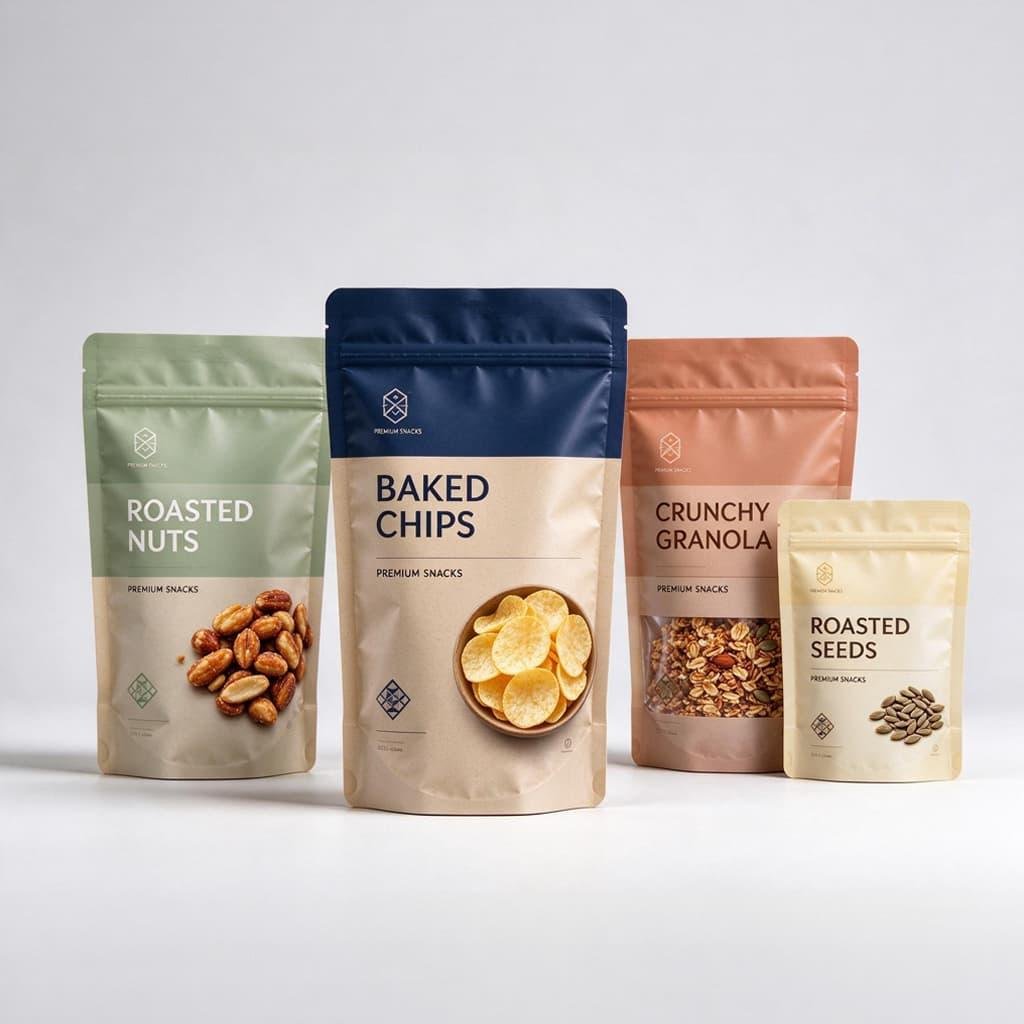
A custom food packaging bag is a high-barrier flexible pouch engineered to protect food from the four things that spoil it — oxygen, moisture, light and aroma loss — plus contamination, matched to the specific format, barrier and closure each food category needs. This is our hub page: for category-specific depth, see our dedicated pages on coffee bags, pet food bags and kraft paper bags.
What you can expect from our factory
- ISO 9001:2015 & BRCGS-compliant factory with food-contact material compliance (FDA 21 CFR 177.1520, EU 10/2011, GB 4806, REACH, Prop 65)
- Quantified barrier data — OTR in cc/m²/day and WVTR in g/m²/day per structure, with test conditions stated
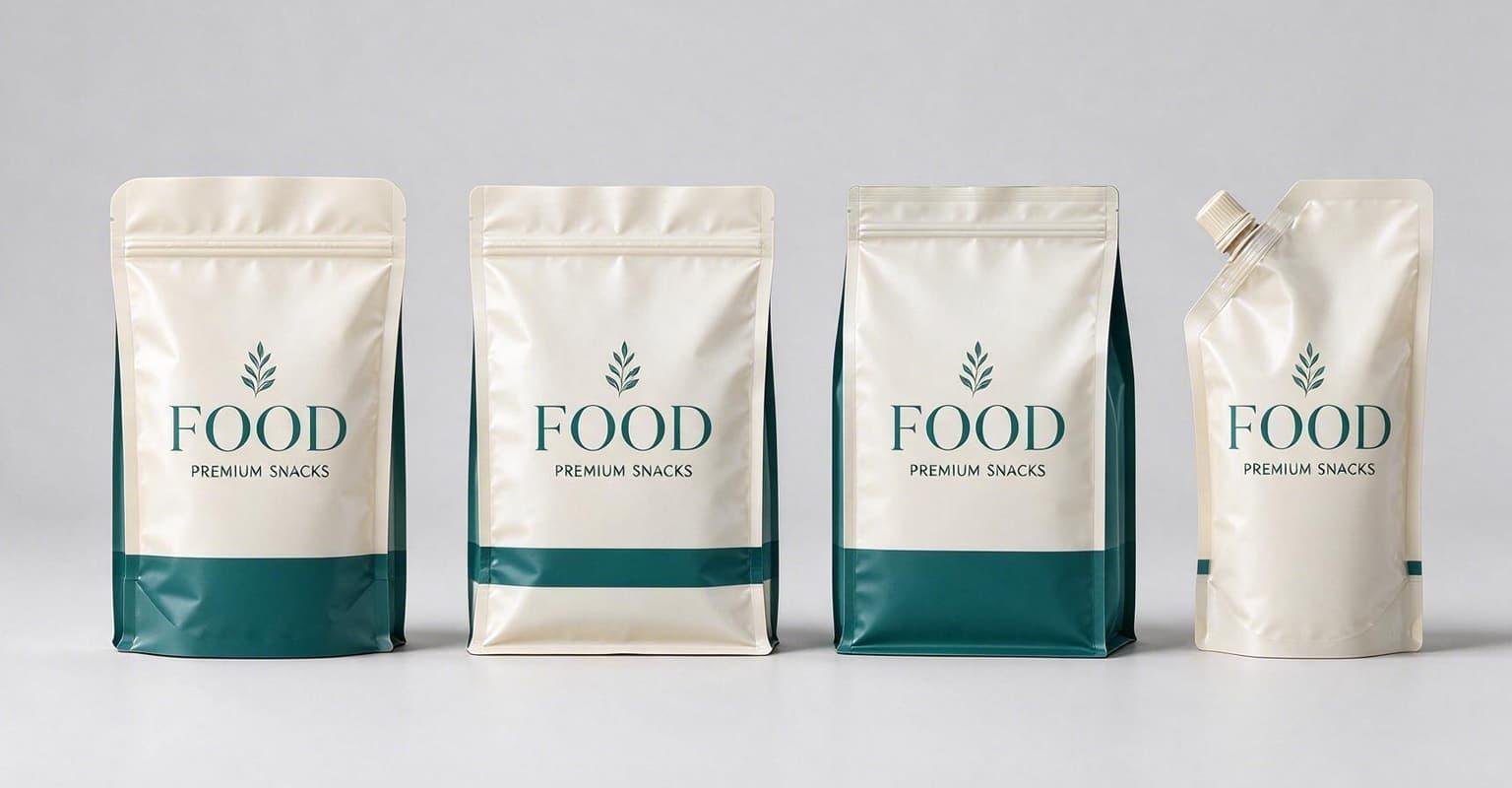
- Every format — stand-up, flat-bottom, side-gusset, quad-seal, pillow, stick pack, spout, retort and vacuum pouches
- Closures & fitments — zippers, spouts, one-way degassing valves, tear notches, hang holes and clear windows, in-house
- Process capability — retort (to 135 °C), hot-fill, pasteurization, MAP and vacuum
- Free pre-production samples in 3–5 days; MOQ from 1,000 pieces; production lead time 7–15 days
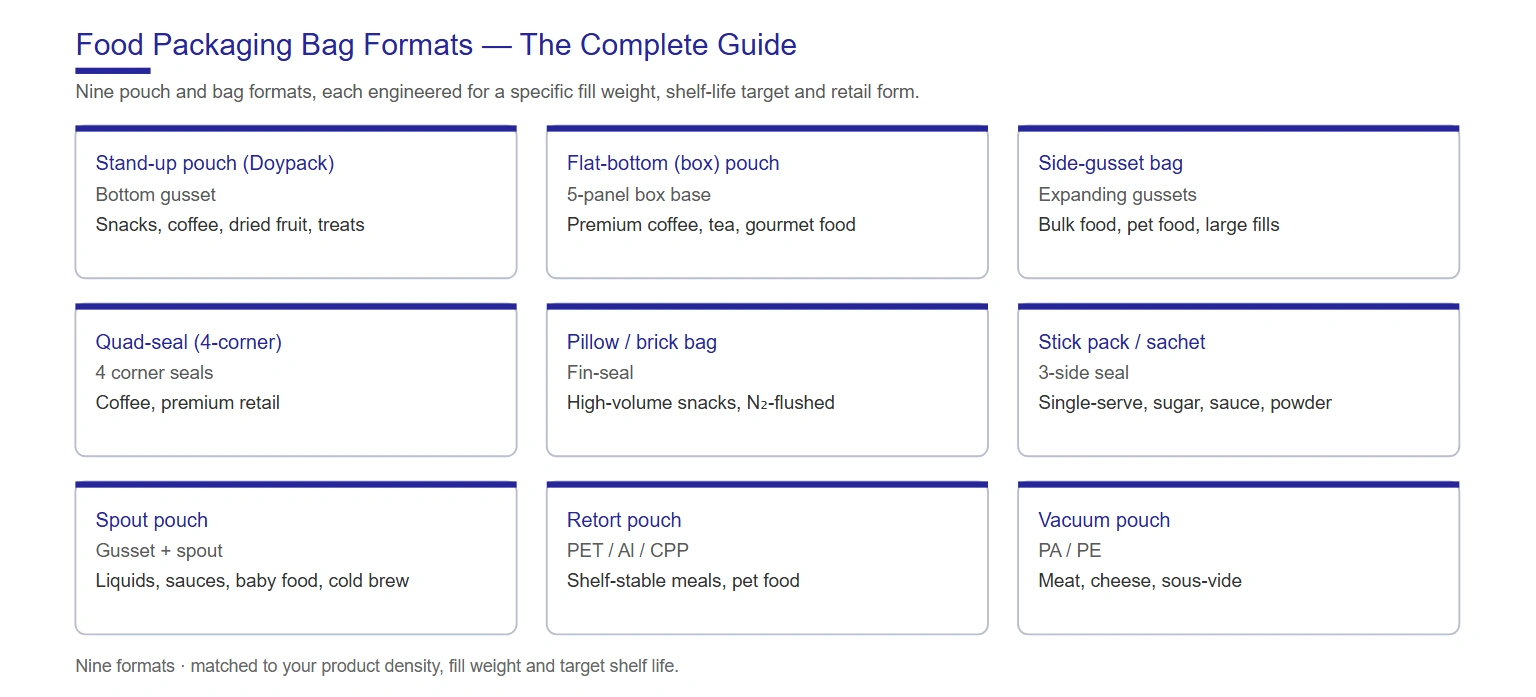
Food Packaging Bag Formats: The Complete Guide
| Format | Structure | Best for | Key features |
|---|---|---|---|
| Stand-up pouch (Doypack) | Bottom gusset | Snacks, coffee, dried fruit, treats | Self-standing, resealable, compact |
| Flat-bottom (box) pouch | 5-panel box base | Premium coffee, tea, gourmet food | 5 printable faces, stable shelf |
| Side-gusset bag | Expanding gussets | Bulk food, pet food, large fills | High capacity, traditional |
| Quad-seal (4-corner) | 4 corner seals | Coffee, premium retail | Box-like, rigid base |
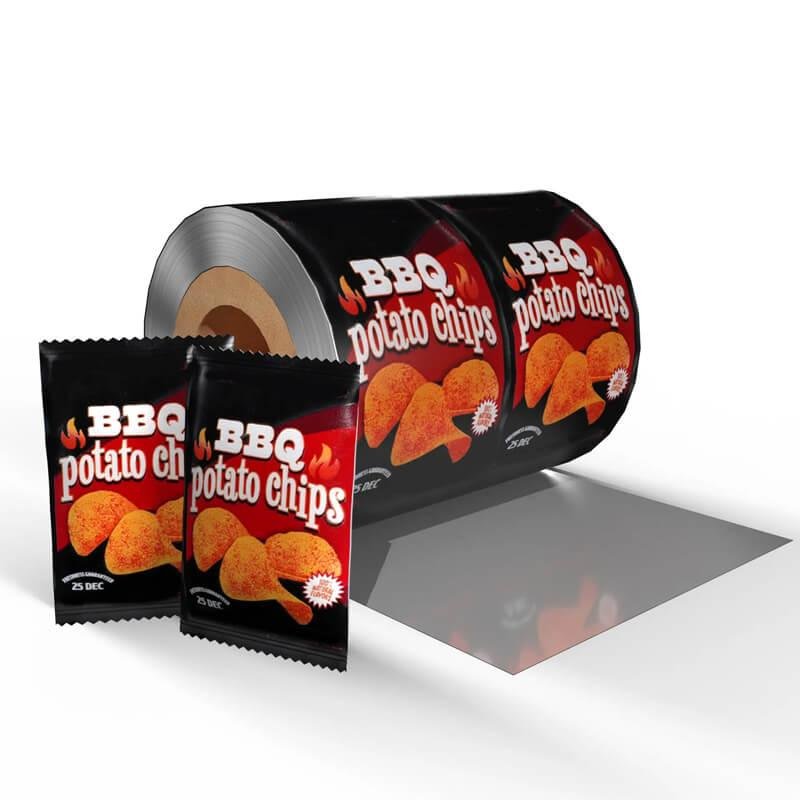
| Pillow / brick bag | Fin-seal | High-volume snacks, N2-flushed | Low cost, high speed |
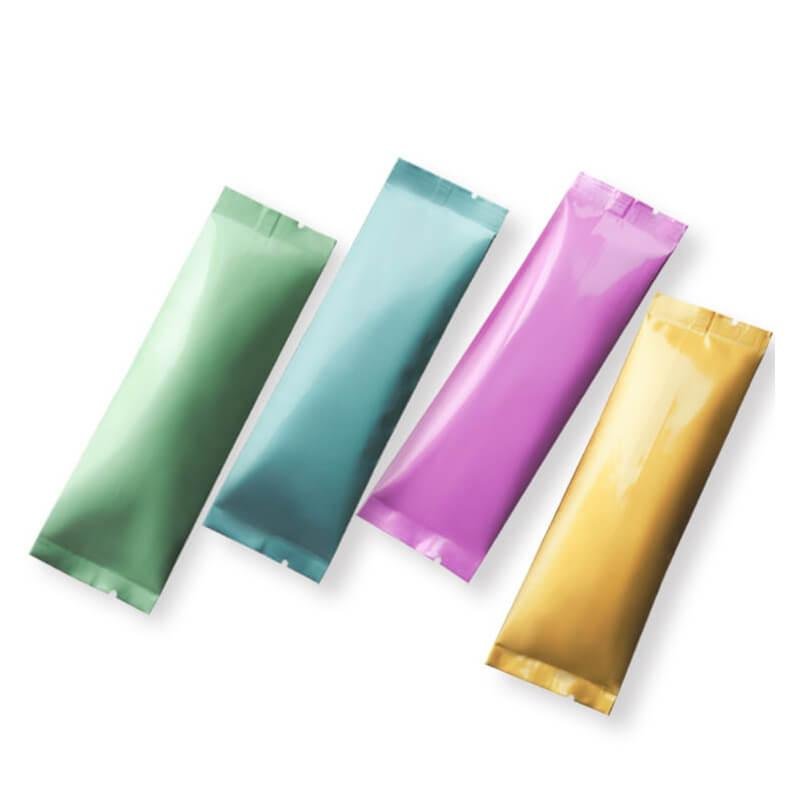
| Stick pack / sachet | 3-side seal | Single-serve, sugar, sauce, powder | Portion control |
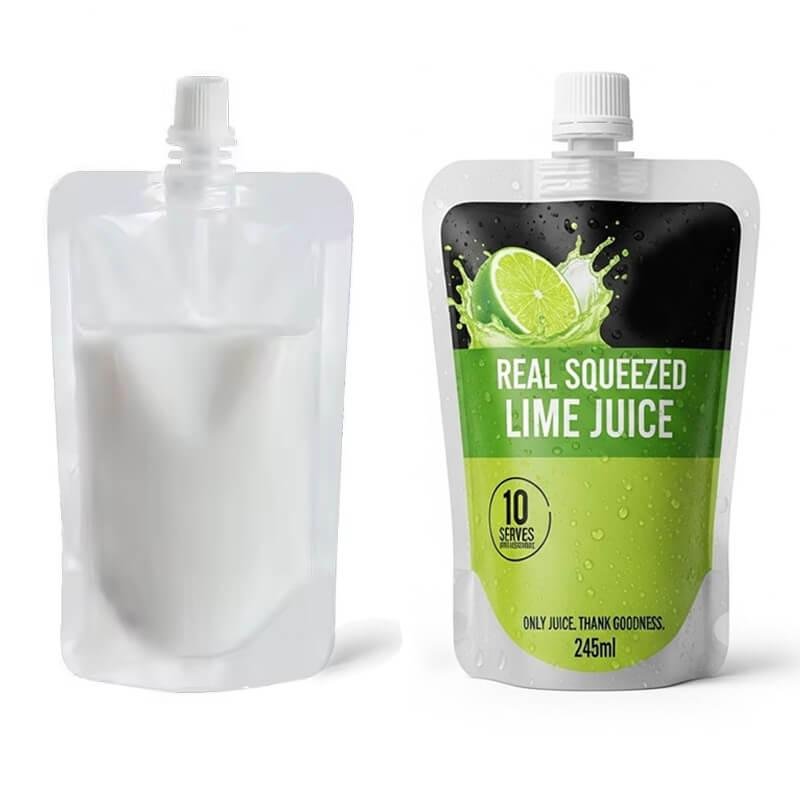
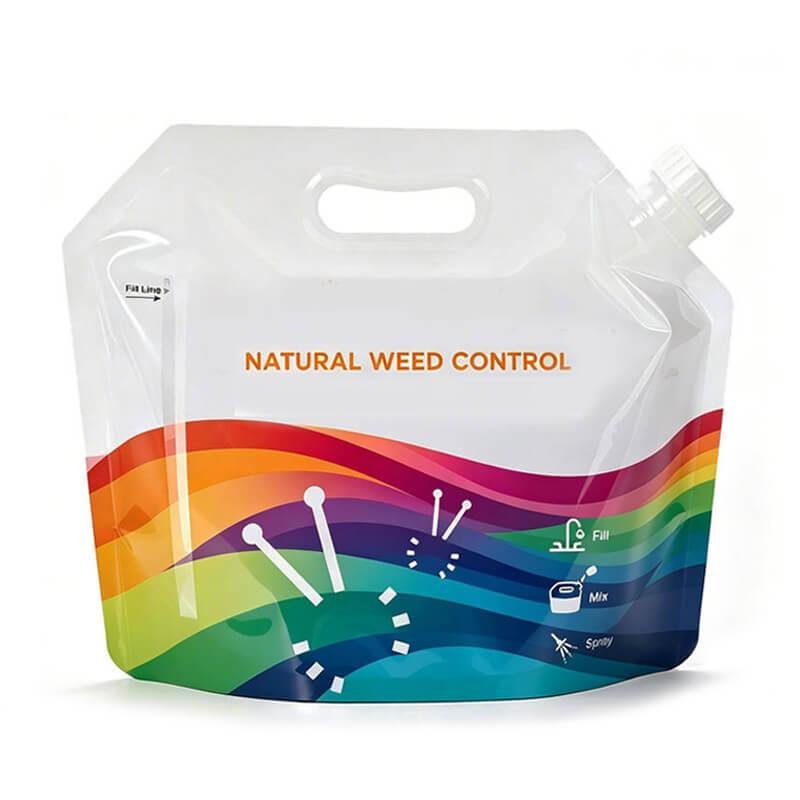
| Spout pouch | Gusset + spout | Liquids, sauces, baby food, cold brew | Pour convenience |
| Retort pouch | PET/Al/CPP | Shelf-stable meals, pet food | Sterilizable to 135 °C |
| Vacuum pouch | PA/PE | Meat, cheese, sous-vide | High barrier, puncture-resistant |
Film Structure & Barrier Engineering
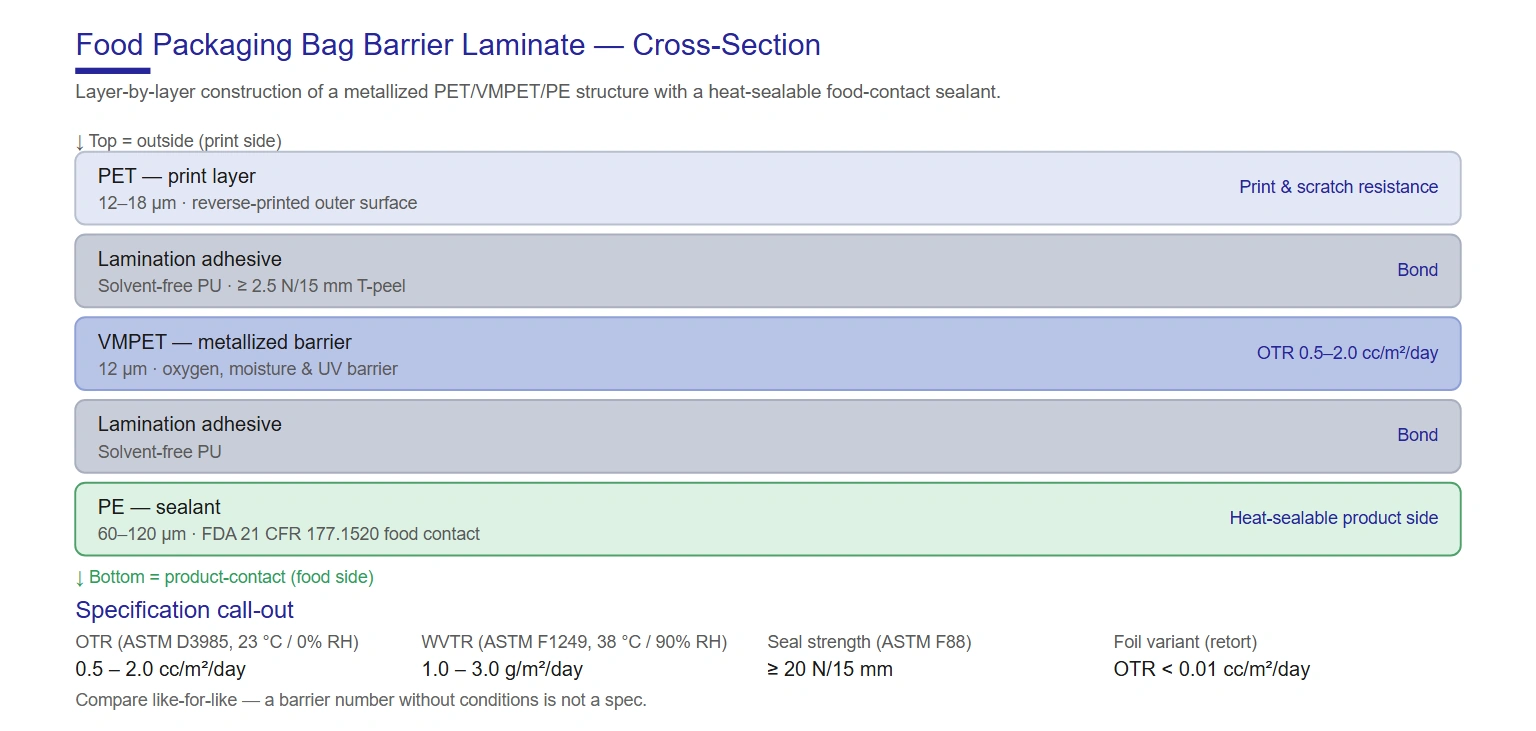
Food spoils through oxygen (rancidity, browning), moisture (staling, mold, clumping), light (vitamin and aroma degradation) and aroma loss (flavour escape). The table gives the oxygen transmission rate (OTR) and water vapour transmission rate (WVTR) for the structures we run, with the conditions stated.
| Film structure | OTR (cc/m²/day) | WVTR (g/m²/day) | Recyclability | Typical use |
|---|---|---|---|---|
| PET / Al foil / PE (3-ply) | < 0.01 | < 0.01 | Non-recyclable | Retort, premium, longest shelf life |
| PET / VMPET / PE (3-ply) | 0.5 – 2.0 | 1.0 – 3.0 | Limited | Snacks, coffee, dry food |
| BOPP / EVOH / PE (3-ply) | 0.1 – 0.5 | 3.0 – 8.0 | Recyclable (all-polyolefin) | Dairy, produce, sauces |
| Kraft / LDPE / Al / PE (4-ply) | < 0.05 | < 0.05 | Non-recyclable | Premium dry food, pet food |
| PA (nylon) / EVOH / PE | 0.1 – 0.5 | 1.0 – 3.0 | Limited | Meat, cheese, vacuum, MAP |
| PE / PE (mono) | 5.0 – 15.0 | 4.0 – 10.0 | Fully recyclable (PE) | Ambient snacks, mailers |
Conditions: OTR per ASTM D3985 @ 23 °C / 0% RH; WVTR per ASTM F1249 @ 38 °C / 90% RH. A barrier number without conditions is not a spec — always compare like-for-like.
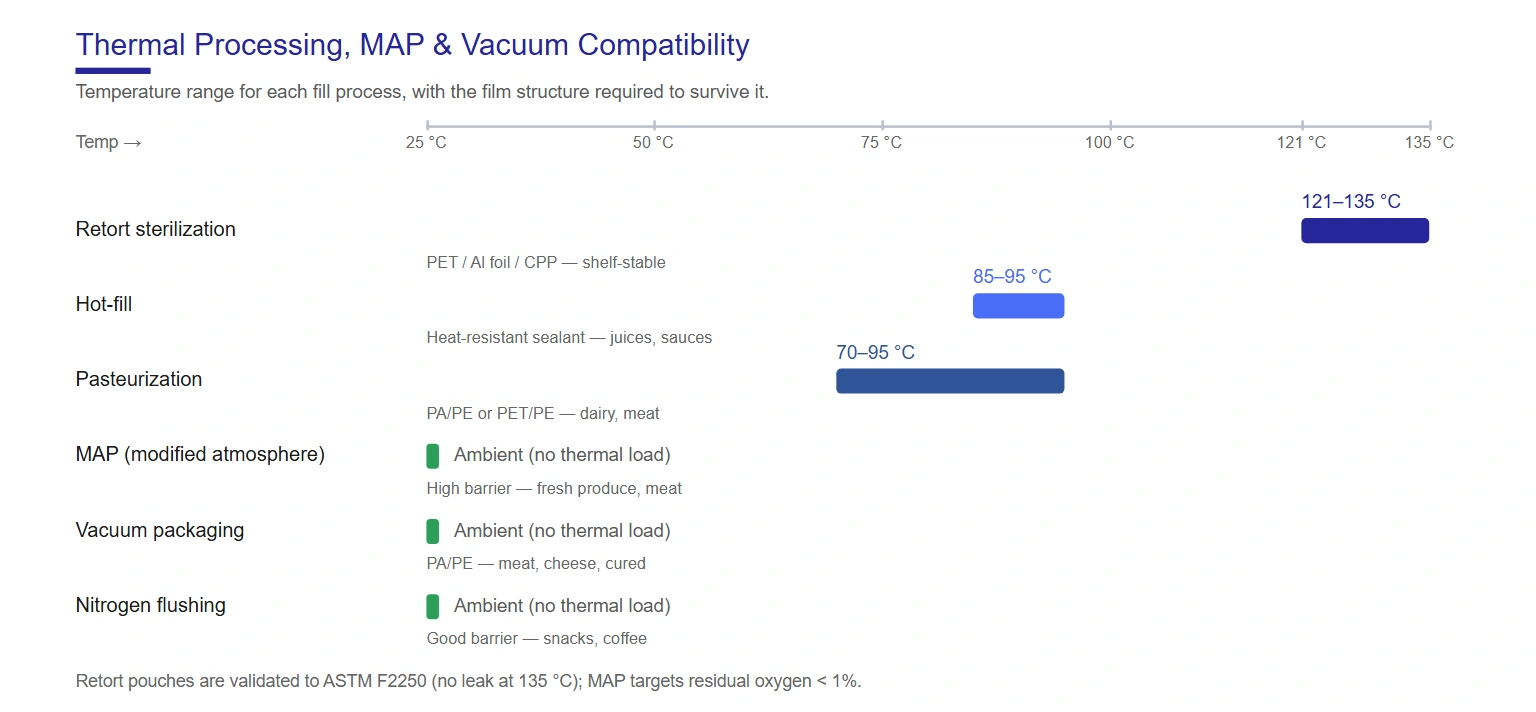
Barrier Selection by Food Type
The right barrier depends on what spoils your specific food. Match the food to its dominant failure mechanism, then select the structure.
| Food category | Dominant spoilage | Required barrier | Recommended structure |
|---|---|---|---|
| Snacks / chips | Oxygen (rancidity) + moisture | OTR < 1, WVTR < 1 | BOPP/VMPET/PE or foil |
| Dried fruit / nuts | Oxygen + moisture | OTR 0.5–2, WVTR 1–3 | PET/VMPET/PE |
| Coffee (whole bean) | Oxygen + aroma + CO2 | OTR < 0.5 + one-way valve | PET/Al/PE + degassing valve |
| Bakery | Moisture (staling) | WVTR < 3 | BOPP/VMPET/PE |
| Frozen food | Freezer burn + puncture | WVTR < 5, low-temp seal | PE/PE or PET/PE |
| Retort (soup, meals) | High-temp seal + oxygen | OTR < 0.1, retort seal | PET/Al foil/CPP |
| Meat / cheese (MAP/vacuum) | Oxygen + moisture | OTR < 0.1, WVTR < 5 | PA/EVOH/PE or foil |
| Spices / powders | Aroma + moisture | OTR < 0.5, WVTR < 1 | PET/Al/PE |
| Greasy / fried food | Grease + oxygen | Grease-resistant sealant | OPP/VMPET/PE (grease sealant) |
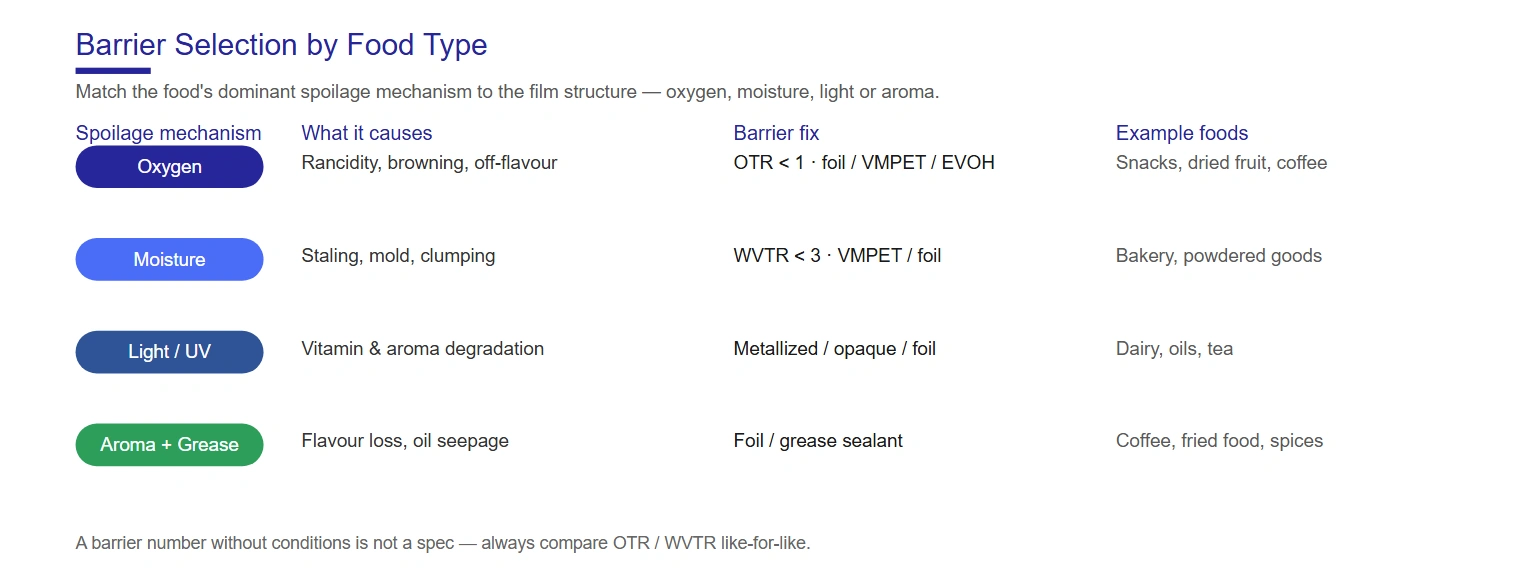
Closures & Fitments
- Press-to-close zipper — standard reseal for snacks, dried fruit, coffee.
- Pull-tab zipper — easier open, premium feel, flat-bottom and stand-up.
- Slider zipper — heavy-duty, large formats and pet food.
- Spout & cap — liquids, sauces, baby food, cold brew; tamper-evident options.
- One-way degassing valve — fresh-roasted coffee; vents CO2, blocks O2.
- Tear notch / laser score — clean, controlled opening above the zipper.
- Clear window — PET or EVOH window to show product.
- Hang hole — retail pegs and subscription mailers.
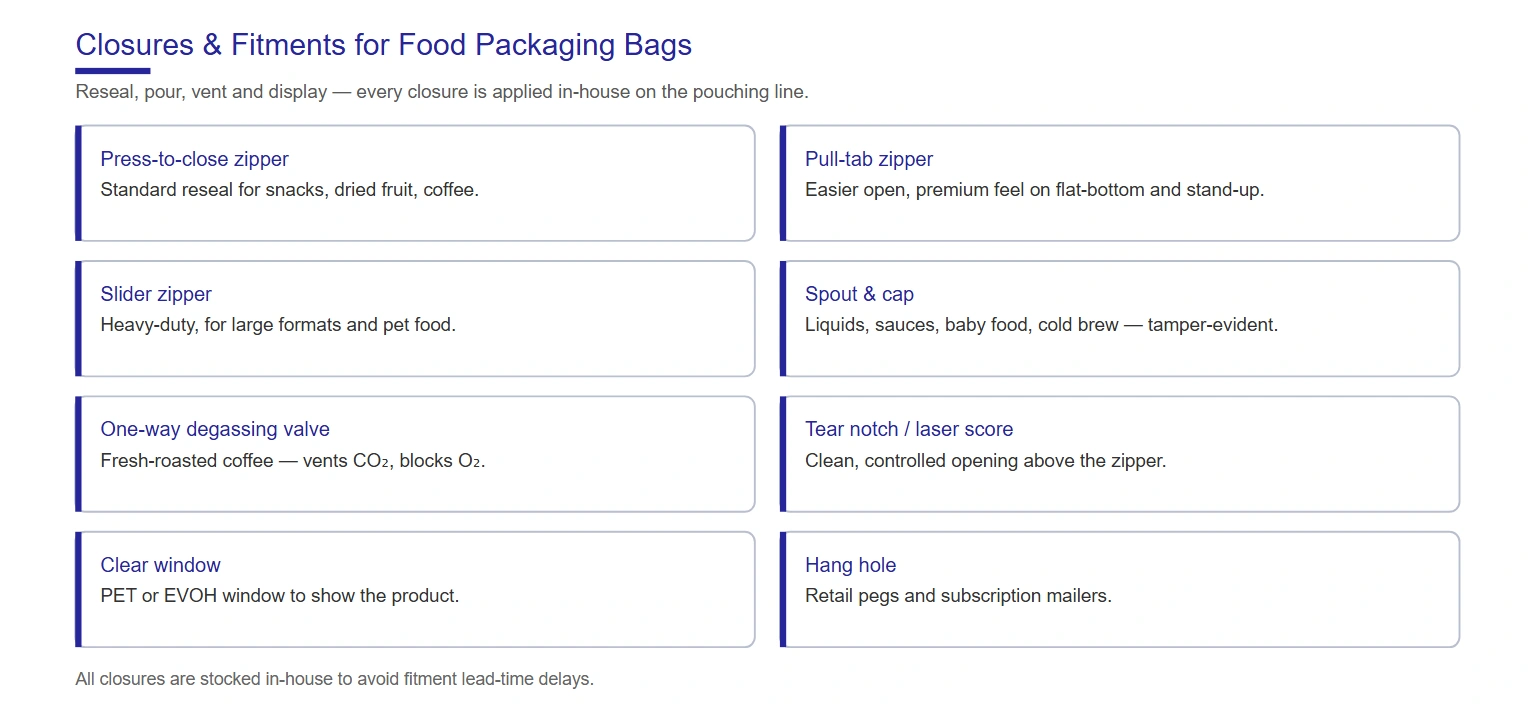
Thermal Processing, MAP & Vacuum Compatibility
| Process | Temperature | Required structure | Notes |
|---|---|---|---|
| Retort sterilization | 121–135 °C | PET/Al foil/CPP (retort-grade) | Shelf-stable meals, pet food |
| Hot-fill | 85–95 °C | Heat-resistant sealant | Juices, sauces, jams |
| Pasteurization | 70–95 °C | PA/PE or PET/PE | Dairy, meat, sous-vide |
| MAP (modified atmosphere) | Ambient | High barrier (EVOH/foil) | Fresh produce, meat, cheese |
| Vacuum packaging | Ambient | PA/PE, puncture-resistant | Meat, cheese, cured products |
| Nitrogen flushing | Ambient | Good barrier | Snacks, coffee, powdered products |
Food Safety & Regulatory Compliance
| Standard / regulation | Scope | What it covers |
|---|---|---|
| FDA 21 CFR 177.1520 / 177.1390 | USA | Olefin polymers & laminate adhesives for food contact |
| EU 10/2011 (EC 1935/2004) | EU | Plastics food-contact; overall migration limit 10 mg/dm² |
| GB 4806.7 / GB 9685 | China | Food-contact plastics & additives |
| REACH (EC 1907/2006) | EU | SVHC declaration |
| California Prop 65 | USA (CA) | Phthalates, lead, BPA |
| BRCGS Packaging (Issue 6) | Global | Packaging food-safety management |
| ISO 22000 / ISO 9001 | Global | Food-safety & quality management |
| EN 13432 / OK Compost / BPI | EU / US | Compostability |
| RecyClass / APR design guidance | EU / US | Recyclability of mono-material structures |
We supply a Declaration of Compliance (DoC) and migration-test certificates for every shipped structure. Ask for the DoC — a supplier that cannot produce one for a food-contact bag has not done the compliance work.
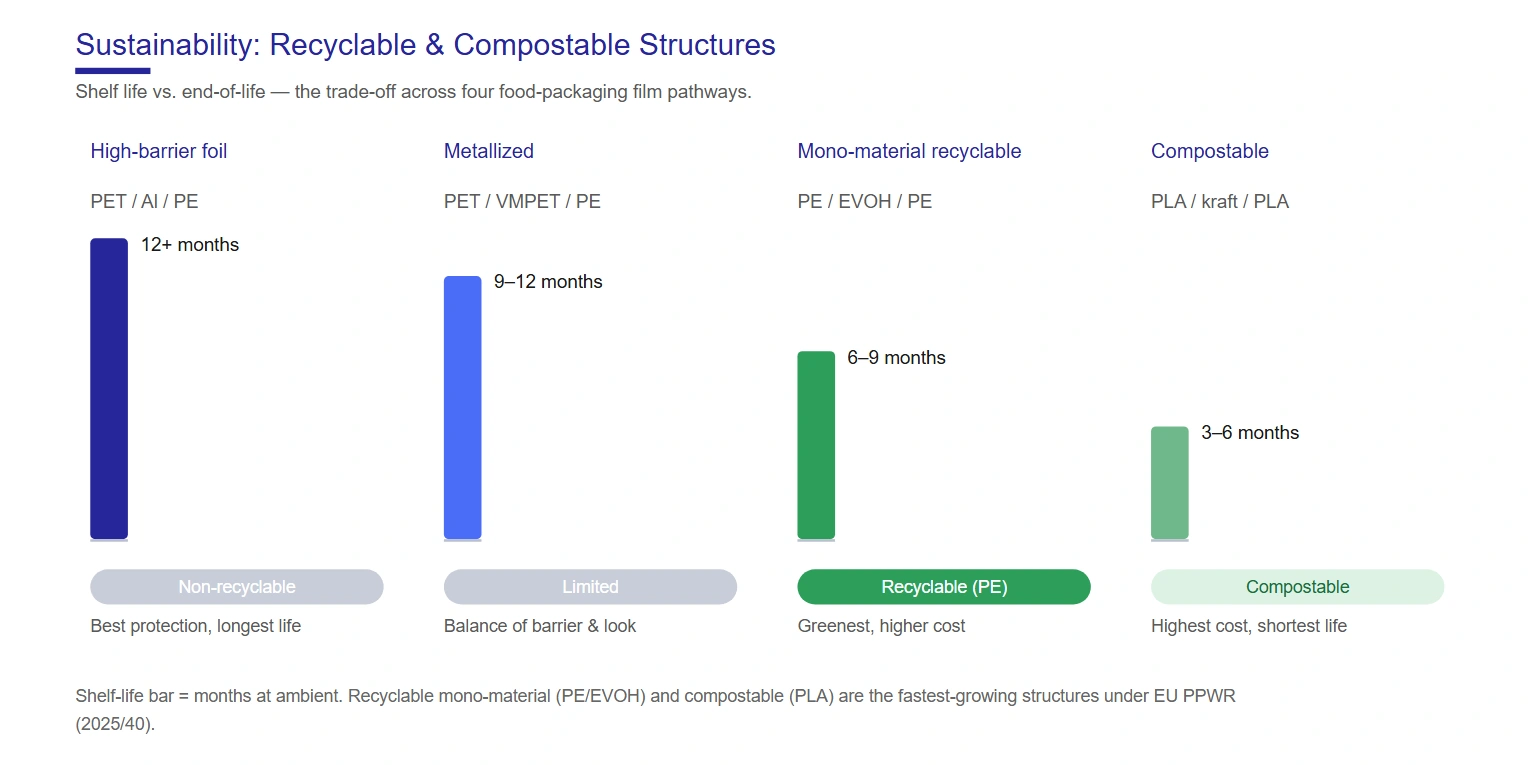
Sustainability & Recyclable / Compostable Structures
| Pathway | Structure | Shelf life | End-of-life | Trade-off |
|---|---|---|---|---|
| High-barrier (foil) | PET/Al/PE | 12+ months | Non-recyclable | Best protection |
| Metallized | PET/VMPET/PE | 9–12 months | Limited | Balance of barrier & look |
| Mono-material recyclable | PE/EVOH/PE | 6–9 months | Recyclable (PE stream) | Higher WVTR, premium cost |
| Compostable | PLA/PLA or Kraft/PLA | 3–6 months | Industrial compostable | Highest cost, shortest life |
The fast-moving lever is the EU PPWR (EU 2025/40) and brand recyclability pledges: mono-material PE/EVOH pouches now achieve RecyClass approval and are the fastest-growing structure in food packaging. We can run a comparative shelf-life trial on your exact product before you commit.
Applications by Food Category
- Snacks & chips — pillow and stand-up pouches, nitrogen-flushed, high print impact.
- Coffee & tea — coffee bags with degassing valves; high-barrier tea pouches.
- Pet food & treats — pet food bags with grease-resistant sealants and heavy-fill engineering.
- Bakery & confectionery — flat-bottom and stand-up pouches, greaseproof options.
- Frozen food — low-temp seal, puncture-resistant, moisture barrier.
- Retort & ready meals — retort pouches to 135 °C, shelf-stable.
- Dairy, meat & cheese — vacuum and MAP pouches, high oxygen barrier.
- Spices, powders & dried goods — high-barrier stick packs and pouches.
- Liquids & sauces — spout pouches, cold brew, baby food.
Customization Options
- Printing — rotogravure (high volume) or digital (low MOQ, no plate fees, full CMYK).
- Finishes — matte, gloss, soft-touch, metallic, holographic, kraft/paper-touch, spot UV.
- Structure & barrier — foil, metallized, mono-material recyclable or compostable, sized to shelf life.
- Features — zipper, spout, degassing valve, tear notch, hang hole, clear window.
- Formats & sizes — any of the nine formats, custom dimensions from your product density.
Quality Control & Test Methodology
| Test | Standard | What it verifies | Typical pass spec |
|---|---|---|---|
| Oxygen transmission (OTR) | ASTM D3985 | Barrier to O2 | Per structure |
| Water vapour transmission (WVTR) | ASTM F1249 | Barrier to moisture | Per structure |
| Seal strength | ASTM F88 | Seal integrity | ≥ 20 N/15 mm |
| Hot tack | ASTM F1921 | Seal holds during fill | ≥ 3 N/15 mm |
| Burst strength | ASTM F2054 / F1140 | Bag integrity under pressure | Per format |
| Puncture resistance | ASTM F1306 | Sharp product resistance | Per gauge |
| Retort integrity | ASTM F2250 (retort) | Sterilization survival | No leak at 135 °C |
| COF | ASTM D1894 | Machine runnability | 0.12–0.25 |
| Dyne / surface energy | ASTM D2578 | Ink adhesion | ≥ 38 dyn/cm |
| Migration testing | EU 10/2011 / FDA | Food-contact safety | ≤ 10 mg/dm² |
Failure Modes & Prevention
| Failure mode | Root cause | Detection | Prevention |
|---|---|---|---|
| Premature staling / rancidity | OTR too high for shelf-life target | OTR test, taste panel | Upgrade barrier; add flex-crack allowance |
| Seal failure / leakers | Contamination in seal area (food dust, oil) | In-line vision, dye-penetrant | Seal-area cleanliness; wider seal |
| Retort pouch delamination | Non-retort adhesive or sealant | Visual, peel test | Retort-grade adhesive/CPP |
| Moisture ingress / clumping | WVTR too high for humid climate | WVTR test | Lower WVTR structure |
| Aroma / flavour loss | Weak seal, low barrier, scented-film migration | GC headspace, sensory | Foil/heavy metallized; low-odour inks |
| Puncture in transit | Thin gauge + sharp edges | Drop test, puncture test | PA/thicker layer |
| Zipper / spout failure | Wrong fitment or misaligned notch | Cycle test | Matched fitment; notch above zipper |
Total Cost of Ownership vs. Rigid Food Packaging
| Cost driver | Flexible food packaging bag | Rigid can / jar / box |
|---|---|---|
| Unit cost | Low — lightweight film | High — metal/glass + lid |
| Freight / warehousing | High cube efficiency, flat-fold | Heavy, low cube efficiency |
| Carbon footprint | Lower per unit | Higher per unit |
| Filling speed | High (VFFS / HFFS) | Slower |
| Shelf life | 9–12+ months | Long, but over-engineered |
| Branding surface | Full 360° print | Limited to label |
A 5% cheaper film that causes 1% line down-time or leakers in transit is a net loss — evaluate the bag as a system cost: barrier + seal reliability + fill speed + freight, not film price per thousand.
MOQ, Pricing Factors & Lead Time
| Factor | Impact |
|---|---|
| Order quantity | MOQ from 1,000 (digital); unit cost falls steeply at 10k / 50k / 100k+ (rotogravure) |
| Print route | Digital = no plate fees, multi-SKU; rotogravure = lower cost at volume |
| Structure | Foil & retort-grade cost more than metallized; VMPET most economical |
| Features | Zipper, spout, valve, window add a fixed per-bag cost |
| Size / film weight | Larger bags & heavier gauges use more film |
| Finishes | Soft-touch, spot UV, holographic add cost |
Lead time: free pre-production samples in 3–5 days; production 7–15 days after artwork approval (digital); rotogravure adds cylinder lead time.
Production Process
- Artwork & prepress — CMYK, vector/PDF, fonts outlined, 3 mm bleed.
- Plate / cylinder (rotogravure) or RIP (digital) — colour-managed.
- Printing & lamination — reverse-print, then solvent-free or solvent lamination.
- Curing — laminate cure to full bond (≥ 2.5 N/15 mm T-peel).
- Slitting & pouching — to width, then form (stand-up / flat-bottom / side-gusset / pillow / spout / retort).
- Fitment application — in-line zipper, spout, valve and window insertion.
- QC & packing — in-line vision + batch testing (OTR/WVTR, seal, burst, retort, migration), then cartoned for export.
Food Packaging Bag Supplier Evaluation Checklist (18 Points)
- Do they state OTR/WVTR with test conditions, or just say “high barrier”?
- Can they quote retort, hot-fill and pasteurization process capability?
- Do they offer recyclable mono-material and compostable structures, with certification?
- Do they provide a Declaration of Compliance and migration-test certificates per structure?
- Can they run a comparative shelf-life trial on your actual product?
- What is their seal-strength and hot-tack test data?
- Do they have in-house pouching, or do they outsource?
- What is their flex-crack allowance for metallized film?
- Do they control COF for high-speed lines?
- What is their real MOQ and does digital print remove plate fees?
- Do they hold zipper/spout/valve inventory to avoid delays?
- What is their QC sampling plan (AQL) and can they ship a CoA?
- Do they understand MAP / nitrogen-flushing residual-oxygen targets?
- Can they match your existing bag exactly (reverse-engineer a sample)?
- Do they validate retort integrity (ASTM F2250) for shelf-stable products?
- Do they publish a failure-mode analysis and prevention plan?
- Are they BRCGS or ISO 22000 certified for food-contact packaging?
- Can they provide low-odour inks and scented-film migration data?
Food Packaging Market Intelligence
Flexible bags and pouches are the growth engine of food packaging. Fortune Business Insights values the global food packaging market at USD 533.22 billion in 2025, projected to reach USD 930.89 billion by 2034 at a 6.46% CAGR, with bags & pouches the leading packaging type at 25.9% share and flexible packaging at 52.01% of product type. MarketsandMarkets sizes the market at USD 421.38 billion (2025), reaching USD 548.51 billion by 2030 at a 5.4% CAGR, with pouches & bags the dominant packaging type and Asia Pacific the largest and fastest-growing region.
- Convenience & on-the-go — single-serve and portion packs grow faster than bulk.
- E-commerce & food delivery — demand for puncture-resistant, mailer-safe flexible packaging.
- Sustainability regulation — EU PPWR (reusable/recyclable by 2030) and brand pledges push mono-material and compostable.
- Smart & active packaging — gas scavengers, antimicrobial films, QR/NFC traceability.
- Emerging markets — Asia Pacific leads growth; India is the fastest-growing market.
Frequently Asked Questions
Which food packaging bag format should I choose?
Start from the product: self-standing retail and snacks suit a stand-up pouch; premium coffee and tea suit a flat-bottom or quad-seal bag; bulk and pet food suit a side-gusset bag; liquids and sauces suit a spout pouch; shelf-stable meals and pet food suit a retort pouch; meat and cheese suit a vacuum or MAP pouch.
How do I choose the right barrier film?
Identify the dominant spoilage mechanism first: oxygen (rancidity, browning), moisture (staling, mold, clumping), aroma loss or grease. Then select the structure — foil for the highest barrier and retort, metallized VMPET for standard shelf life, and mono-material PE/EVOH for recyclability.
Do food packaging bags need FDA or EU compliance?
Yes — any food-contact material must meet FDA 21 CFR 177.1520 (USA) or EU 10/2011 (EC 1935/2004) with an overall migration limit of 10 mg/dm². Request a Declaration of Compliance and migration-test certificates for every structure.
What is the minimum order quantity (MOQ)?
From 1,000 pieces on digital print (no plate fees). Unit cost drops sharply at 10k / 50k / 100k+ pieces where rotogravure becomes economical. Free pre-production samples ship in 3–5 days.
Can you make recyclable or compostable food packaging bags?
Yes. Recyclable mono-material PE/EVOH/PE carries RecyClass approval, and PLA or kraft/PLA structures are industrially compostable (EN 13432 / BPI / OK Compost). We run a comparative shelf-life trial on your product before you commit.
Do you offer retort and hot-fill capability?
Yes — retort pouches sterilize to 135 °C (ASTM F2250 validated), and we support hot-fill (85–95 °C) and pasteurization (70–95 °C) with heat-resistant sealants.
Can you match a bag I already use?
Yes — send a sample and we reverse-engineer the structure, dimensions, barrier, closure and print, then quote a like-for-like or improved version.
How do you test quality?
Every batch is tested for OTR (ASTM D3985), WVTR (ASTM F1249), seal strength (F88), hot tack (F1921), burst (F2054), retort integrity (F2250) and migration (EU 10/2011), with a CoA on request.
Key Takeaways
- Match the format and barrier to the food — the spoilage mechanism (oxygen/moisture/aroma/grease) determines the structure.
- Specify barrier with numbers and conditions — OTR/WVTR without temperature/RH is not a spec.
- Verify process capability — retort, hot-fill, MAP and vacuum each demand a specific structure.
- Evaluate total cost of ownership — barrier + seal reliability + fill speed + freight, not film price per thousand.
- Plan for sustainability now — PPWR and brand pledges are already moving food volume to recyclable and compostable structures.
Get a Free Food Packaging Bag Sample & Quote
Tell us your product, format, fill weight, target shelf life, process (retort/hot-fill/MAP/vacuum), print route and sustainability goal — our engineers will return a structure recommendation with quantified barrier data and a quote within 24 hours. Free pre-production samples in 3–5 days.
You Also May Like

Ready to Improve Your Packaging Supply Chain?
Whether you are looking for a new packaging supplier, a backup manufacturer, or a trusted sourcing partner, We are ready to support your business.