
Custom Kraft Paper Bags
— Sustainable Paper Packaging for Retail, Food & Industrial Use
A custom kraft paper bag is a renewable, recyclable paper carrier — natural brown or white, with or without handles, liners and closures — that replaces plastic while carrying real load. Built for retail, food, grocery, e-commerce and industrial buyers who specify paper packaging as an engineering component: paper grade, GSM, handle strength, liner barrier and load capacity.
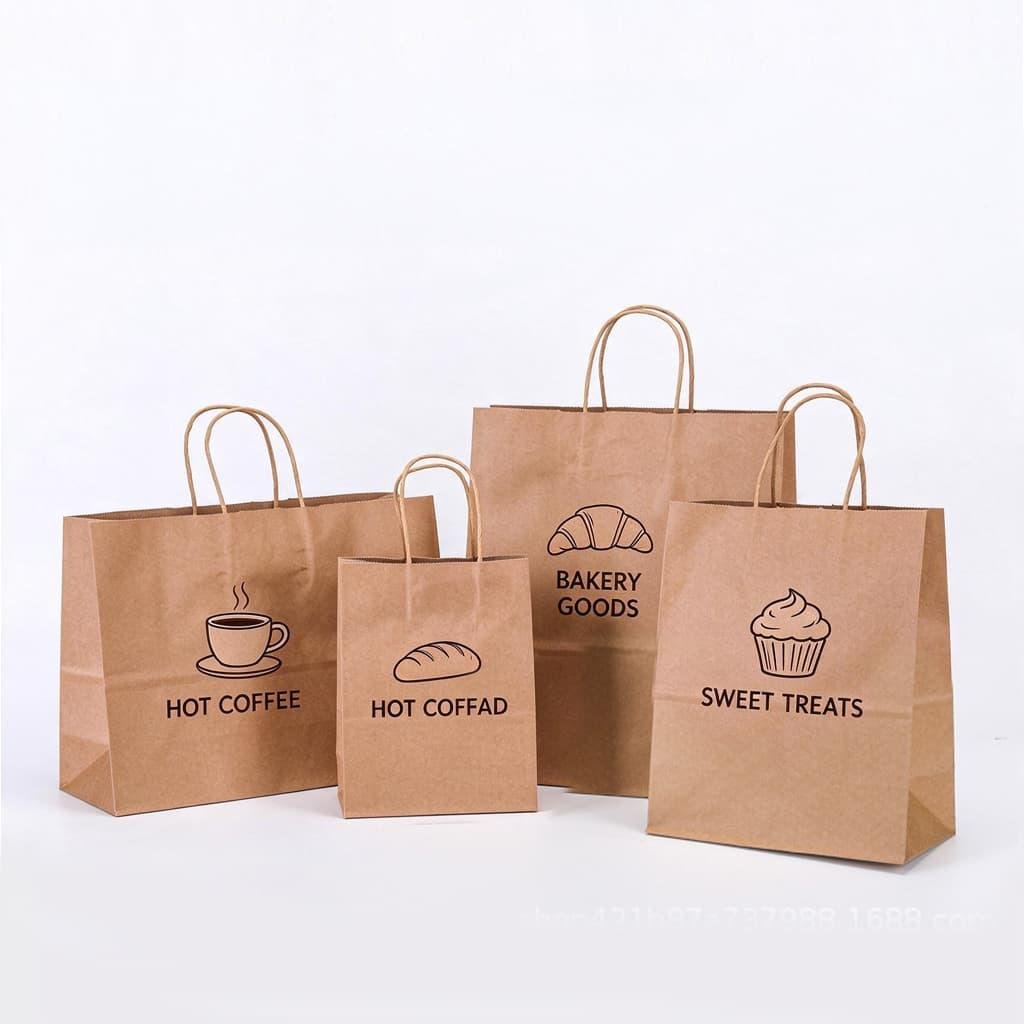
A custom kraft paper bag is a renewable, recyclable carrier made from kraft paper — natural unbleached brown or bleached white — that replaces plastic across retail, food, grocery, e-commerce and industrial applications. Unlike film pouches, a kraft bag is a paper engineering problem: the paper grade and basis weight (GSM), the handle attachment, the bottom fold and the optional liner or coating all determine how much weight it carries and how it survives moisture, grease and transit.
What you can expect from our factory
- ISO 9001:2015 quality system with food-contact compliance (FDA 21 CFR 176.170, EU 1935/2004, BfR XXXVI, GB 4806, REACH, Prop 65) and FSC-certified paper options
- Virgin and recycled kraft, unbleached brown or bleached white, from 40 to 350+ GSM, with wet-strength and greaseproof grades
- Handles & closures — twisted, flat, rope and die-cut handles, tin-ties, tape and heat-seal closures, all in-house
- Food-grade liners — PE, PLA and foil liners plus greaseproof kraft for bakery, coffee, dried goods and takeout
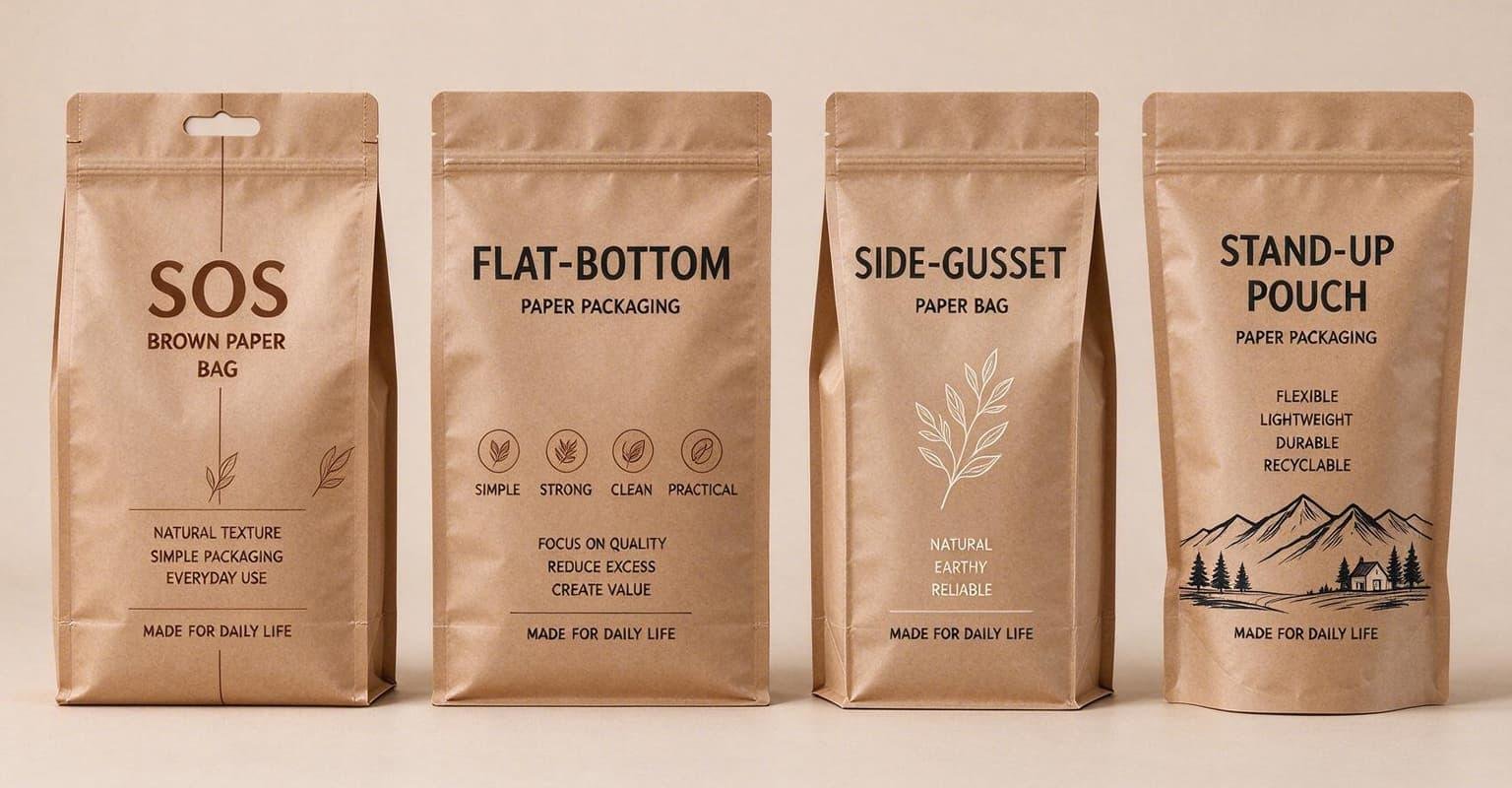
- Formats: SOS, pinch-bottom, flat-bottom (box), side-gusset, stand-up pouch and multi-wall industrial sacks
- Free pre-production samples in 3–5 days; MOQ from 1,000 pieces; production lead time 7–15 days
Anatomy of a Kraft Paper Bag: Every Component, Specified
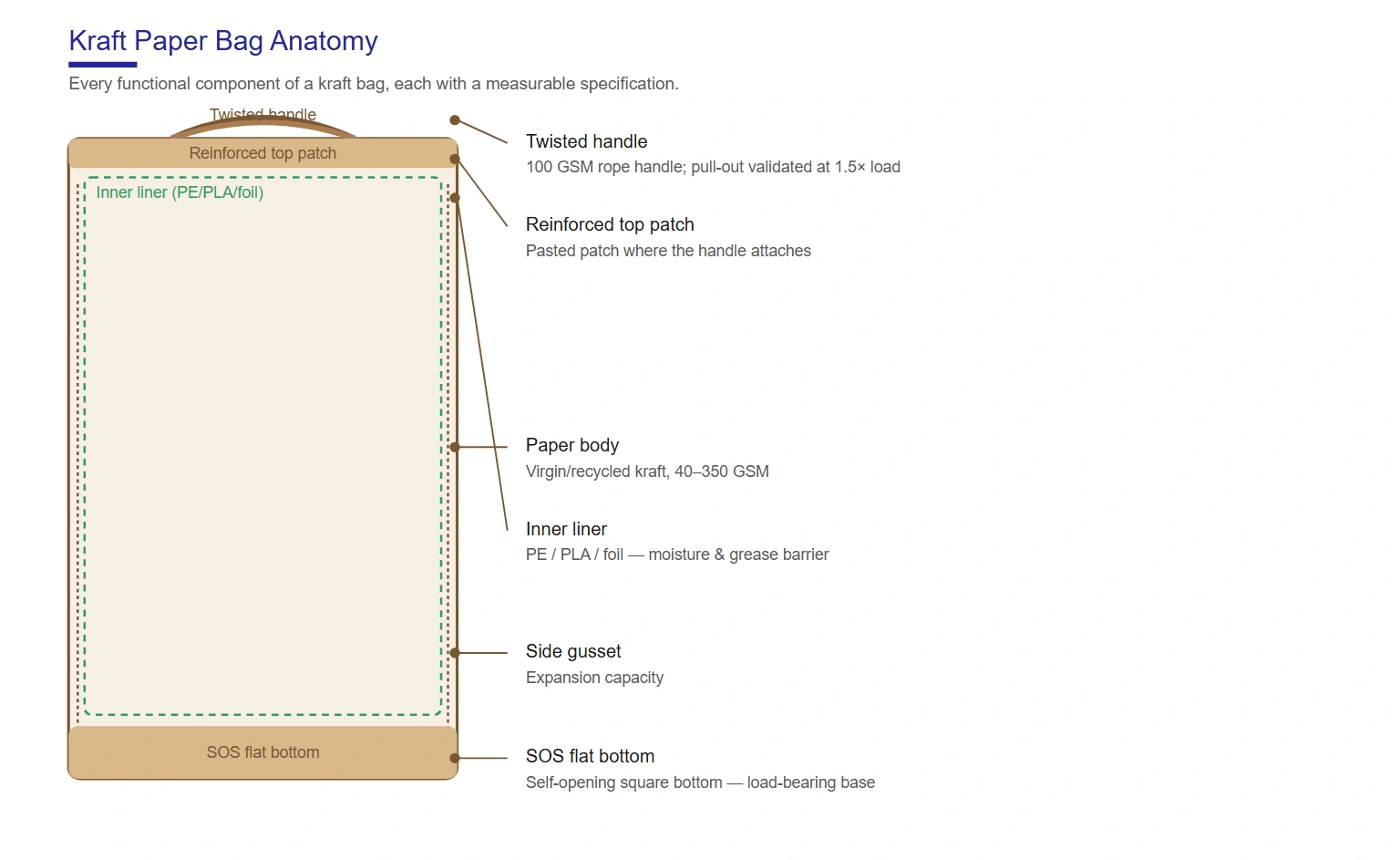
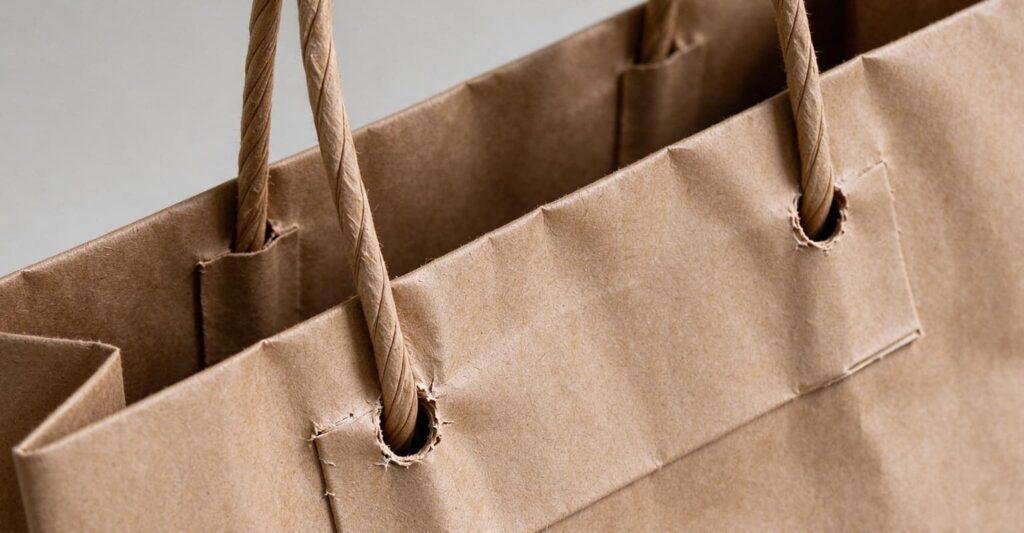
A kraft paper bag is a system of interacting components, and each has a measurable specification that determines load capacity, durability and shelf life. The diagram below labels a kraft bag with a twisted handle; the table gives the specification you should be able to ask any supplier to quantify.
| Component | Function | Key specification to request |
|---|---|---|
| Handle (twisted / flat / rope / die-cut) | Carry load | Handle type, attachment method, pull-out strength (N) |
| Paper body | Structure + print surface | Grade (virgin/recycled), GSM, wet-strength, color |
| Bottom fold | Load-bearing base | SOS flat-bottom vs pinch-bottom vs block-bottom; burst strength |
| Side gusset | Expansion capacity | Gusset depth (mm), fold quality |
| Inner liner / coating | Moisture / grease barrier (food) | PE / PLA / foil liner, greaseproof kraft |
| Reinforced top / patch | Handle attachment strength | Patch material, stitch/paste strength |
| Print layer | Branding | Ink type (water-based), print method, rub resistance |
| Tin-tie / closure | Reclose (food) | Wire gauge, tape adhesion |
Kraft Paper Grades & Basis Weight: The Numbers That Matter
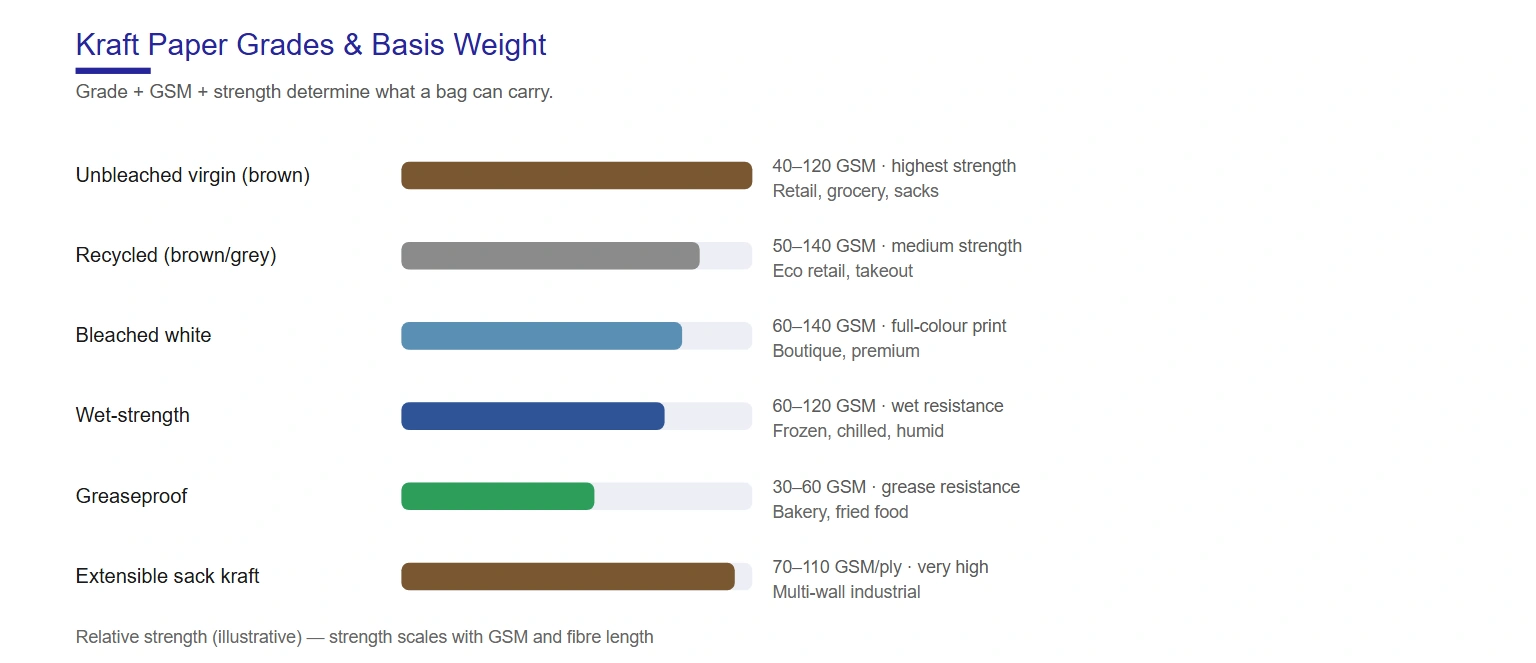
Kraft paper is specified by grade (virgin vs recycled, bleached vs unbleached) and basis weight (GSM, grams per square metre). These two choices determine strength, cost, print quality and sustainability — and they are where most bag buyers under-specify.
| Paper grade | GSM range | Strength | Print quality | Sustainability | Typical use |
|---|---|---|---|---|---|
| Unbleached virgin kraft (natural brown) | 40–120 | Highest (long fibre) | Good — flexo 1–3 colour | Renewable, recyclable, compostable | Retail, grocery, industrial sacks |
| Recycled kraft (brown/grey) | 50–140 | Medium (short fibre) | Good — lighter print | 100% recycled content | Eco retail, takeout, mailers |
| Bleached white kraft | 60–140 | Medium | Excellent — full colour | Renewable, recyclable | Boutique, cosmetics, premium retail |
| Wet-strength kraft | 60–120 | High (wet-resist) | Good | Recyclable (with additives) | Frozen, chilled, humid |
| Greaseproof kraft | 30–60 | Medium | Good | Compostable (fluorochemical-free) | Bakery, fried food, deli |
| Extensible sack kraft | 70–110 | Very high (stretch) | Basic | Recyclable | Multi-wall industrial sacks |
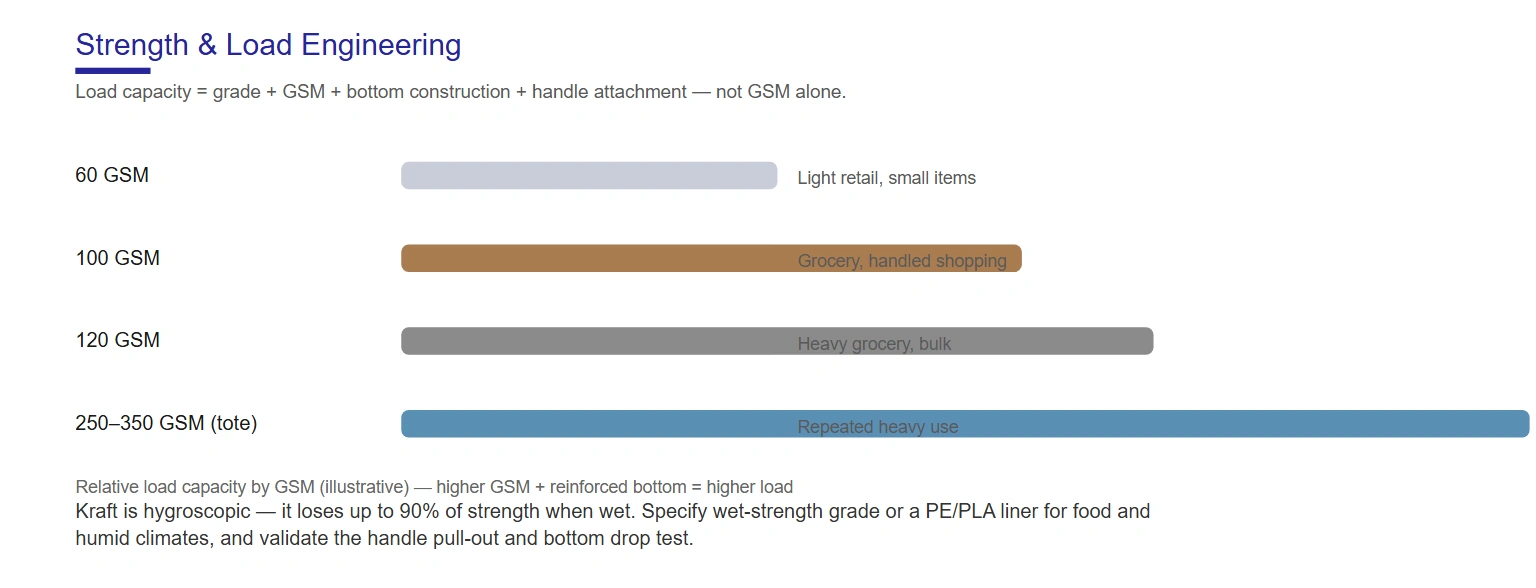
Basis weight (GSM) is the primary strength lever: a 60 GSM bag carries light retail items, a 100–120 GSM bag carries groceries, and a 350 GSM washable tote handles repeated heavy use. Always confirm GSM — a supplier who will not state it cannot guarantee load capacity.
Kraft Bag Styles & Formats
| Format | Structure | Best for | Load capacity | Relative cost |
|---|---|---|---|---|
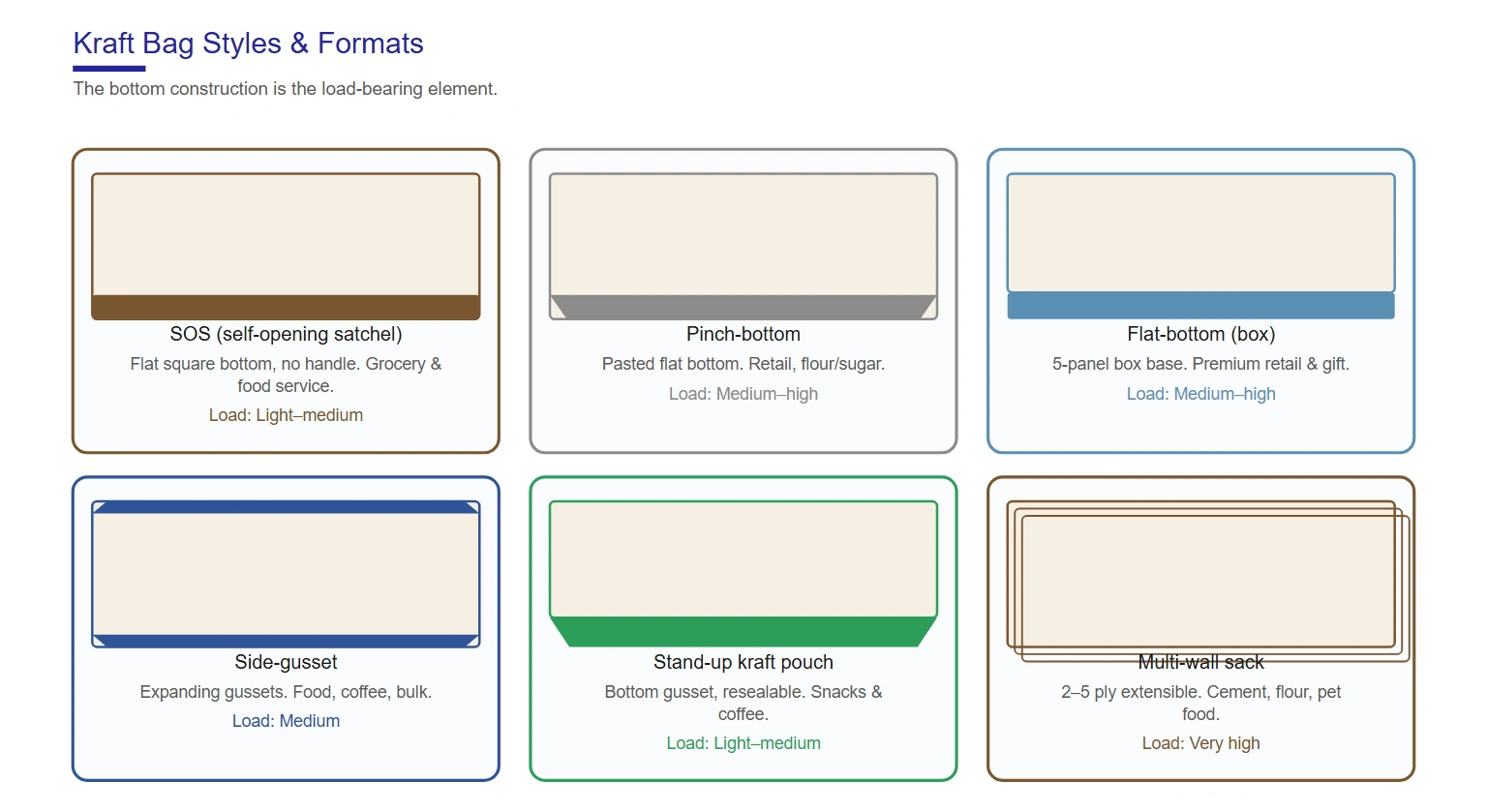
| SOS (self-opening satchel) | Flat square bottom, no handle | Grocery, food service, bulk | Light–medium | Lowest |
| Pinch-bottom (pasted) | Pasted flat bottom | Retail, dry goods, flour/sugar | Medium–high | Low |
| Flat-bottom (box) | 5-panel box base | Premium retail, boutique, gift | Medium–high | High |
| Side-gusset | Expanding side gussets | Food, coffee, bulk retail | Medium | Medium |
| Stand-up kraft pouch | Bottom gusset, resealable | Food, snacks, coffee (with liner) | Light–medium | Medium |
| Multi-wall paper sack | 2–5 ply extensible kraft | Cement, flour, pet food, chemicals | Very high (25–50 kg) | Medium |
The bottom is the load-bearing element. An SOS or flat-bottom bag with a reinforced bottom carries far more than a flat bag of the same GSM — specify the bottom construction, not just the paper weight.
Handles & Closures
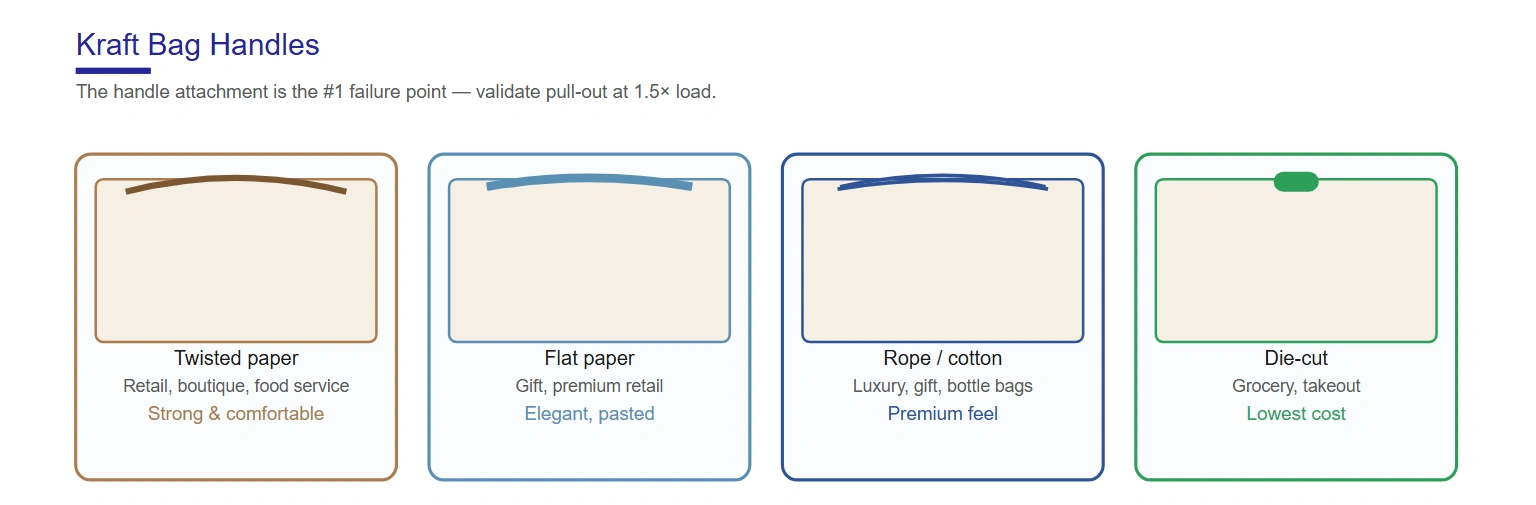
| Handle / closure | Best for | Notes |
|---|---|---|
| Twisted paper handle | Retail, boutique, food service, 100 GSM | Strong, comfortable; standard premium choice |
| Flat paper handle | Gift, premium retail | Flat, elegant, pasted to the bag |
| Rope / cotton handle | Luxury, gift, bottle bags | Premium feel, higher cost |
| Die-cut handle | High-volume grocery, takeout | Cut into the bag, lowest cost, medium strength |
| Tin-tie | Coffee, food reclose | Roll-top reseal, wire + tape |
| Tape / heat seal | Industrial, multi-wall sacks | Sealed closure for powders and bulk |
The handle attachment is the #1 failure point on a kraft bag: a 350 GSM bag with a weak handle attachment still tears out under load. We reinforce handle patches and validate pull-out strength at 1.5× the rated load.
Food-Grade Liners & Barrier Options
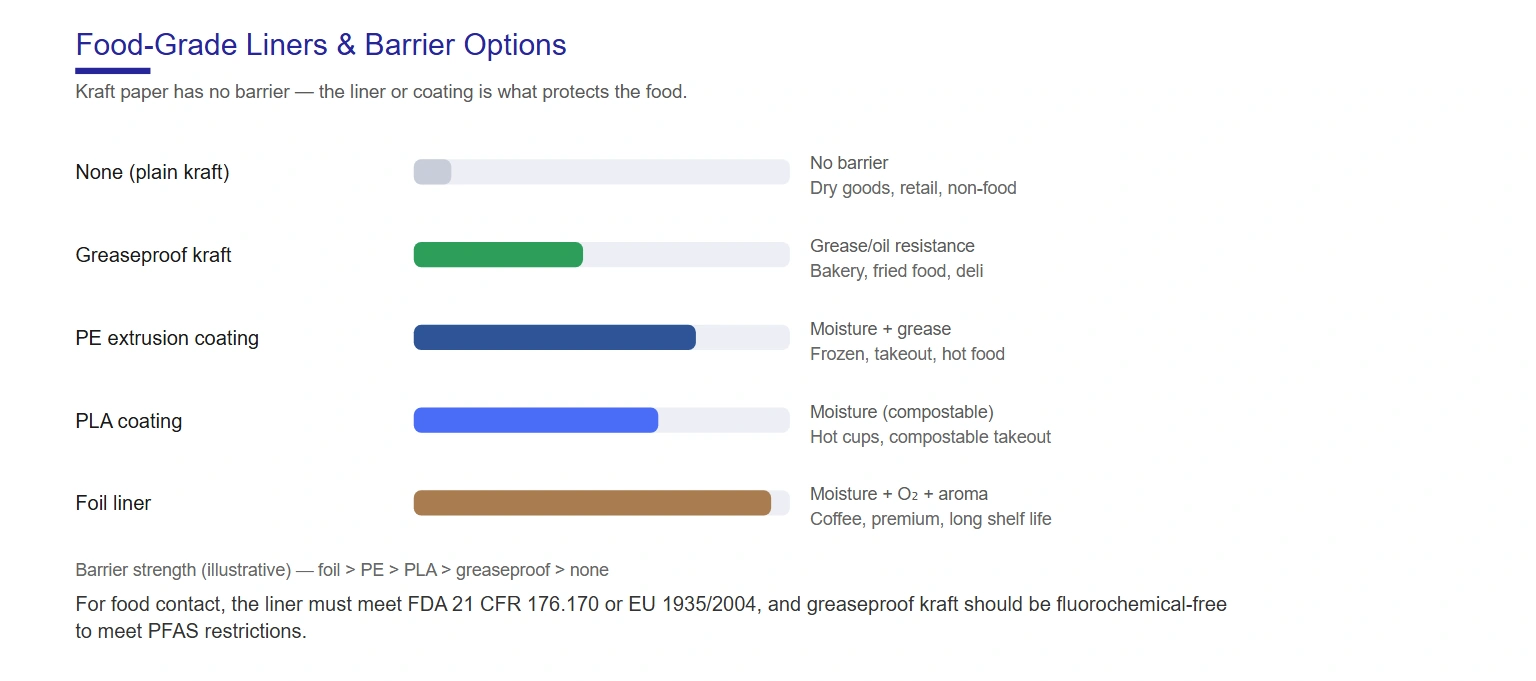
Kraft paper itself has no moisture or oxygen barrier — it is highly permeable. Food and takeout applications therefore require a liner or coating, and choosing the wrong one is the most common kraft bag failure. The table maps each option to what it actually protects.
| Liner / coating | Barrier provided | Compostable | Typical use |
|---|---|---|---|
| None (plain kraft) | No moisture/grease barrier | Yes | Dry goods, retail, non-food |
| Greaseproof kraft | Grease/oil resistance | Yes (fluorochemical-free) | Bakery, fried food, deli, BBQ |
| PE extrusion coating | Moisture + grease barrier | No | Frozen, takeout, hot food, wet products |
| PLA coating | Moisture barrier | Yes (compostable) | Hot cups, compostable takeout |
| Foil liner | Moisture + oxygen + aroma | No | Coffee, premium, long shelf life |
| Wet-strength additive | Wet tensile strength | Mostly | Frozen, chilled, humid export |
For food contact, the liner must meet FDA 21 CFR 176.170 (paper/paperboard) or EU 1935/2004, and greaseproof kraft should be fluorochemical-free to meet modern PFAS restrictions (EU and multiple US state bans). Ask for the food-contact declaration on the liner, not just the paper.
Strength & Load Engineering
A kraft bag’s load capacity is a function of paper grade + GSM + bottom construction + handle attachment — not GSM alone. Kraft is hygroscopic: it loses strength when it absorbs moisture, which is why wet-strength and liners matter for food and humid climates.
- Burst strength (TAPPI T-403 / Mullen) — the primary measure of a bag’s resistance to rupture under load. Specify it for anything over 5 kg.
- Wet tensile (TAPPI T-456) — a plain kraft bag loses up to 90% of its strength when wet; wet-strength kraft retains 15–30%.
- Handle pull-out (N) — validate at 1.5× the rated load; this is the #1 field failure.
- Bottom drop test — a filled bag dropped from 1 m should not split at the bottom fold; test the bottom construction, not just the paper.
- Moisture — kraft is hygroscopic; specify a PE/PLA liner or wet-strength grade for humid or chilled environments.
Regulatory & Compliance Matrix
| Standard / regulation | Scope | What it covers for kraft bags |
|---|---|---|
| FDA 21 CFR 176.170 / 176.180 | USA | Paper & paperboard food-contact, including liners |
| EU 1935/2004 / BfR XXXVI | EU / Germany | Food-contact paper & board, migration limits |
| GB 4806.8 / GB 9685 | China | Food-contact paper & additives |
| REACH (EC 1907/2006) | EU | SVHC declaration on materials & inks |
| California Prop 65 | USA (CA) | Lead, BPA, phthalates in coatings |
| FSC (Forest Stewardship Council) | Global | Certified sustainable paper sourcing |
| PFAS restrictions | EU / US states | Fluorochemical-free greaseproof kraft |
| EN 13432 / OK Compost / BPI | EU / US | Compostability of PLA-coated & uncoated kraft |
| ISO 9001 / ISO 14001 | Global | Quality & environmental management |
We supply a Declaration of Compliance (DoC), FSC chain-of-custody and migration-test certificates for every food-contact kraft bag. Ask for the DoC and the FSC certificate — a supplier that cannot produce them has not done the compliance and sourcing work.
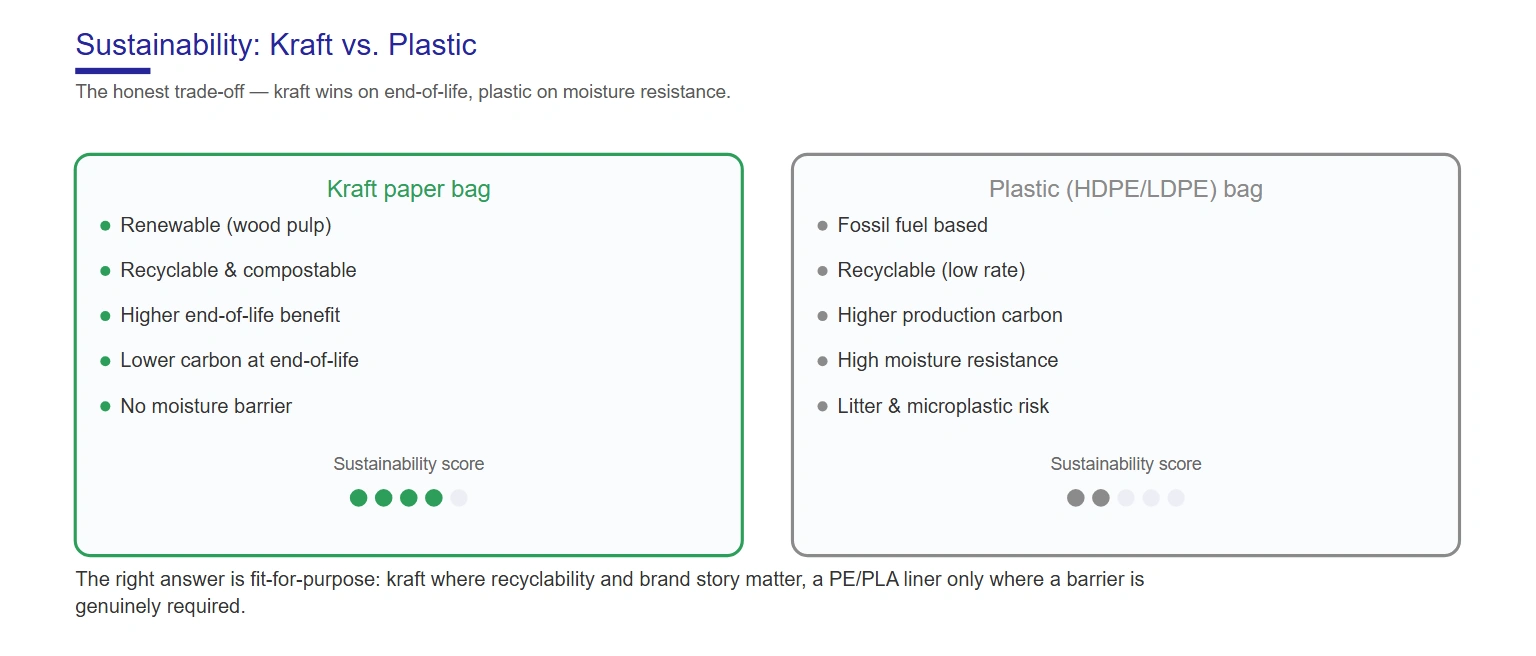
Sustainability: Kraft vs. Plastic — the Honest Trade-Off
| Factor | Kraft paper bag | Plastic (HDPE/LDPE) bag |
|---|---|---|
| Raw material | Renewable (wood pulp) | Fossil fuel |
| End-of-life | Recyclable, compostable, biodegradable | Recyclable (low rate), not compostable |
| Recycling rate | High (paper stream) | Low |
| Carbon footprint | Lower per bag at end-of-life | Lower per bag in production |
| Moisture resistance | Low (needs liner) | High |
| Load capacity per weight | Higher strength-to-weight | Medium |
The honest position: kraft has a lower end-of-life impact and is renewable and compostable, but a plain kraft bag has no moisture barrier and its production uses water and energy. The right answer is usually a fit-for-purpose choice — kraft where the recyclability and brand story matter, a PE/PLA liner only where a barrier is genuinely required. We can run a comparative lifecycle and load trial on your application.
Printing on Kraft: What Brown Paper Does to Colour
- Brown kraft is a dark, absorbent substrate. Light colours and pastels will not reproduce faithfully — unbleached brown kraft is best for 1–3 colour logos in white, black and dark inks.
- Bleached white kraft is the choice for full colour. It takes flexo and digital CMYK with far better colour accuracy.
- Water-based flexo inks are the eco-standard for kraft — request water-based, low-odour inks for food contact.
- Rub resistance matters. Kraft is absorbent and ink can smear — specify a rub-resistant overprint varnish for handled bags.
- Digital print for low MOQ. Digital removes plate fees and enables multi-SKU short runs; flexo/gravure is economical at high volume.
Total Cost of Ownership vs. Plastic Bags
| Cost driver | Kraft paper bag | Plastic bag |
|---|---|---|
| Unit cost | Higher (paper + converting) | Lower |
| Regulatory / ESG risk | Lower (compliant, brand-positive) | Higher (plastic bans, EPR fees) |
| Brand value | Premium, eco-positioning | Commodity |
| Freight | Higher per bag (heavier) | Lower |
| Load capacity per weight | High | Medium |
| End-of-life cost | Recyclable/compostable, no EPR burden | EPR fees, landfill |
Comparing unit price alone misses the point: a kraft bag is more expensive per unit but carries ESG value, avoids plastic-bag fees and bans, and builds brand equity. Evaluate the system cost — unit + regulatory + brand + end-of-life — not paper price per thousand.
Applications by Industry
- Food & beverage — bakery, coffee, dried goods, takeout (greaseproof or PE/PLA-lined kraft).
- Retail & boutique — shopping bags with twisted/flat/rope handles, natural brown or white.
- Grocery — SOS self-opening satchels, #5–#25 sizes, 75–120 GSM.
- E-commerce & mailers — recycled kraft mailers, padded kraft, low MOQ digital print.
- Industrial & agriculture — multi-wall extensible sacks for cement, flour, pet food, chemicals, seed.
- Gift & events — flat-bottom and rope-handle kraft gift bags, custom printed.
Customization Options
- Paper — virgin or recycled, unbleached brown or bleached white, 40–350+ GSM, wet-strength or greaseproof.
- Printing — water-based flexo (high volume) or digital (low MOQ, full colour on white kraft).
- Handles — twisted, flat, rope/cotton, die-cut, or none.
- Closures & liners — tin-tie, tape, heat seal; PE/PLA/foil liner, greaseproof coating.
- Formats & sizes — SOS, pinch-bottom, flat-bottom, side-gusset, stand-up, multi-wall; custom dimensions.
- Finishes — matte/gloss overprint varnish, embossing, spot UV, window.
Quality Control & Test Methodology
| Test | Standard | What it verifies | Typical pass spec |
|---|---|---|---|
| Basis weight (GSM) | TAPPI T-410 / ISO 536 | Paper weight | ±5% of spec |
| Burst strength (Mullen) | TAPPI T-403 / ISO 2758 | Rupture resistance under load | Per GSM & ply spec |
| Tear strength | TAPPI T-414 (Elmendorf) | Tear resistance | Per grade spec |
| Tensile strength | TAPPI T-494 / ISO 1924 | MD/CD tensile | Per grade spec |
| Wet tensile | TAPPI T-456 | Strength retention when wet | 15–30% of dry (wet-strength grade) |
| Grease resistance | TAPPI T-559 / T-454 | Greaseproof kraft | Grease kit ≥ 6–10 |
| Water absorption (Cobb) | TAPPI T-441 | Moisture uptake | Per coating spec |
| Handle pull-out | Internal | Handle attachment | ≥ 1.5× rated load |
| Drop test | ISTA 1A / internal | Bottom & seal integrity | No split at rated load |
| Rub / ink adhesion | TAPPI T-830 / D3359 | Print durability | No visible smear |
Failure Modes & Prevention
| Failure mode | Root cause | Detection | Prevention |
|---|---|---|---|
| Handle tear-out | Weak handle attachment, overload | Pull-out test | Reinforced patch; validate 1.5× load |
| Bottom blowout | Weak bottom fold, overloading | Drop test | SOS/flat bottom; reinforced base |
| Moisture weakening | Plain kraft absorbs moisture | Wet tensile test | Wet-strength grade or PE/PLA liner |
| Grease bleed-through | Non-greaseproof kraft on oily food | TAPPI T-559 | Greaseproof kraft or liner |
| Liner delamination | Poor PE/PLA adhesion to kraft | Peel test | Proper extrusion/coating bond |
| Ink rub-off / smear | Absorbent kraft, no varnish | Rub test | Overprint varnish, water-based inks |
| Puncture | Sharp contents, thin GSM | Puncture test | Higher GSM or liner |
| Paper curl / distortion | Humidity, single-side coating | Visual | Balanced construction, conditioning |
MOQ, Pricing Factors & Lead Time
| Factor | Impact |
|---|---|
| Order quantity | MOQ from 1,000 pieces (digital); unit price falls steeply at 10k / 50k / 100k+ (flexo) |
| Paper grade | Bleached white & FSC-certified cost more than recycled brown; wet-strength adds cost |
| GSM | Higher basis weight uses more fibre and costs more |
| Handles & features | Rope handles, liners, windows and tin-ties add a fixed per-bag cost |
| Print route | Digital = no plate fees, multi-SKU short runs; flexo = lower cost at high volume |
| Finishes | Varnish, embossing, spot UV add cost |
Lead time: free pre-production samples in 3–5 days; production 7–15 days after artwork approval (digital); flexo/gravure adds plate/cylinder lead time. We hold standard handle, liner and tin-tie inventory to avoid component delays.
Production Process
- Artwork & prepress — vector/PDF, fonts outlined, colour-managed to kraft substrate; we proof on the actual paper grade.
- Plate (flexo/gravure) or RIP (digital) — flexo plates or digital file for low MOQ.
- Printing — water-based flexo (high volume) or digital (short run) on the kraft web.
- Converting & bag-making — sheet to bag: fold, gusset, bottom formation (SOS / pinch / flat / block).
- Handle & liner application — pasting handles, attaching ropes, applying PE/PLA/foil liners.
- Curing & QC — adhesive cure, then batch testing (GSM, burst, wet tensile, grease, handle pull-out, drop).
- Packing & export — flat-packed and cartoned for export, moisture-protected.
Kraft Paper Bag Supplier Evaluation Checklist (18 Points)
- Do they state the paper grade (virgin/recycled, bleached/unbleached) and exact GSM?
- Do they provide FSC chain-of-custody for the paper?
- Can they specify burst strength (TAPPI T-403) and wet tensile (T-456)?
- Do they offer wet-strength and greaseproof grades, and state the grease-kit rating?
- For food: do they provide FDA 21 CFR 176.170 / EU 1935/2004 declarations on the liner?
- Is their greaseproof kraft fluorochemical-free (PFAS-compliant)?
- Do they validate handle pull-out strength at 1.5× the rated load?
- Do they test the bottom construction with a drop test, not just the paper?
- Can they run a comparative load & moisture trial on your actual product?
- Do they have in-house bag-making, or do they outsource converting?
- What is their real MOQ and does digital print remove plate fees?
- Do they hold handle/liner/tin-tie inventory to avoid component delays?
- What is their QC sampling plan (AQL) and can they ship a CoA?
- Can they match your existing bag exactly (reverse-engineer a sample)?
- Do they use water-based, low-odour inks for food contact?
- Do they publish a failure-mode analysis and prevention plan?
- Can they provide migration-test certificates and a Declaration of Compliance?
- Do they have ISO 14001 (environmental) alongside ISO 9001?
Kraft Paper Bag Market Intelligence
Paper bags are a structural growth story driven by plastic bans and brand sustainability goals. Future Market Insights values the global retail paper bag market at USD 12.8 billion in 2025, projected to reach USD 23.7 billion by 2035 at a 6.3% CAGR, with kraft paper bags the leading product segment at 42% share. Allied Market Research sizes the broader paper bag market at USD 4.8 billion (2022), reaching USD 8.4 billion by 2032 at a 5.8% CAGR, with the flat-bottom segment the highest revenue contributor and the B2B channel dominant.
- Plastic bans & EPR — single-use plastic-bag bans across the EU, US states and Asia are the primary demand driver.
- Brand sustainability — retail and food brands shift to paper carriers for recyclability and ESG positioning.
- E-commerce & mailers — kraft mailers and paper packaging grow with parcel volume.
- Premiumization — rope-handle, embossed and full-colour kraft bags command premium positioning in fashion and beauty.
- Industrial sacks — multi-wall extensible kraft remains the standard for cement, flour, pet food and chemicals.
Frequently Asked Questions
What GSM kraft paper should I use?
It depends on the load. Light retail items suit 60–80 GSM; groceries and handled shopping bags use 100–120 GSM; heavy tote bags run 250–350 GSM; and multi-wall industrial sacks use 70–110 GSM per ply (2–5 ply). Always confirm the GSM and match it to the bottom construction and handle attachment.
Do kraft paper bags need a liner for food?
Yes, if the food carries moisture or grease. Plain kraft has no barrier. Greaseproof kraft suits bakery and fried food; PE coating suits frozen, takeout and wet products; PLA coating is compostable; and a foil liner gives the highest barrier for coffee and premium dry goods.
Are kraft paper bags recyclable and compostable?
Yes — uncoated kraft is recyclable in the paper stream and industrially compostable (EN 13432). PE-coated kraft is recyclable only where the coating can be separated; PLA-coated and greaseproof kraft are compostable. FSC-certified paper guarantees sustainable sourcing.
What is the minimum order quantity (MOQ)?
From 1,000 pieces on digital print (no plate fees). Unit cost drops sharply at 10k / 50k / 100k+ pieces where flexo printing becomes economical. Free pre-production samples ship in 3–5 days.
How strong is a kraft paper bag compared to plastic?
Kraft has a higher strength-to-weight ratio than plastic — a 100–120 GSM kraft bag comfortably carries groceries. The weakness is moisture: plain kraft loses strength when wet, which is why wet-strength grades and liners exist for food and humid climates.
Can I print full colour on kraft paper?
On bleached white kraft, yes — flexo or digital CMYK reproduces full colour accurately. On unbleached brown kraft, light colours and pastels will not reproduce well; brown kraft is best for 1–3 colour logos in white, black and dark inks.
Do you offer FSC-certified paper?
Yes — we supply FSC chain-of-custody certified virgin and recycled kraft, and provide the FSC certificate with every certified order.
Can you match a kraft bag I already use?
Yes — send a sample and we reverse-engineer the paper grade, GSM, bottom construction, handle and print, then quote a like-for-like or improved version.
Key Takeaways
- Specify grade + GSM + bottom construction — load capacity is all three, not paper weight alone.
- Kraft has no barrier — choose the liner/coating for moisture and grease, and get the food-contact declaration.
- The handle attachment is the #1 failure point — validate pull-out at 1.5× the rated load.
- Kraft is hygroscopic — wet-strength grade or liner for food and humid climates.
- Evaluate system cost — unit + regulatory + brand + end-of-life, not paper price per thousand.
Get a Free Kraft Paper Bag Sample & Quote
Tell us your format, load weight, paper grade, food-contact needs, print route and sustainability goal — our engineers will return a kraft bag specification with quantified strength data and a quote within 24 hours. Free pre-production samples in 3–5 days.
You Also May Like

Ready to Improve Your Packaging Supply Chain?
Whether you are looking for a new packaging supplier, a backup manufacturer, or a trusted sourcing partner, We are ready to support your business.