
Custom Pet Food Bags
— Engineered Barrier & Grease-Resistant Flexible Packaging for Dry, Fresh & Treat Pet Food
A custom pet food bag is a high-barrier flexible pouch engineered for pet food — dry kibble, treats, freeze-dried and fresh/raw — that must resist fat and oil migration, survive sharp kibble edges and heavy fill weights, and hold a resealable closure consumers open dozens of times. Built for pet food brands, co-packers, packaging engineers and procurement teams who specify packaging as an engineering component.
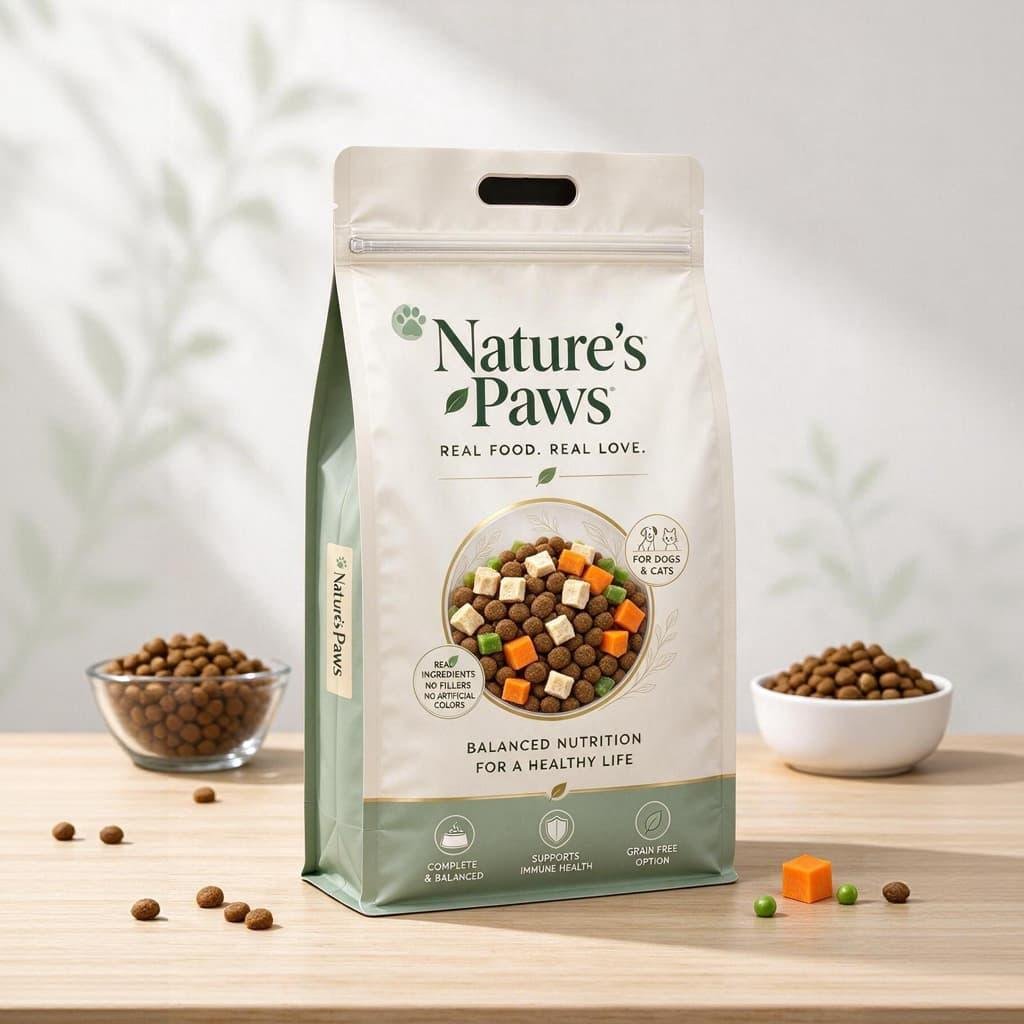
A custom pet food bag is a high-barrier flexible pouch purpose-built for dry kibble, treats, freeze-dried and fresh/raw pet food — a product category that combines three of the toughest demands in flexible packaging: fatty-acid (grease) migration from animal fats and oils, puncture resistance against hard kibble edges, and heavy fill weights that stress seals and handles up to 40 lb.
What you can expect from our factory
- ISO 9001:2015 quality system with food-contact material compliance (FDA 21 CFR 177.1520, EU 10/2011, GB 4806, REACH, Prop 65, AAFCO feed-safe materials)
- Quantified barrier data — OTR in cc/m²/day, WVTR in g/m²/day and grease resistance per structure, with test conditions stated
- Grease & oil resistant sealants for animal-fat and oily formulations that defeat standard PE films
- Resealable closures — press-to-close, pull-tab and slider zippers, die-cut handles, tin-ties, tear notches and clear windows, all in-house
- Formats: flat-bottom, quad-seal, side-gusset, stand-up and pillow/brick, from 2 oz treat packs to 40 lb foodservice bags
- Free pre-production samples in 3–5 days; MOQ from 1,000 pieces; production lead time 7–15 days
Anatomy of a Pet Food Bag: Every Component, Specified
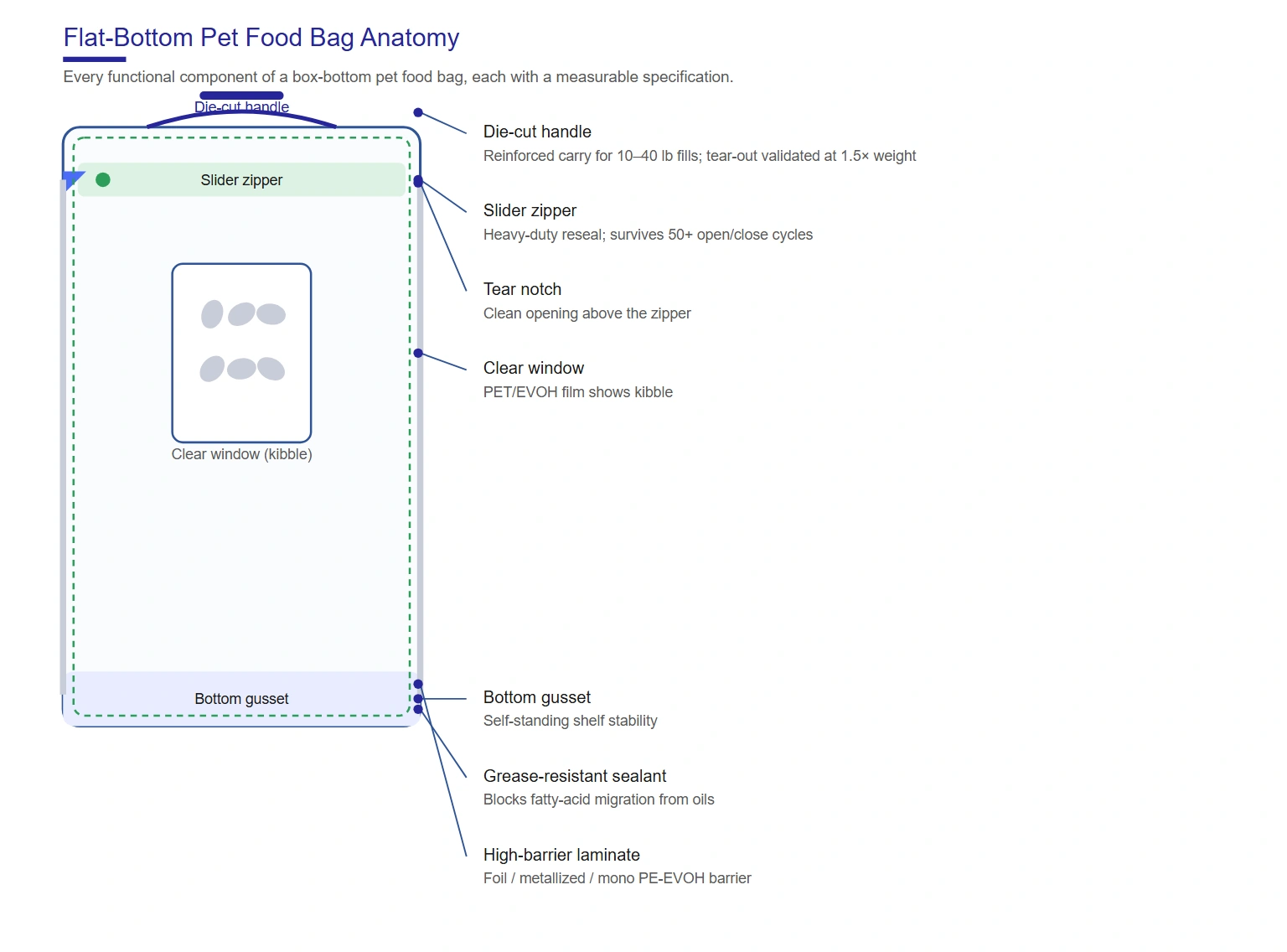
A pet food bag is a system of interacting components, and each has a measurable specification that affects shelf life, fill-line behaviour and the consumer experience. The diagram below labels a flat-bottom pet food bag; the table gives the specification you should be able to ask any supplier to quantify.
| Component | Function | Key specification to request |
|---|---|---|
| Resealable zipper / slider | Freshness across 20+ re-openings | Type (press-to-close / pull-tab / slider), opening force, re-close cycle life |
| Die-cut handle | Carry for 10–40 lb fills | Handle geometry, tear-out resistance (N), reinforcement |
| Front / back panels | Branding + primary barrier | Laminate structure, OTR/WVTR, grease resistance, print finish |
| Bottom gusset | Self-standing shelf stability | Gusset depth (mm), crease quality, fold geometry |
| Side / top seals | Containment under grease load | Seal width, seal strength (N/15 mm, ASTM F88), grease-aged seal retention |
| Clear window | Product visibility | Window film, clarity, seal compatibility, grease haze resistance |
| Tear notch | Clean opening above the zipper | Position, depth, laser vs. mechanical |
| Grease-barrier sealant | Blocks fatty-acid migration | Sealant resin, grease kit rating (TAPPI T-559) |
Film Structure, Barrier & Grease Resistance: The Numbers That Matter
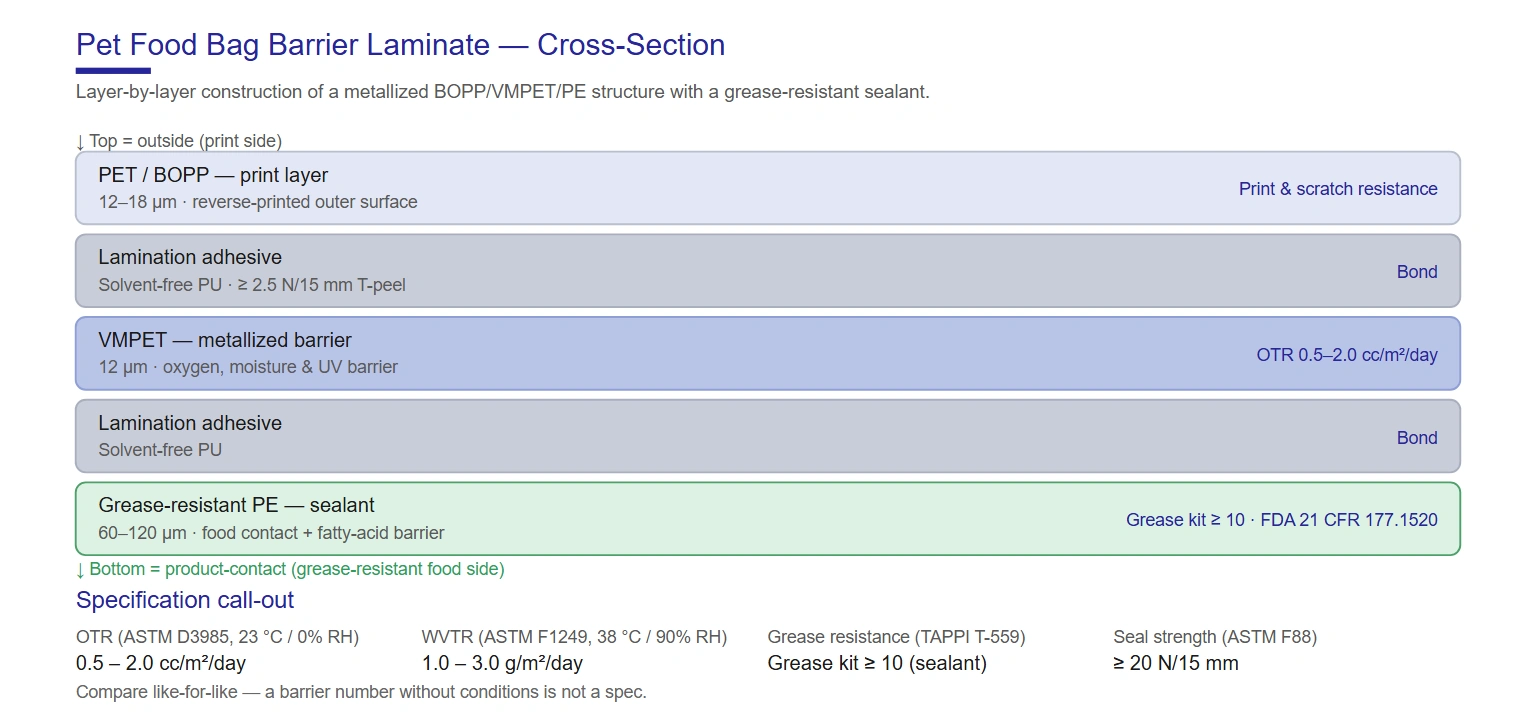
Pet food is more aggressive on packaging than most dry foods: kibble and treats carry animal fats that migrate into and through ordinary sealant films, weakening seals and causing staining, and the oils oxidise when oxygen reaches them. The table gives OTR and WVTR for the structures we run, plus grease resistance — the property most pet food suppliers never quantify.
| Film structure | OTR (cc/m²/day) | WVTR (g/m²/day) | Grease resistance | Recyclability | Typical use |
|---|---|---|---|---|---|
| PET / Al foil / PE (3-ply) | < 0.01 | < 0.01 | Excellent | Non-recyclable | Premium, longest shelf life, oily treats |
| Kraft / LDPE / Al / PE (4-ply) | < 0.05 | < 0.05 | Excellent | Non-recyclable | Kraft-look premium kibble |
| BOPP / VMPET / PE (3-ply) | 0.5 – 2.0 | 1.0 – 3.0 | Good | Limited | Standard kibble — workhorse |
| PA (nylon) / VMPET / PE (3-ply) | 0.5 – 2.0 | 1.0 – 3.0 | Good | Limited | Puncture-resistant heavy kibble |
| PE / EVOH / PE (mono, recyclable) | 0.1 – 0.5 | 3.0 – 8.0 | Good (EVOH) | Recyclable | Mono-material / recyclable programs |
| Kraft / PLA / PLA (compostable) | 5.0 – 15.0 | 4.0 – 10.0 | Moderate | Compostable | Compostable treat bags |
Conditions: OTR per ASTM D3985 @ 23 °C / 0% RH; WVTR per ASTM F1249 @ 38 °C / 90% RH; grease resistance per TAPPI T-559 (grease kit test) and T-454 (turpentine). The same film read at 23 °C / 50% RH can report up to 3× higher OTR — always compare like-for-like.
How to select a structure (engineer's checklist)
- Start from the fat profile. High-fat kibble, oily treats and freeze-dried raw need a grease-resistant sealant and a foil or metallized barrier; low-fat dry kibble can use a standard metallized structure.
- Add a puncture layer for hard kibble. A nylon (PA) or thicker PE layer prevents pinholes from sharp kibble edges — test with your actual product, not a proxy.
- Add a 10% barrier-degradation allowance for metallized structures — flex-cracking during forming degrades VMPET barrier.
- Match the sealant to the fill line and the fat load. Grease in the seal area is the #1 cause of pet food bag seal failure — specify a grease-resistant sealant and validate seal strength on grease-wiped samples.
Grease & Oil Resistance: The Property Most Suppliers Skip
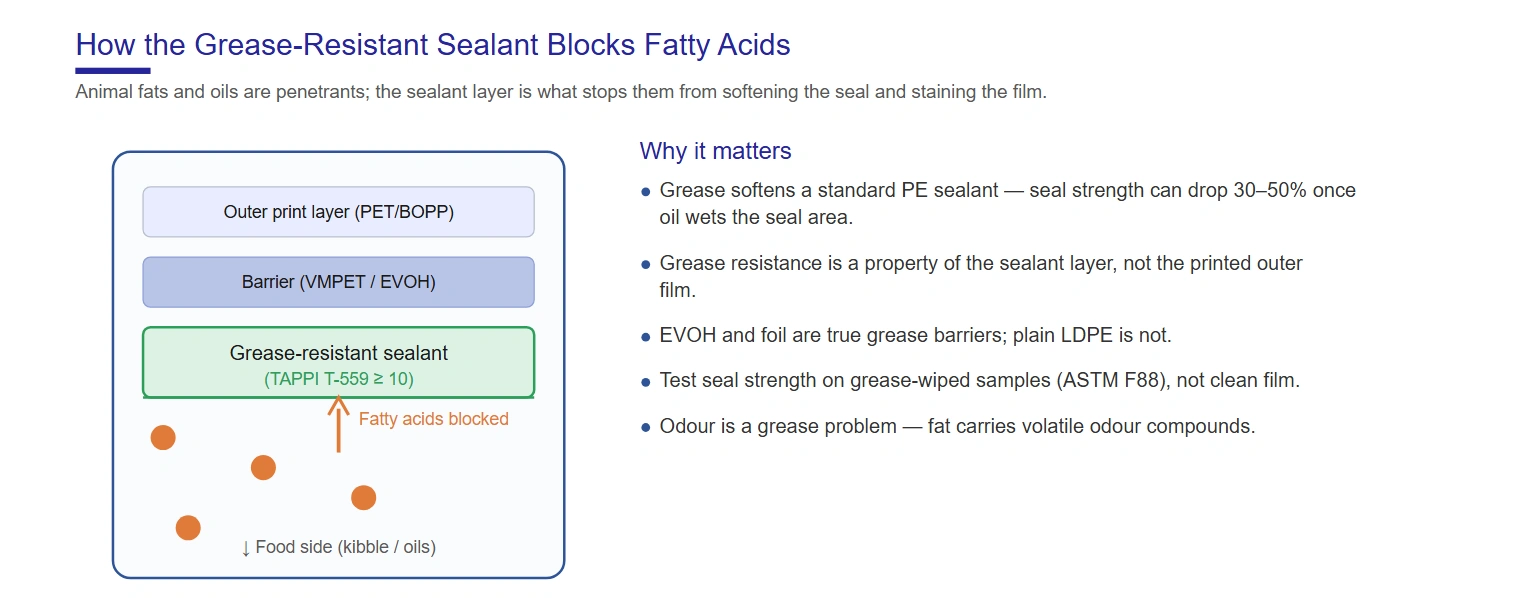
Animal fats and vegetable oils in pet food are penetrants: they soften and swell standard polyethylene sealant films, migrate through the laminate, and carry odour and oxidation with them. A bag that looks fine on the shelf can lose seal strength by 30–50% once grease wets the seal area. This is the single most common field failure in pet food bags — and the one most film converters never test for.
- Grease resistance is a property of the sealant layer, not the printed outer film. Request the grease-kit rating (TAPPI T-559) of the sealant, not the laminate as a whole.
- EVOH and foil are true grease barriers; standard LDPE is not. A metallized structure with a plain PE sealant will still let fatty acids through over 6–12 months.
- Test seal strength on grease-contaminated samples (ASTM F88 after applying a drop of the product’s oil to the seal area) — this is the real-world condition, not a clean seal.
- Odour is a grease problem. Fat carries volatile odour compounds; a grease-resistant sealant and a foil/metallized barrier are what actually contain the smell of fish and liver treats.
Resealable Closures & Handles
| Closure | Best for | Notes |
|---|---|---|
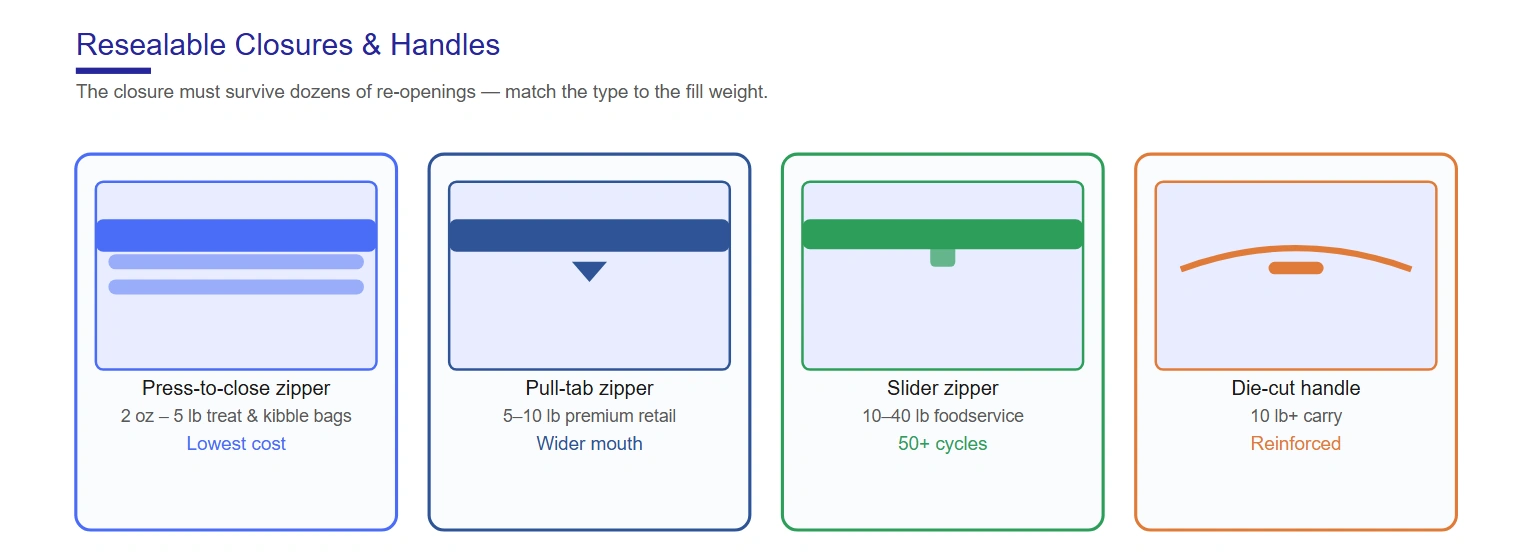
| Press-to-close zipper | 2 oz – 5 lb treat and kibble bags | Lowest cost, standard reseal |
| Pull-tab (EZ-pull) zipper | 5–10 lb premium retail | Wider mouth, easier open, premium feel |
| Slider zipper | 10–40 lb foodservice & large retail | Heavy-duty, re-closable under load, survives 50+ cycles |
| Tin-tie roll-top | Small specialty treat bags | Classic roll-top reseal |
| Die-cut handle | 10 lb+ bags | Reinforced carry; must not tear out under full weight |
| Tear notch | All formats | Positioned above the zipper so the zipper survives first open |
For heavy fills the handle is a structural element, not a convenience: a 40 lb bag carried by a weak handle tears out and destroys the pack. We reinforce die-cut handles and validate tear-out resistance at 1.5× the rated fill weight.
Pet Food Bag Formats & Fill Weights
| Format | Structure | Best for | Shelf presence | Relative cost |
|---|---|---|---|---|
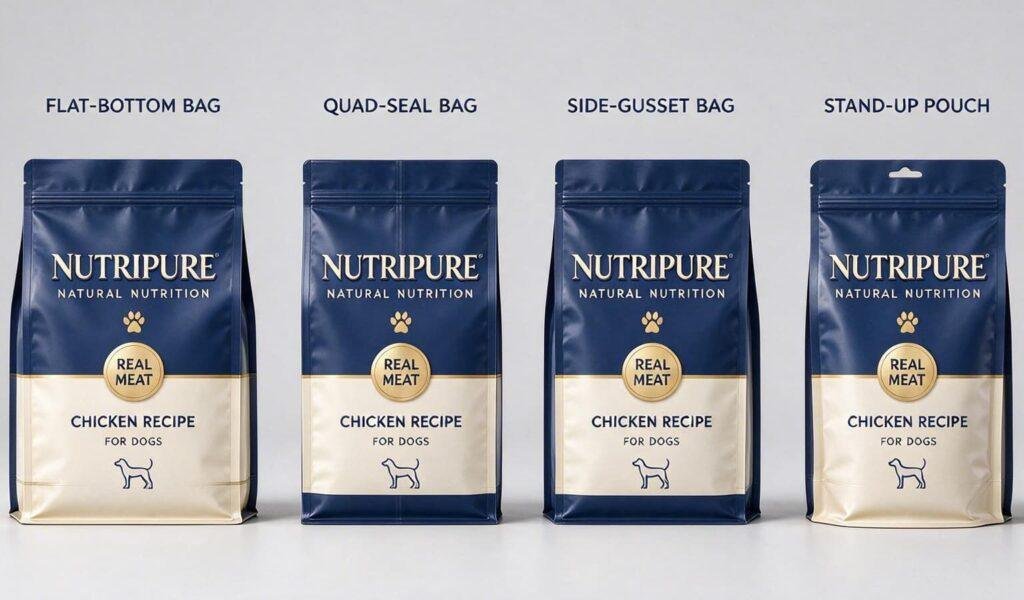
| Flat-bottom (box) | 5-panel box base | Premium kibble, subscription, 2–12 lb | Excellent — 5 printable faces | Highest |
| Quad-seal | 4 corner seals, flat base | Whole-grain & premium kibble, 4–10 lb | Very good — box-like | High |
| Side-gusset | Expanding gussets | Commercial & foodservice, 5–40 lb | Good — traditional | Medium |
| Stand-up pouch | Bottom gusset | Treats, freeze-dried, 1–5 lb | Good — compact | Lowest |
| Pillow / brick | Fin-seal, N2-flushed | High-volume kibble, stick packs | Flat, stackable | Lowest |
| Fill weight | Format (typical) | Reference dimensions (W × H + gusset) |
|---|---|---|
| 2 oz treats | Stand-up pouch | 100 × 150 + 40 mm |
| 1 lb | Stand-up pouch | 160 × 240 + 70 mm |
| 4–5 lb | Flat-bottom or quad-seal | 220 × 300 + 100 mm |
| 10–12 lb | Flat-bottom with handle | 280 × 380 + 120 mm |
| 25–40 lb | Side-gusset with handle | Custom — sized to kibble density |
Dimensions are reference points; final size is calculated from your kibble’s bulk density (typically 0.42–0.55 g/ml for kibble, 0.30–0.45 g/ml for freeze-dried) plus headroom for the zipper and seal.
Puncture Resistance & Heavy-Fill Engineering
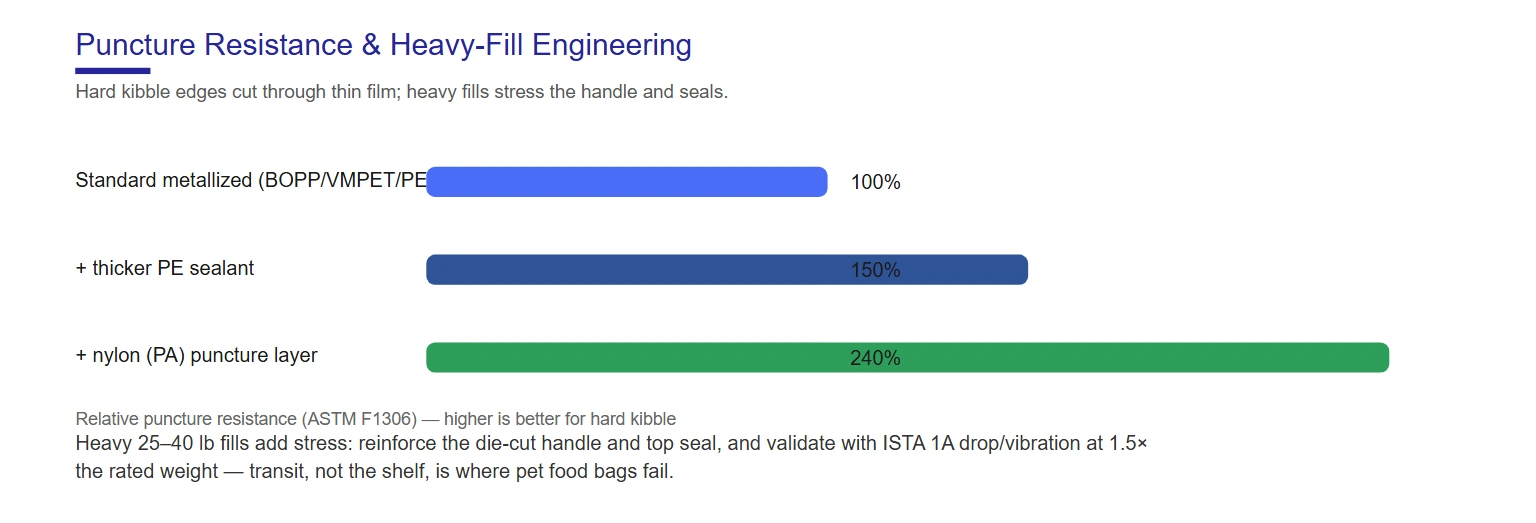
Hard kibble edges act like a cutting tool on film — a 1 mm pinhole is invisible on the line but lets in oxygen and moisture that turn kibble stale and rancid in transit. Heavy fills compound the problem: a 40 lb bag that is dropped or vibrated in shipping concentrates stress on the seals and the handle.
- Add a nylon (PA) or thicker PE layer for hard, angular kibble — validate with ASTM F1306 slow-puncture and D5748 dart-drop on your actual product.
- Match gauge to fill weight, not just shelf life. A structure that holds 2 lb will pinhole under 40 lb of vibration.
- Reinforce the handle and the top seal for 10 lb+ bags — these are the two stress concentration points in a heavy bag.
- Test dropped and vibrated packs (ISTA 1A transit simulation), not just static shelf samples — transit is where pet food bags fail.
Filling, Nitrogen Flushing & Line Compatibility
| Process | What it demands of the bag | Recommended structure / feature |
|---|---|---|
| Nitrogen flushing (MAP) | Low residual O2 (< 1–2%) requires a tight barrier to hold the flush | Foil or heavy metallized |
| High-speed VFFS (pillow/brick) | Low & consistent COF (0.12–0.25), clean hot-tack | Film with controlled slip additive |
| Zipper applied inline | Zipper must survive downstream seals | Matched zipper/sealant compatibility |
| Greasy / oily fill | Seal must hold under grease load | Grease-resistant sealant, wider seal |
| Heavy-weight fill (25–40 lb) | Drop & vibration resistance | Thicker gauge, reinforced handle |
| Hand/bench packing (small brands) | Easy-open, forgiving seals | Press-to-close zipper, standard sealant |
Regulatory & Compliance Matrix
| Standard / regulation | Scope | What it covers for pet food bags |
|---|---|---|
| FDA 21 CFR 177.1520 / 177.1390 | USA | Olefin polymers & laminate adhesives for food contact |
| AAFCO feed-safe materials | USA | Pet food is regulated as feed; materials must be feed-contact safe |
| EU 10/2011 (EC 1935/2004) | EU | Plastics food-contact; overall migration limit 10 mg/dm² |
| GB 4806.7 / GB 9685 | China | Food-contact plastics & additives |
| REACH (EC 1907/2006) | EU | SVHC declaration on materials & inks |
| California Prop 65 | USA (CA) | Phthalates, lead, BPA limits |
| BRCGS Packaging (Issue 6) | Global | Packaging food-safety management |
| ISO 22000 / ISO 9001 | Global | Food-safety & quality management |
| EN 13432 / OK Compost / BPI | EU / US | Industrial compostability of paper-PLA structures |
| RecyClass / APR design guidance | EU / US | Recyclability of mono-material structures |
We supply a Declaration of Compliance (DoC) and migration-test certificates for every shipped structure, and can provide feed-safe (AAFCO) material statements for US pet food programs. Ask for the DoC — a supplier that cannot produce one for a food/feed-contact bag has not done the compliance work.
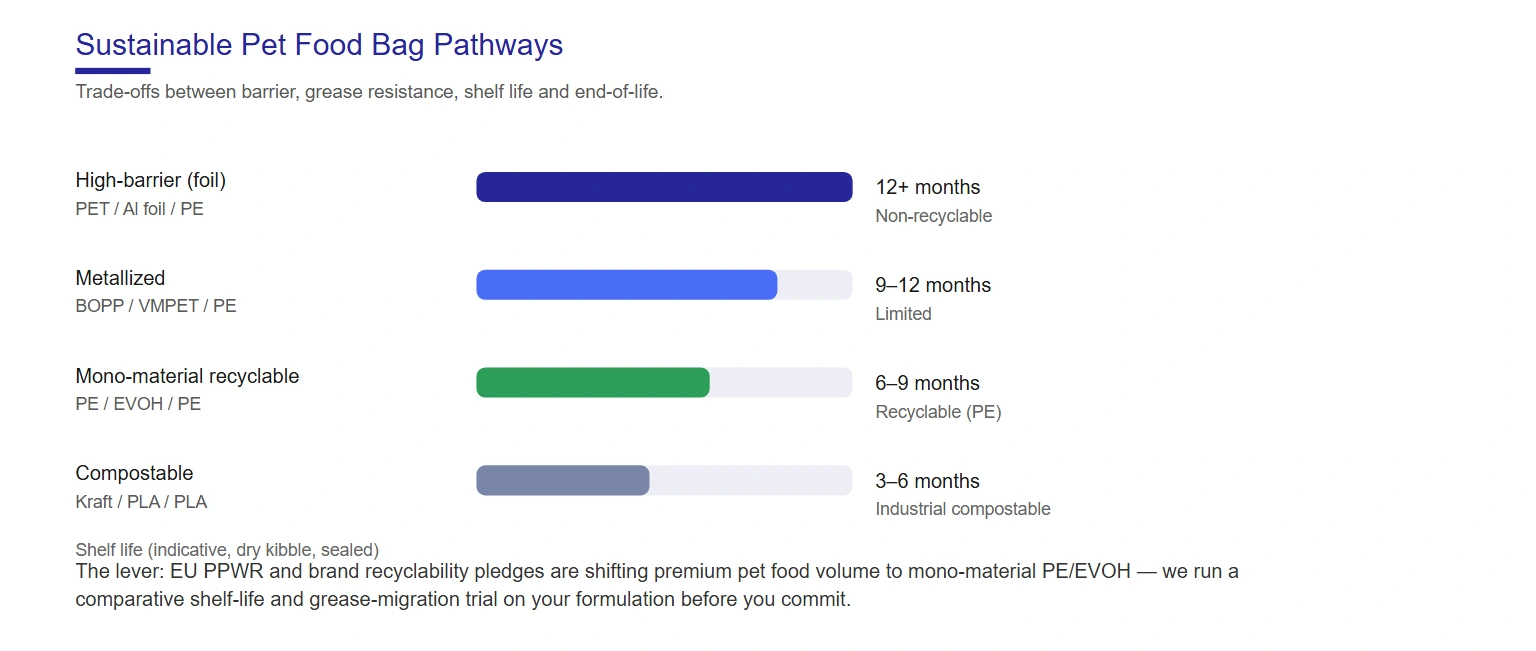
Sustainability & Recyclable / Compostable Structures
| Pathway | Structure | Shelf life | End-of-life | Trade-off |
|---|---|---|---|---|
| High-barrier (foil) | PET/Al/PE | 12+ months | Non-recyclable | Best protection, oily treats |
| Metallized | BOPP/VMPET/PE | 9–12 months | Limited | Balance of barrier & look |
| Mono-material recyclable | PE/EVOH/PE | 6–9 months | Recyclable (PE stream) | Slightly higher WVTR, premium cost |
| Compostable | Kraft/PLA | 3–6 months | Industrial compostable | Highest cost, shortest shelf life |
The fast-moving lever is the EU PPWR (EU 2025/40) and brand recyclability pledges: mono-material PE/EVOH pet food bags now achieve RecyClass approval while still carrying grease resistance and a zipper, and are the fastest-growing structure in the premium pet food segment. We can run a comparative shelf-life and grease-migration trial on your exact formulation before you commit.
Total Cost of Ownership vs. Rigid Pet Food Packaging
| Cost driver | Flexible pet food bag | Rigid can / plastic tub |
|---|---|---|
| Unit packaging cost | Low — lightweight film | High — metal/plastic + lid |
| Freight / warehousing | High cube efficiency, flat-fold pre-form | Heavy, low cube efficiency |
| Carbon footprint | Lower per unit | Higher per unit |
| Filling speed | High (VFFS / HFFS) | Slower (rigid handling) |
| Shelf life | 9–12+ months | Long, but over-engineered for dry kibble |
| Branding surface | Full 360° print, no plate for digital | Limited to label |
The common mistake is comparing bag unit price alone. A 5% cheaper film that pinholes in transit or loses seal strength under grease is a net loss — evaluate the bag as a system cost: barrier + grease resistance + seal reliability + puncture + fill speed + freight, not film price per thousand.
Applications by Pet Food Segment
- Dry kibble — pillow/brick for high volume; flat-bottom & quad-seal for premium retail; side-gusset for 25–40 lb foodservice.
- Treats & chews — stand-up pouches and stick packs, 2 oz to 2 lb, high print impact.
- Freeze-dried & air-dried raw — highest barrier demand (oil-rich, oxidation-prone), foil or heavy metallized, nitrogen-flushed.
- Fresh / refrigerated — grease-resistant sealant, modified-atmosphere, shorter shelf life.
- Amazon & e-commerce — puncture-resistant mailer-safe structure, sized to FBA dims, hang hole.
- Private label & subscription — low MOQ, digital print, fast format changeovers.
Customization Options
- Printing — rotogravure (high volume) or digital (low MOQ, no plate fees, full CMYK with photography).
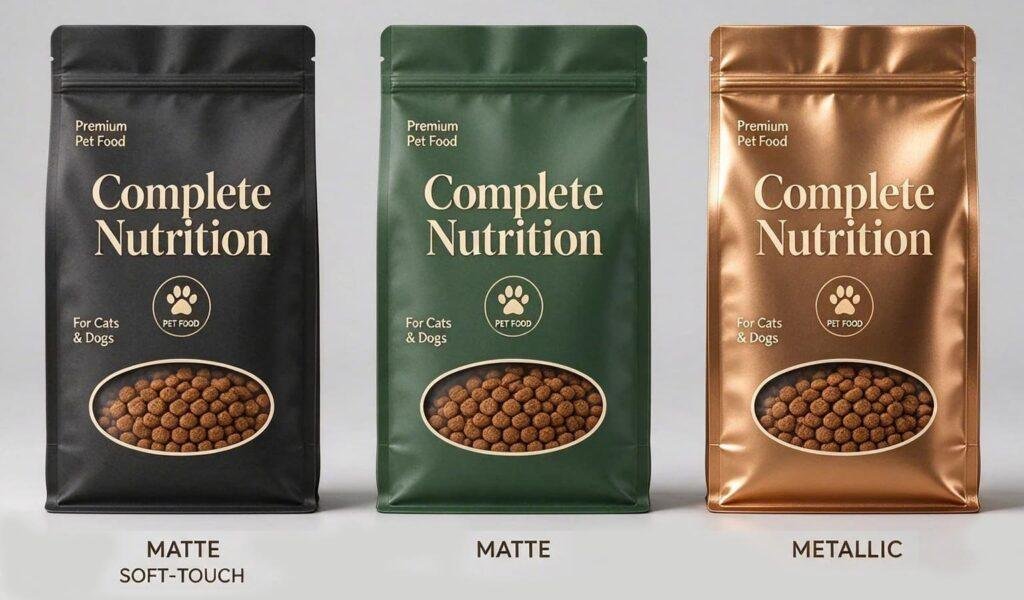
- Finishes — matte, gloss, soft-touch, metallic, kraft/paper-touch, spot UV and varnish.
- Structure & barrier — foil, metallized, mono-material recyclable or compostable, with grease-resistant sealant where needed.
- Features — press-to-close / pull-tab / slider zipper, die-cut handle, tin-tie, tear notch, hang hole, clear window.
- Formats & sizes — any of the five formats, custom dimensions calculated from fill weight and kibble density.
Quality Control & Test Methodology
Every batch is tested against the standards below and we ship a certificate of analysis (CoA) on request. These are the tests a serious pet food bag supplier should be able to quote pass values for.
| Test | Standard | What it verifies | Typical pass spec |
|---|---|---|---|
| Oxygen transmission (OTR) | ASTM D3985 | Barrier to O2 (rancidity) | Per structure (see barrier table) |
| Water vapour transmission (WVTR) | ASTM F1249 | Barrier to moisture (mold) | Per structure |
| Grease resistance | TAPPI T-559 / T-454 | Fatty-acid migration | Grease kit ≥ 10 (sealant) |
| Seal strength | ASTM F88 | Seal integrity | ≥ 20 N/15 mm (structure-dependent) |
| Seal strength after grease | ASTM F88 (grease-wiped) | Seal holds under oil load | ≥ 60% of clean-seal value |
| Hot tack | ASTM F1921 | Seal holds during fill | ≥ 3 N/15 mm |
| Puncture resistance | ASTM F1306 / D5748 | Kibble-edge resistance | Per gauge spec |
| Coefficient of friction | ASTM D1894 | Machine runnability | 0.12–0.25 (film-to-metal) |
| Gauge / thickness | ASTM D6988 | Film thickness | ±3% of spec |
| Dyne / surface energy (print side) | ASTM D2578 | Ink adhesion | ≥ 38 dyn/cm |
| Drop / vibration | ISTA 1A | Transit survival of heavy fills | No leak / no pinhole |
Failure Modes & Prevention
These are the failure modes we most often inherit from other suppliers’ pet food bags. Ask a candidate supplier how they prevent each one — the answer separates a film converter from a pet food packaging engineer.
| Failure mode | Root cause | Detection | Prevention |
|---|---|---|---|
| Seal failure under grease | Grease migration into seal area softens PE sealant | Grease-wiped seal test | Grease-resistant sealant; wider seal |
| Fatty-acid staining / migration | Plain PE sealant, no grease barrier | TAPPI T-559, visual over 6 mo | EVOH/foil barrier or grease-resistant sealant |
| Kibble puncture / pinholes | Thin gauge, sharp kibble edges, vibration | Puncture test, dye-penetrant | Add PA/thicker layer; validate on real kibble |
| Rancidity / staling | OTR too high; flex-crack in metallized film | OTR test, peroxide value | Upgrade barrier; add flex-crack allowance |
| Odour leakage | Weak seal + fat-carried volatiles | Sensory, GC headspace | Foil/metallized barrier + grease-resistant sealant |
| Zipper failure (heavy bags) | Wrong zipper type or load exceeds zipper | Cycle test under load | Slider zipper for 10 lb+ fills |
| Handle tear-out | Unreinforced die-cut handle | Tear-out test at 1.5× fill | Reinforced handle; validate weight |
| Moisture ingress / mold | WVTR too high for humid climate | WVTR test, moisture content | Lower WVTR structure for export markets |
MOQ, Pricing Factors & Lead Time
| Factor | Impact |
|---|---|
| Order quantity | MOQ from 1,000 pieces (digital print); unit price falls steeply at 10k / 50k / 100k+ (rotogravure) |
| Print route | Digital = no plate fees, ideal for multi-SKU & <10k; rotogravure = lower unit cost at high volume |
| Structure | Foil & grease-resistant structures cost more than standard metallized; VMPET most economical |
| Features | Each add-on (zipper, slider, handle, window, tin-tie) adds a fixed per-bag cost |
| Size / film weight | Larger bags & heavier gauges use more film |
| Finishes | Soft-touch, spot UV, holographic add cost vs. standard matte/gloss |
Lead time: free pre-production samples in 3–5 days; production 7–15 days after artwork approval (digital); rotogravure adds cylinder lead time. We hold standard zipper, slider and handle inventory to avoid component delays.
Production Process
- Artwork & prepress — CMYK, PDF/vector, fonts outlined, 3 mm bleed; we check for registration and print feasibility.
- Plate / cylinder (rotogravure) or RIP (digital) — colour-managed to your brand standard.
- Printing & lamination — reverse-print on film, then solvent-free or solvent lamination of the barrier layers.
- Curing — laminate cure to full bond strength (≥ 2.5 N/15 mm T-peel) before slitting.
- Slitting & pouching — to width, then form (flat-bottom / quad-seal / side-gusset / stand-up / pillow).
- Zipper, handle & fitment application — in-line application of zippers, sliders and die-cut handles.
- QC & packing — in-line vision + batch testing (seal, OTR/WVTR, grease, puncture), then poly-packed and cartoned for export.
Pet Food Bag Supplier Evaluation Checklist (18 Points)
- Do they state OTR/WVTR with test conditions, or just say “high barrier”?
- Do they specify the grease-kit rating (TAPPI T-559) of the sealant layer?
- Can they run a seal-strength test on grease-wiped samples (ASTM F88)?
- Do they offer recyclable mono-material and compostable structures, with certification?
- Do they provide a Declaration of Compliance and migration-test certificates per structure?
- Can they run a comparative shelf-life + grease-migration trial on your actual kibble/treats?
- Do they have in-house pouching, or do they outsource (adds lead time & margin)?
- What is their flex-crack allowance for metallized film?
- Do they add a nylon/puncture layer for hard kibble and validate it on your product?
- Do they control COF for high-speed lines?
- What is their real MOQ and does digital print remove plate fees?
- Do they hold zipper/slider/handle inventory to avoid component delays?
- What is their QC sampling plan (AQL) and can they ship a CoA?
- Do they understand MAP / nitrogen-flushing residual-oxygen targets?
- Can they match your existing bag exactly (reverse-engineer a sample)?
- How do they validate handle tear-out and heavy-fill drop/vibration (ISTA 1A)?
- Do they publish a failure-mode analysis and prevention plan?
- Can they provide AAFCO feed-safe material statements for US programs?
Pet Food Packaging Market Intelligence
The global pet food packaging market is a growing, consolidating segment driven by the humanization of pets and the premiumization of pet food. MarkNtel Advisors values the market at USD 11.34 billion in 2024, projected to reach USD 15.48 billion by 2030 at a 5.32% CAGR, and Grand View Research estimates the market at approximately USD 12.9 billion in 2025, projected to reach USD 19.78 billion by 2033 at a 5.5% CAGR, with bags & pouches the leading product segment. Stand-up pouches account for over 40% of all pet food packaging sales.
- Premiumization — grain-free, freeze-dried, air-dried and raw formulations are more oil-rich and oxidation-prone, driving demand for higher-barrier, grease-resistant bags.
- E-commerce & subscription — direct-to-consumer pet food shifts volume toward puncture-resistant, mailer-safe flexible bags.
- Single-serve & treats — stick packs and small stand-up pouches grow faster than bulk retail.
- Sustainability regulation — EU PPWR and brand pledges push mono-material and compostable structures.
- Convenience reseal — slider and pull-tab zipper adoption rises as consumers re-open dozens of times.
Frequently Asked Questions
Which film structure is best for pet food bags?
It depends on the fat profile and shelf-life target. Foil (PET/Al/PE) gives the lowest OTR and WVTR and best grease barrier for oil-rich treats and freeze-dried raw (12+ months). Metallized BOPP/VMPET/PE is the economical standard for dry kibble (9–12 months). Recyclable mono-material PE/EVOH/PE suits 6–9 month sustainability programs.
Why does my pet food bag seal fail after a few months?
In most cases grease migration: animal fats penetrate the seal area and soften a standard PE sealant, cutting seal strength by 30–50%. The fix is a grease-resistant sealant and a wider seal, validated on grease-wiped samples (ASTM F88), not clean film.
What is the minimum order quantity (MOQ)?
From 1,000 pieces on digital print (no plate fees). Unit cost drops sharply at 10k / 50k / 100k+ pieces where rotogravure becomes economical. Free pre-production samples ship in 3–5 days.
Can I get recyclable or compostable pet food bags?
Yes. Recyclable mono-material PE/EVOH/PE carries RecyClass approval, and Kraft/PLA structures are industrially compostable (EN 13432 / BPI / OK Compost). We run a comparative shelf-life and grease-migration trial on your formulation before you commit.
Do pet food bags need a grease-resistant sealant?
For oily treats, high-fat kibble and freeze-dried/raw, yes — animal fats will soften a standard PE sealant. Low-fat dry kibble can use a standard sealant, but we recommend validating with a grease-kit test (TAPPI T-559) regardless.
What formats do you offer?
Flat-bottom (box), quad-seal, side-gusset, stand-up pouch and pillow/brick — plus roll-stock film and stick packs — sized from 2 oz treats to 40 lb foodservice bags.
How do you handle heavy 25–40 lb bags?
Thicker gauge, a nylon or reinforced puncture layer, reinforced die-cut handles and ISTA 1A drop/vibration validation at 1.5× the rated fill weight.
Can you match a bag I already use?
Yes — send a sample and we reverse-engineer the structure, dimensions, barrier, grease resistance and closure, then quote a like-for-like or improved version.
Key Takeaways
- Grease resistance is the differentiator — specify the sealant’s grease-kit rating and test seal strength on grease-wiped samples.
- Specify barrier with numbers and conditions — OTR/WVTR without temperature/RH is not a spec.
- Engineer for puncture and heavy fill — hard kibble and 40 lb bags demand a nylon layer, thicker gauge and reinforced handles.
- Evaluate total cost of ownership — barrier + grease + seal reliability + puncture + fill speed + freight, not film price per thousand.
- Plan for sustainability now — PPWR and brand pledges are already moving pet food volume to recyclable and compostable structures.
Get a Free Pet Food Bag Sample & Quote
Tell us your format, fill weight, fat profile, target shelf life, print route and sustainability goal — our engineers will return a structure recommendation with quantified barrier and grease-resistance data and a quote within 24 hours. Free pre-production samples in 3–5 days.
You Also May Like

Ready to Improve Your Packaging Supply Chain?
Whether you are looking for a new packaging supplier, a backup manufacturer, or a trusted sourcing partner, We are ready to support your business.