
Custom Protein Powder Pouch
— Engineered High-Barrier Flexible Packaging
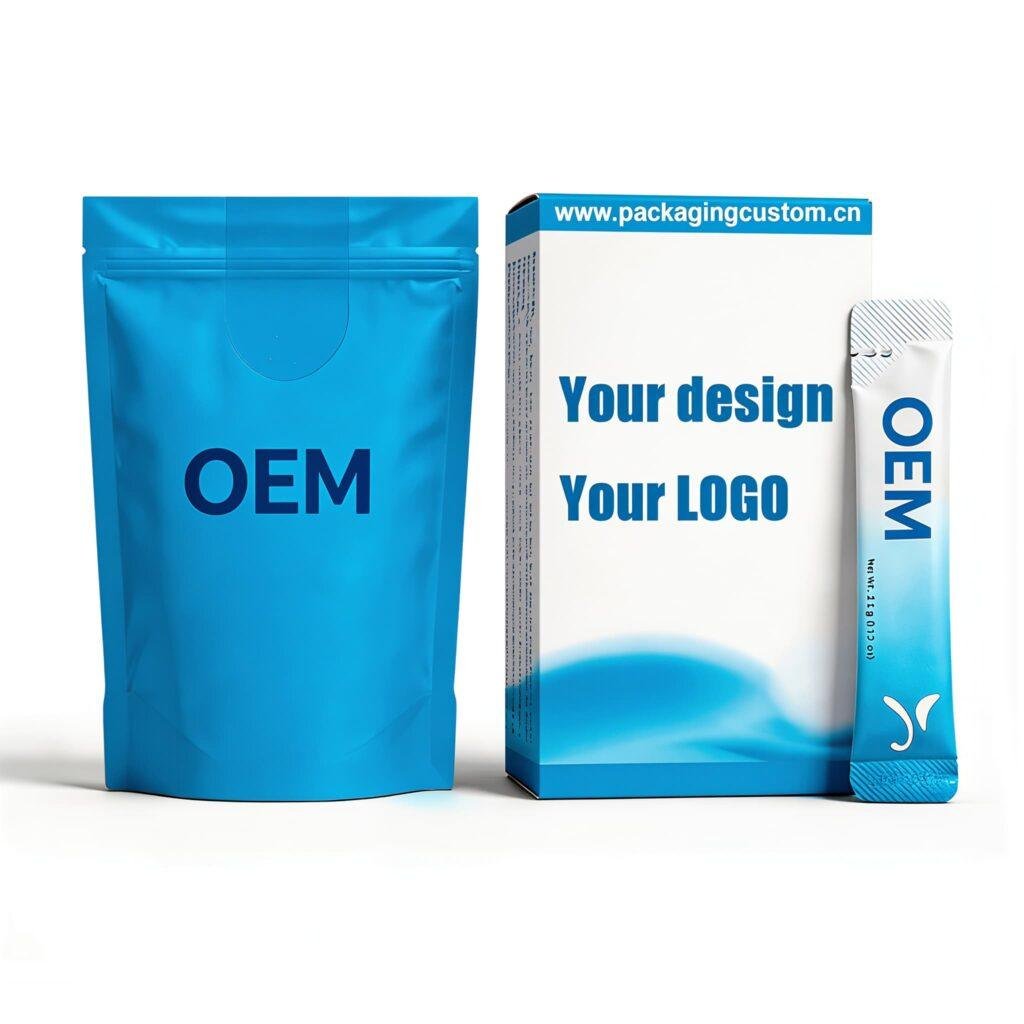
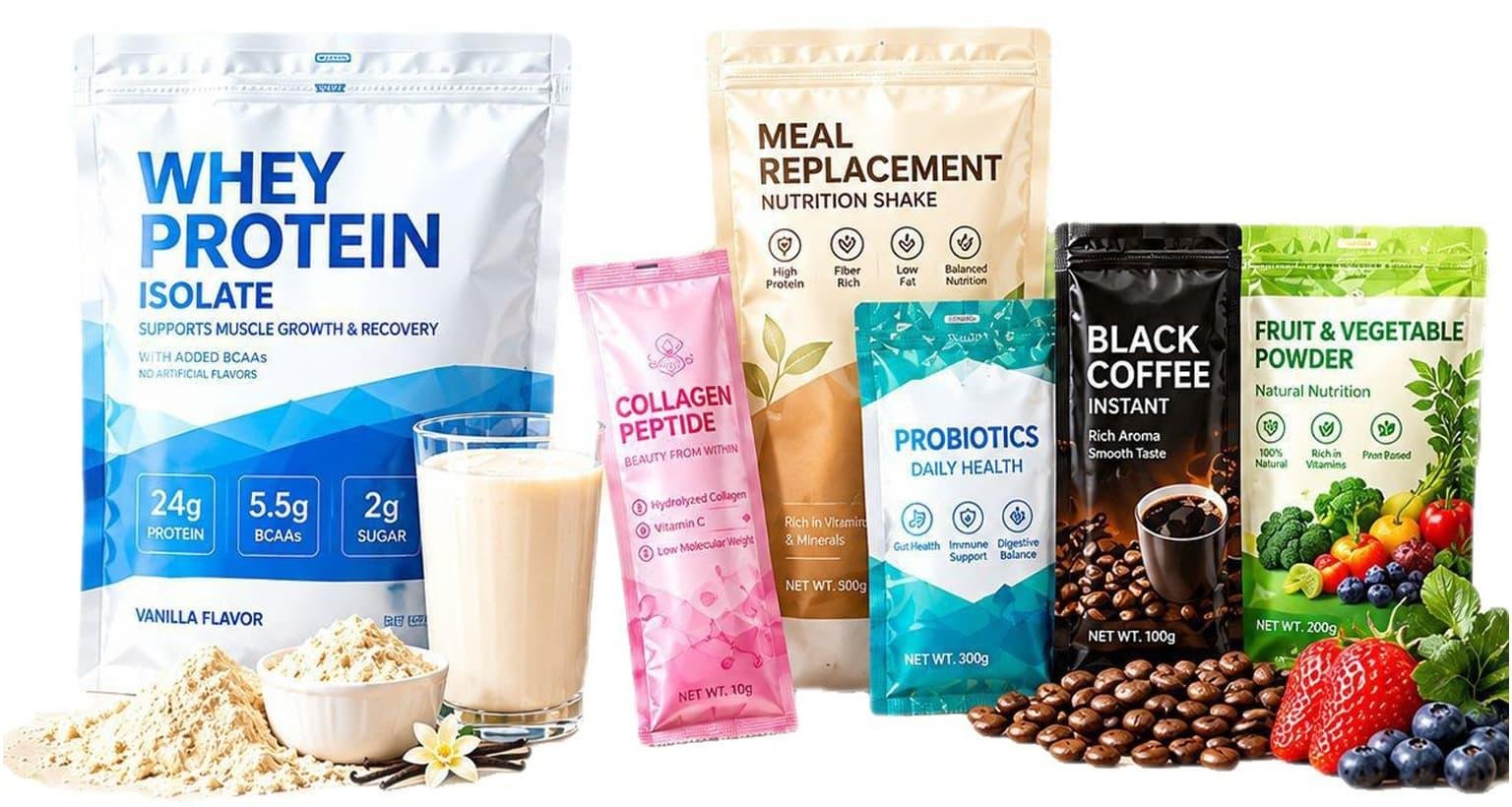
A protein powder pouch is a gusseted, stand-up flexible bag engineered to protect hygroscopic powders — whey, casein, plant protein, creatine, pre-workout and greens blends — from oxygen, moisture and light, while delivering a resealable, scoop-friendly, retail-ready pack.
What you can expect from our factory
- ISO 9001:2015 & BRCGS Packaging certified food-grade manufacturing
- Quantified barrier data (OTR/WVTR) per film structure, with ASTM test conditions stated
- Anti-static sealant as standard for powder fills — prevents seal-zone contamination
- MOQ from 500 units (digital); free pre-production sample in 3–5 days
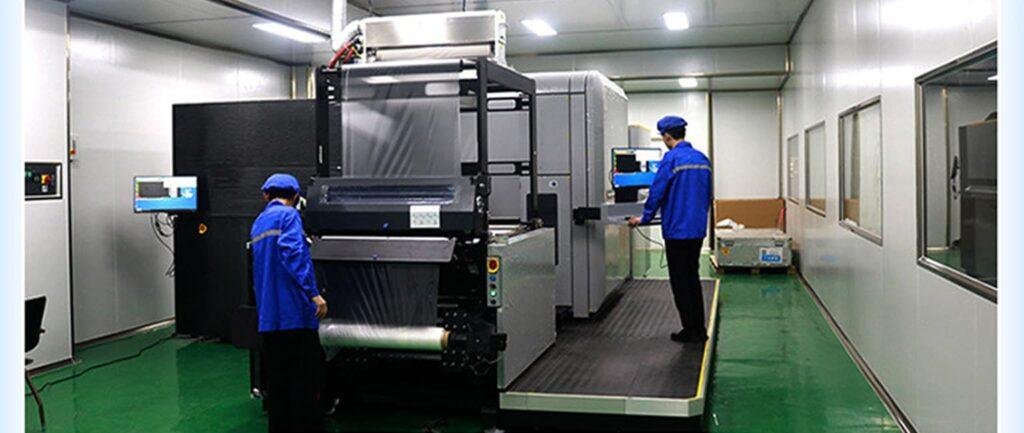
- 7–15 day lead time; flexo, rotogravure & HP Indigo digital printing up to 12 colors
What Is a Protein Powder Pouch?
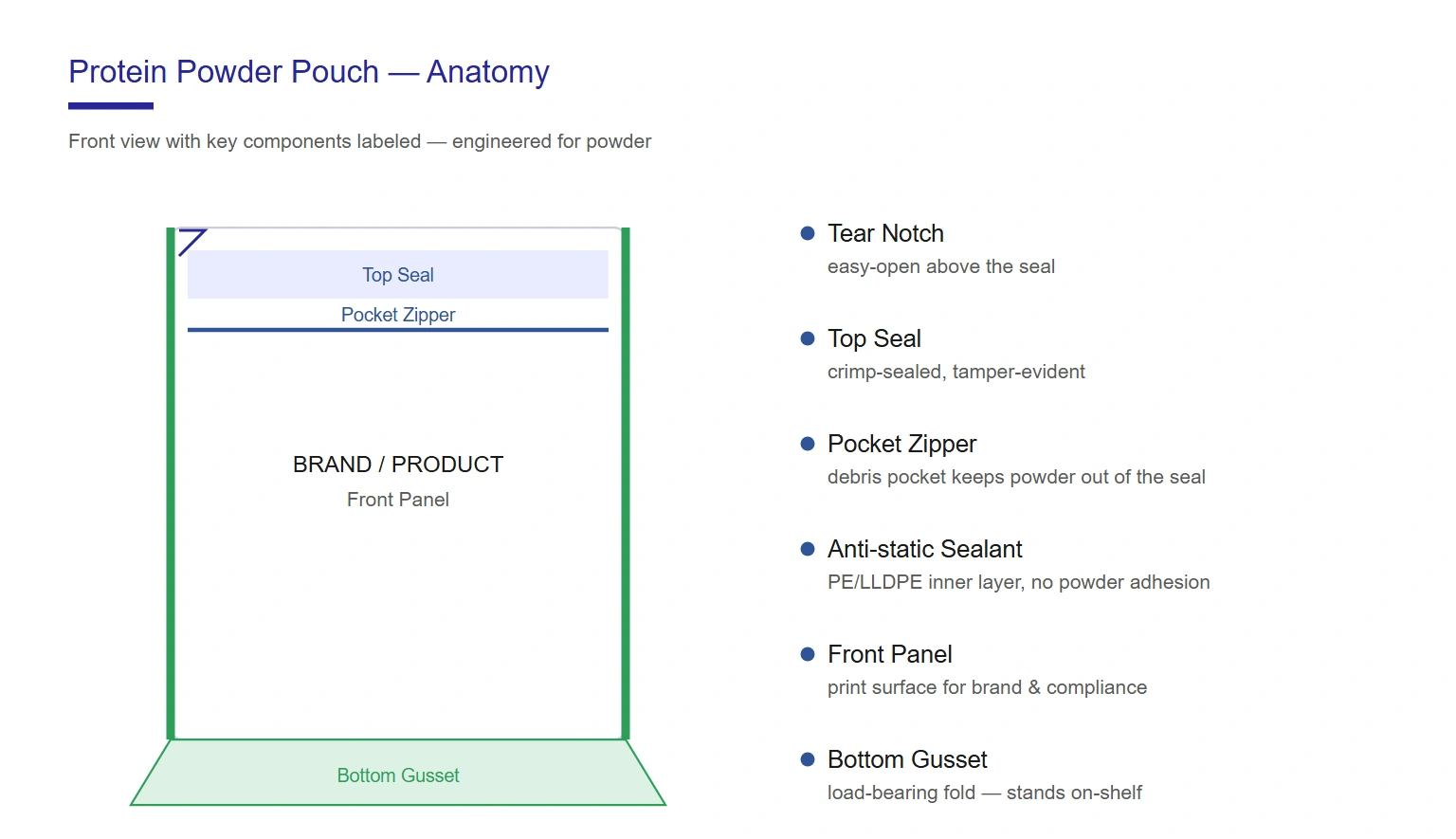
A protein powder pouch (also called a supplement pouch or powder stand-up bag) is a multi-layer laminate bag with a folded bottom gusset that lets it stand upright on-shelf, and a resealable closure — usually a pocket zipper — heat-welded to the inner sealant layer. It replaces rigid tubs and jars for the powder supplement category, where it wins on billboard surface area, cube efficiency, and reclosability.
- Front & back panels — printable surface for branding, nutrition facts and compliance
- Bottom gusset (round Doyen or flat K-seal) — the load-bearing fold that lets the pouch stand
- Pocket zipper — a debris pocket under the profiles catches powder so the zipper stays clean
- Anti-static sealant layer — the #1 powder-specific feature, prevents dust in the seal zone
- Optional — tear notch, hang hole, clear window, one-way valve, scoop, laser score
Pouch Formats & Configurations
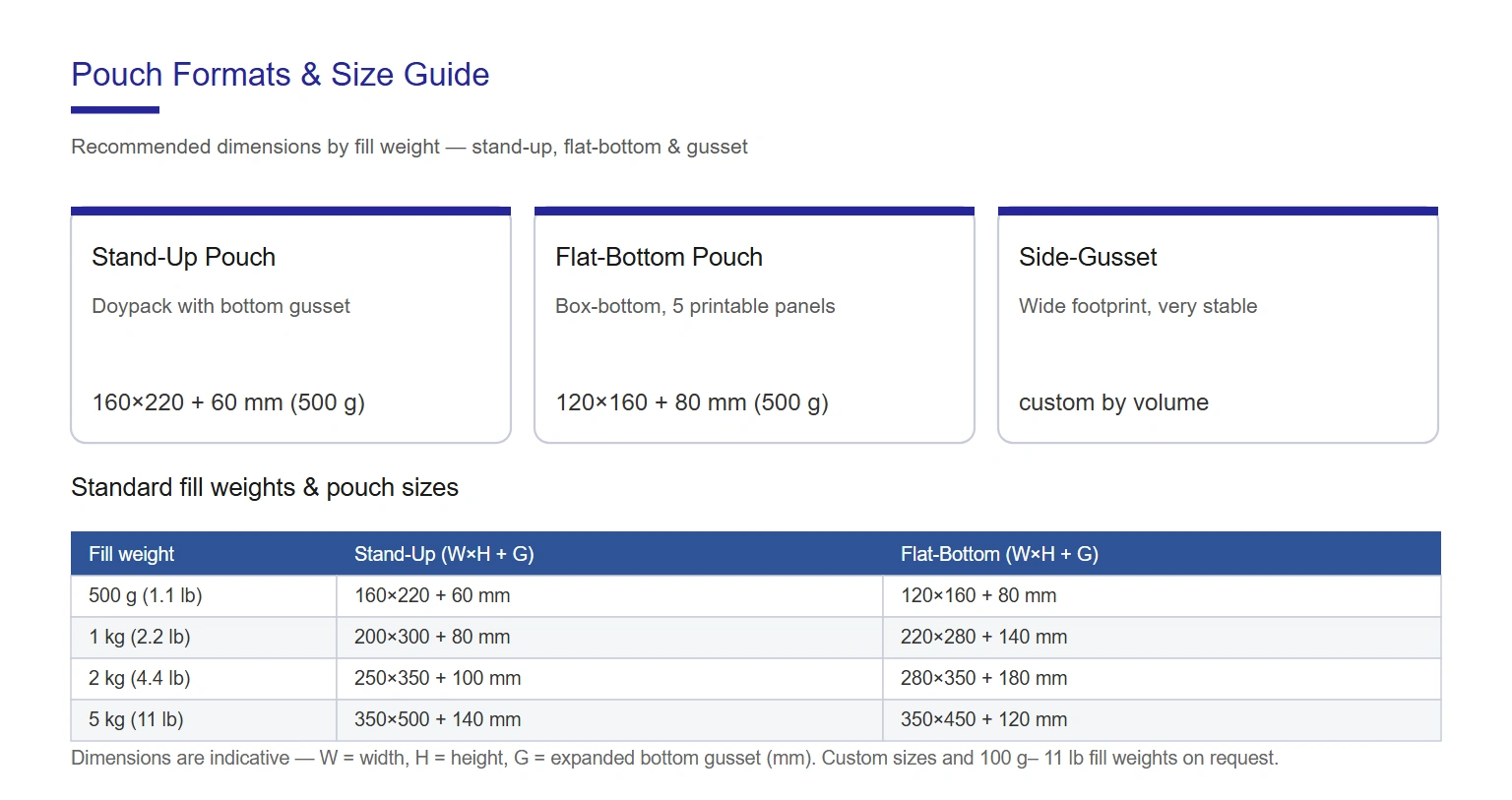
The format is set by fill weight, shelf channel, and filling line. The three workhorse formats for protein and supplement powders are the stand-up pouch (Doypack), the flat-bottom (box-bottom) pouch, and the side-gusset pouch. A fourth — the single-serve stick pack — is the fastest-growing format for on-the-go and sample programs.
| Format | Stand-up Stability | Print Panels | Best For |
|---|---|---|---|
| Stand-up pouch (Doypack) | High | Front + back | 500 g – 2 kg retail; most common |
| Flat-bottom (box) pouch | Highest | 5 panels | Premium / coffee-style, heavy fill |
| Side-gusset pouch | Very high | Front + back + gussets | Coffee, pet food, bulk powder |
| Stick pack | N/A (lay-flat) | Single panel | Single-serve 10–30 g sachets |
Film Structures & Barrier Performance (Quantified)
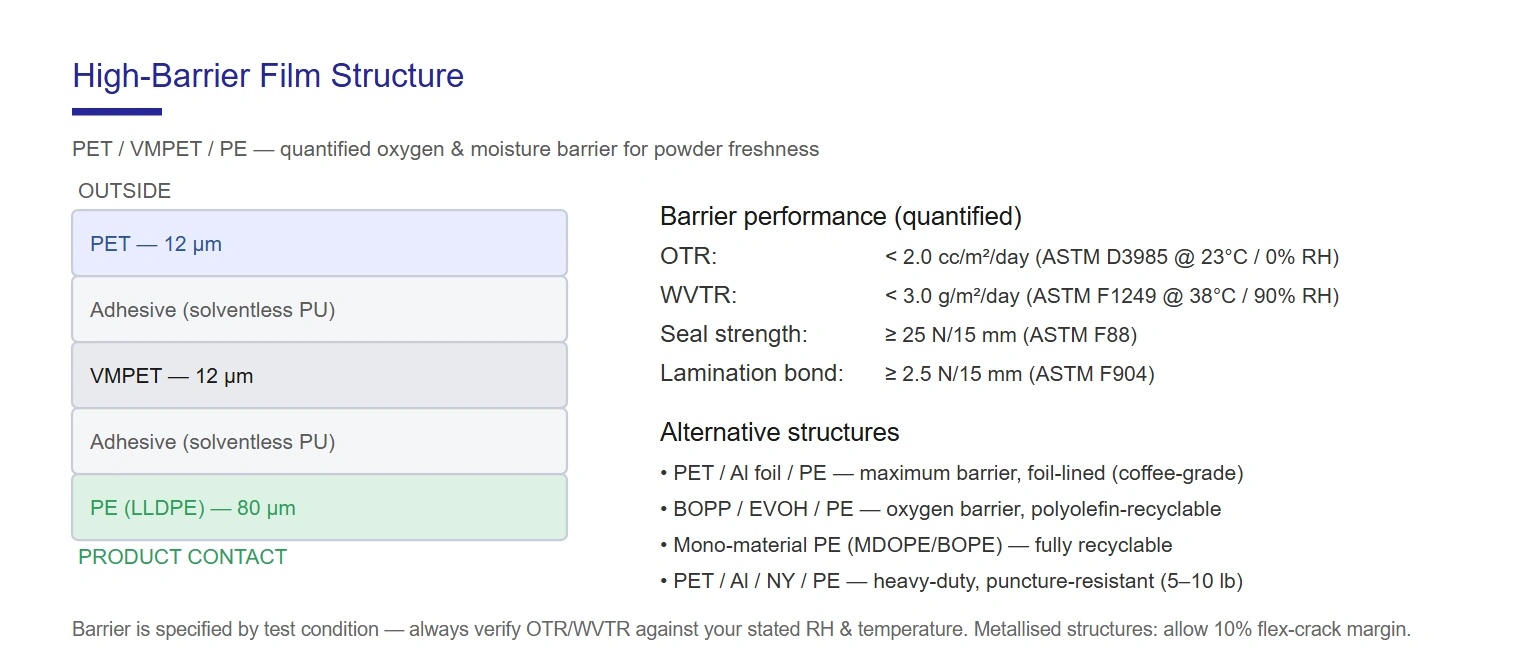
Barrier is specified by two numbers — OTR (oxygen transmission rate, cc/m²/day, ASTM D3985 @ 23°C / 0% RH) and WVTR (water-vapour transmission rate, g/m²/day, ASTM F1249 @ 38°C / 90% RH). Always state the test conditions: the same film can read up to 3× higher OTR at 50% RH than at 0% RH. Protein powder is moisture-sensitive — WVTR is the number that determines whether your powder clumps or stays free-flowing.
| Structure | OTR (cc/m²/day) | WVTR (g/m²/day) | Seal (N/15 mm) | Recyclability | Typical Use |
|---|---|---|---|---|---|
| PET / VMPET / PE (3-ply) | 0.5–2.0 | 1.0–3.0 | 25–40 | Limited | Whey / casein / standard supplement (most common) |
| PET / Al foil / PE (3-ply) | < 0.01 | < 0.01 | 30–50 | Non-recyclable | Maximum barrier — moisture-critical, premium |
| PET / Al / NY / PE (4-ply) | < 0.05 | < 0.05 | 28–45 | Non-recyclable | Heavy-duty 5–10 lb, puncture-resistant |
| BOPP / EVOH / PE (3-ply) | 0.1–0.5 | 3.0–8.0 | 20–35 | Recyclable (polyolefin) | Oxygen-sensitive blends, dairy |
| Mono-material PE (MDOPE/BOPE) | 5.0–15.0 | 4.0–10.0 | 15–30 | Fully recyclable | Ambient / EPR-driven SKUs |
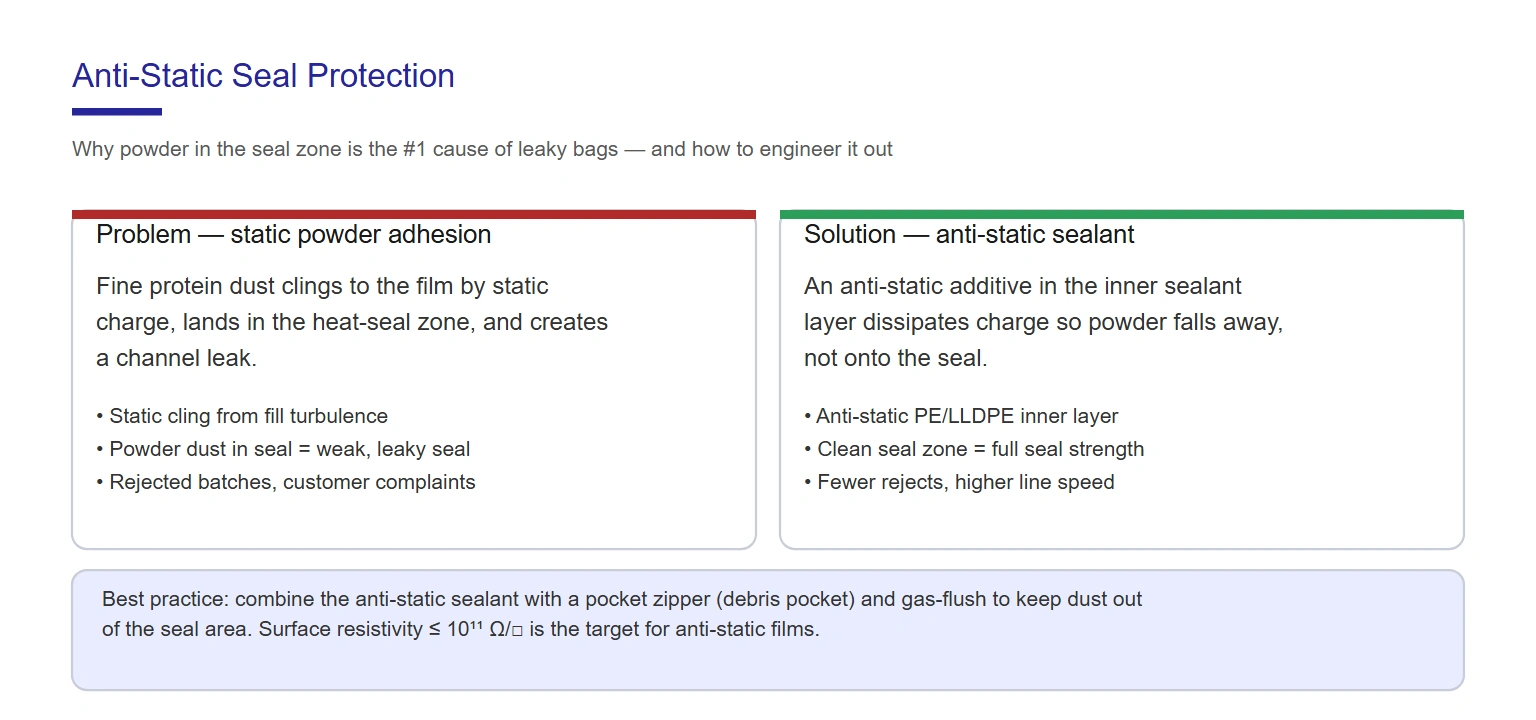
Anti-Static & Powder-Seal Protection (The #1 Powder-Specific Feature)
Fine protein dust clings to film by static charge during fill, lands in the heat-seal zone, and creates a channel leak — the single most common cause of rejected powder pouches. The fix is an anti-static additive in the inner sealant layer (target surface resistivity ≤ 10¹¹ Ω/□) that dissipates charge so powder falls away from the seal. Combined with a pocket zipper (debris pocket under the profiles) and gas-flush, this keeps the seal zone clean and seal strength at full spec.
Product Specifications & Parameters
The reference specification below covers the most commercially relevant protein powder pouch. All dimensions, gauges and features are customizable — treat these as starting points, not limits.
| Parameter | Specification | Notes |
|---|---|---|
| Bag styles | Stand-up / flat-bottom / side-gusset / stick pack | Custom shapes on request |
| Fill weights | 100 g – 11 lb (5 kg) | Standard 500 g / 1 kg / 2 kg / 5 kg |
| Film structures | PET/VMPET/PE, PET/Al/PE, PET/Al/NY/PE, MDOPE/BOPE/PE | Recyclable & compostable options |
| Total gauge | 80–150 µm (3.2–6.0 mil) | Gauge tolerance ±3% (ASTM D6988) |
| Closure | Pocket zipper / press-to-close / slider | Anti-static sealant standard |
| Printing | Flexo (8c) / rotogravure (12c) / HP Indigo digital | Pantone, matte, gloss, soft-touch |
| MOQ | 500 units (digital) / 10,000 (gravure) | Free pre-production sample |
| Lead time | 7–15 days production | +7–10 days rotogravure cylinders |
| Unit price | $0.03–0.20 (structure & volume dependent) | See pricing section below |
Regulatory & Compliance Matrix
| Regulation | Scope | Requirement | What It Means for You |
|---|---|---|---|
| FDA 21 CFR 177.1520 / 177.1390 | US food-contact olefins & adhesives | Material on approved list | Passes US import & retailer audits |
| EU 10/2011 (EC 1935/2004) | EU plastics food-contact | Overall migration ≤ 10 mg/dm² | Passes EU border & retailer audits |
| GB 4806.7 / GB 9685 | China food-contact plastics | Migration limits + positive list | Domestic China compliance |
| REACH (EC 1907/2006) | EU SVHC | No SVHC > 0.1% w/w | EU market access |
| California Prop 65 | US (CA) | No phthalates/lead/BPA above limits | Avoids CA litigation exposure |
| BRCGS Packaging Issue 6 | Food-safety management | Audit-grade traceability + HACCP | Retailer vendor approval |
| ISO 22000 / ISO 9001 | Food-safety & QMS | Certified management system | Reduces audit burden |
| EN 13432 / PPWR (EU 2025/40) | Recyclability + EPR | Recyclability rating, EPR fees | EU sustainability roadmap |
Process Compatibility: Fill, Seal & Run on Your Line
Machine runnability is set by the coefficient of friction: kinetic COF of 0.12–0.25 (film-to-metal, ASTM D1894) is the operating window for VFFS/HFFS. Below 0.10 causes web-tracking failures; above 0.30–0.35 causes forming-collar friction and seal-line wander. Seal strength is set primarily by temperature + dwell time, not pressure — ~1.25 bar minimum brings the surfaces into contact.
| Fill Process | Temp / Condition | Required Structure | Key Notes |
|---|---|---|---|
| Ambient / gas flush (MAP) | RT, 1.0–1.5 bar | PET/VMPET/PE, PET/AL/PE | Gas flush keeps dust out of the seal area |
| Auger / volumetric fill | High dust generation | Anti-static sealant + pocket zipper | Static control is critical — see anti-static section |
| Hot fill (liquid-adjacent) | 85–95 °C | Heat-resistant sealant, BOPP/EVOH/PE | Sealant must withstand fill temp |
| Vacuum | Negative pressure | Stiffer structure | Round-bottom preferred for conformity |
Failure Modes & Prevention (What We Engineer Out)
| Failure Mode | Root Cause | Detection | Prevention |
|---|---|---|---|
| Channel leak at seal | Powder dust in seal zone (static) | Vacuum decay / dye penetration | Anti-static sealant + pocket zipper + gas flush |
| Powder clumping / caking | Moisture ingress (high WVTR) | Shelf-life moisture test | Foil or VMPET barrier; verify WVTR spec |
| Zipper jam | Powder in zipper profiles | Functional test | Pocket zipper with debris pocket |
| Pouch blowout (drop) | Sharp product / thin sealant | Dart drop (ASTM D1709) | Up-gauge sealant; add NY puncture layer |
| Delamination | Adhesive failure / flex-crack | T-peel (ASTM F904) | Solventless PU adhesive; 10% barrier margin |
| Poor COF (jams) | Wrong slip additive | COF test (ASTM D1894) | Slip additive to target 0.12–0.25 |
Total Cost of Ownership vs Rigid Tubs
Against a rigid HDPE tub or PET jar, the protein powder pouch routinely wins on landed cost by 30–50% — but the number that matters is landed cost per unit sold, not per unit purchased. A 5% film-cost saving that costs 1% OEE on the filling line is a net loss.
| Cost Factor | Protein Powder Pouch | Rigid Tub / Jar | Impact |
|---|---|---|---|
| Unit material cost | $0.03–0.20 | $0.15–0.80 | 50%+ lower |
| Shipping weight (empty) | ~8–15 g | 40–150 g | Freight + FBA fee savings |
| Cube / warehousing | Flat or pre-formed, >90% less cube | High cube | Storage + FBA savings |
| Damage / breakage | Near-zero (no shatter) | 2–5% breakage | Fewer returns, cleaner reviews |
| Reclosability | Pocket zipper, stays fresh | Snap lid (limited) | Review tail + repeat purchase |
Sustainability & Recyclable Structures
The PPWR (EU Regulation 2025/40) makes recyclability a design requirement and adds extended-producer-responsibility (EPR) fees to hard-to-recycle formats. A mono-material PE (MDOPE/BOPE) pouch is fully recyclable and can materially reduce EU EPR exposure — at a barrier trade-off. Confirm the product’s moisture sensitivity first; an EVOH layer at ≤5% keeps a polyolefin structure recyclable while restoring oxygen barrier.
| Structure | Recyclability | Barrier Trade-off | End-of-Life |
|---|---|---|---|
| Mono-material PE (MDOPE/BOPE) | Fully recyclable (PE stream) | OTR 5–15, WVTR 4–10 | Store drop-off / curbside |
| BOPP / EVOH / PE (EVOH ≤5%) | Recyclable (polyolefin) | Good barrier | Recyclable with compatibilizer |
| PET / VMPET / PE | Limited | High barrier | Metallisation hard to separate |
| PET / Al foil / PE | Non-recyclable | Maximum barrier | Landfill / incineration |
| Compostable (Kraft / PLA / PBAT) | Industrially compostable | Poor moisture barrier | EN 13432 facility only |
Applications by Powder Type
- Whey protein (concentrate, isolate, hydrolysate) — moisture-sensitive, needs VMPET/foil barrier
- Casein & blends — fine powder, anti-static + pocket zipper essential
- Plant-based (pea, rice, hemp, soy) — clean-label Kraft or recyclable mono-PE
- Creatine & pre-workout — hygroscopic, gas-flush + high barrier
- Greens & superfood — oxygen-sensitive, EVOH or foil
- Collagen peptides — premium finish, matte/soft-touch
- BCAA / EAA / electrolytes — stick packs + medium pouches
- Meal replacement & mass gainer — 2–5 lb heavy-duty pouch with handle
Customization Options
- Printing — flexo (8 colors), rotogravure (12, photo-real), HP Indigo digital (no plates, variable data, ΔE < 2)
- Finishes — matte, gloss, soft-touch, paper-look, metallic, spot UV, embossing
- Windows — clear PET/PE window for powder visibility
- Closures — pocket zipper, press-to-close, slider, tear notch, hang hole, laser score
- Extras — clear window, one-way valve, scoop, handle, corner holes, euro-slot
- Variable data — QR codes, batch/expiry, serialization, sequential numbering
QC & Test Methodology (What We Verify & How)
| Test | Standard | What It Verifies | Pass Spec |
|---|---|---|---|
| Oxygen transmission | ASTM D3985 | Oxygen barrier | Structure-specific (see § barrier) |
| Moisture transmission | ASTM F1249 | Moisture barrier | Structure-specific |
| Heat seal strength | ASTM F88 | Seal integrity | ≥ 20 N/15 mm |
| Hot tack | ASTM F1921 | Seal while hot | ≥ 3 N/15 mm |
| Coefficient of friction | ASTM D1894 | Machine runnability | Kinetic 0.12–0.25 |
| Lamination bond | ASTM F904 | Layer adhesion | ≥ 2.5 N/15 mm T-peel |
| Puncture resistance | ASTM F1306 / D5748 | Puncture (sharp product) | Structure-specific |
| Dart drop | ASTM D1709 | Impact (transit / drop) | Structure-specific |
| Leak (bubble) | ASTM F2096 | Gross leak detection | No continuous bubble stream |
| Surface resistivity | Internal / ASTM D257 | Anti-static performance | ≤ 10¹¹ Ω/□ |
| Gauge | ASTM D6988 | Thickness tolerance | ±3% |
| Dyne level | ASTM D2578 | Print adhesion | ≥ 38 dyn/cm print side |
MOQ, Pricing Factors & Lead Time
| Factor | Typical Range | Notes |
|---|---|---|
| MOQ | 500 units (digital); 10,000+ (rotogravure) | Digital has no plate fee, higher per-unit |
| Unit price | $0.03–0.20 | Scales with volume, structure, print |
| Plate / cylinder fee | $0 (digital) – $300–800/color (gravure) | Amortizes over volume |
| Sampling | 3–5 days, free pre-production sample | Confirm structure before mass run |
| Production lead time | 7–15 days | +7–10 days rotogravure cylinders |
| Shipping | Sea 15–30 days / air 3–7 days | FOB / CIF / EXW terms |
Price is set by five levers: film structure, total gauge, print method + color count, closure type, and order volume. Volume is the largest single lever — moving from 10k to 50k units typically drops unit cost 20–40%.
Production Process (From Film to Finished Pouch)
- Film lamination — barrier / print / sealant layers bonded
- Printing — flexo / rotogravure / digital on the outer web
- Slitting — master roll cut to working widths
- Pouch forming — gusset fold + side seals + bottom shape
- Zipper insertion — pocket zipper heat-welded to the anti-static sealant
- Optional finishing — window, valve, tear notch, hang hole
- Inline QC — camera inspection, seal-strength, leak, barrier sampling
- Packing — flat or pre-formed, export-grade cartoning
15-Point Supplier Evaluation Checklist
- BRCGS / ISO 22000 food-safety certification — current and in your product scope
- Material compliance documentation — FDA, EU 10/2011, REACH, Prop 65 on file
- In-house lab with OTR/WVTR / seal / leak test capability
- Anti-static film capability — verified surface-resistivity data
- Pocket zipper compatibility tested against your sealant resin
- Color management — ΔE target + Pantone matching proof
- Sample policy — free pre-production sample with your exact structure
- MOQ matching your launch stage (digital vs gravure)
- Lead-time commitment with penalty / remedy clause
- Plate / cylinder fee transparency + amortization terms
- Third-party audit scorecard (SGS, Intertek, TÜV)
- Traceability — lot-level raw-material trace to film supplier
- Contingency capacity — a second line for peak season
- Logistics — FOB/CIF/EXW + Incoterms clarity
- IP protection — NDA, no reuse of artwork or dieline
Market Intelligence (For the Decision-Maker)
The global protein supplements market was valued at US$ 22.3 billion in 2023 and is projected to reach US$ 41.1 billion by 2033, growing at a 6.3% CAGR (Fact.MR). Protein powder holds more than 55% of that revenue — it is the category, not a niche. Flexible packaging overall is a ~$284–301B market growing at 4.2–4.9% CAGR (MarketsandMarkets / Future Market Insights), with APAC ~40% of demand and growing fastest.
- Powder over tubs — flexible pouches are displacing rigid tubs on cube, freight and reclosability
- E-commerce / Amazon FBA — pouches cut dimensional weight and storage cube
- Sustainability pressure — mono-material recyclable pouches under EU PPWR
- Plant-based growth — pea/rice protein brands favor clean-label Kraft & recyclable formats
- Stick-pack convenience — single-serve is the fastest-growing supplement format
Strategic implication: the protein powder pouch is a growth format, not a commodity. Brands that specify it correctly (barrier, anti-static sealant, pocket zipper, geometry) capture margin; those that treat it as a commodity lose it to leaky seals, clumped powder and returns.
Frequently Asked Questions
What film structure should I use for whey protein powder?
Whey is moisture-sensitive but not as oxygen-critical as roasted coffee. PET/VMPET/PE (OTR 0.5–2.0 cc/m²/day, WVTR 1.0–3.0 g/m²/day) is the workhorse and the best cost-per-performance choice. If you need maximum shelf life or a premium barrier claim, step up to PET/Al foil/PE (OTR <0.01, WVTR <0.01).
What is a pocket zipper and why do I need one for powder?
A pocket zipper is a press-to-close zipper with a debris pocket under the profiles — a void that catches powder dust so it doesn’t jam the zipper or contaminate the seal. For any fine powder fill it is strongly recommended over a plain press-to-close zipper.
How do I prevent powder from leaking through the seal?
Use an anti-static sealant layer (surface resistivity ≤ 10¹¹ Ω/□) so static charge doesn’t draw powder into the heat-seal zone, add a pocket zipper, and gas-flush to keep dust suspended during sealing. This is the #1 engineering control for leak-free powder pouches.
What is the minimum order quantity?
500 units with HP Indigo digital printing (no plate fee), and 10,000 units for rotogravure. Digital is ideal for launches and multi-SKU lineups; gravure becomes cost-effective at volume. Free pre-production sample in 3–5 days.
Do you offer recyclable or compostable protein powder pouches?
Yes — mono-material PE (MDOPE/BOPE) is fully recyclable, and BOPP/EVOH/PE with ≤5% EVOH remains polyolefin-recyclable while restoring oxygen barrier. Compostable Kraft/PLA/PBAT structures are available for clean-label brands, but note they trade away moisture barrier.
Can I include a scoop and clear window?
Yes. A scoop sized to your serving weight is included as standard at all fill weights, and a clear PET/PE window can be added for powder visibility. Confirm the window placement clears the seal and gusset zones during dieline development.
How long does production and delivery take?
Pre-production sample in 3–5 days (digital); production in 7–15 days; rotogravure adds 7–10 days for cylinder making. Sea freight 15–30 days, air 3–7 days, shipped FOB/CIF/EXW.
What certifications does the factory hold?
ISO 9001:2015, BRCGS Packaging, and ISO 22000-aligned food-safety systems, with material compliance documentation for FDA 21 CFR 177.1520/177.1390, EU 10/2011, GB 4806.7, REACH, and Prop 65 available on request.
Key Takeaways
- Specify barrier by test condition (OTR ASTM D3985 @ 0% RH; WVTR ASTM F1249 @ 90% RH) — WVTR is the number that keeps powder free-flowing
- Anti-static sealant is non-negotiable for fine powder — it is the difference between leak-free and rejected batches
- Use a pocket zipper — the debris pocket keeps the reseal clean and the seal intact
- Geometry drives landed cost — optimize gusset depth against carton, pallet, and FBA dimensional weight
- A 5% film-cost saving that costs 1% OEE is a net loss — evaluate landed cost per unit sold
- Protein powder is 55%+ of the protein supplements market — specify it as an engineered system, not a commodity
Specify Your Protein Powder Pouch
Send your powder type, serving size, fill weight and volume — or just your shelf-life target — and receive a quantified barrier recommendation, a free digital pre-production sample, and a landed-cost quote within 24 hours.
You Also May Like
Ready to Improve Your Packaging Supply Chain?
Whether you are looking for a new packaging supplier, a backup manufacturer, or a trusted sourcing partner, We are ready to support your business.