
Daily Chemical Bag Manufacturer
Engineered Flexible Packaging for Household & Personal-Care Products
Custom stand-up, spout and refill pouches engineered for detergent, personal-care and household products. Chemical-compatible barrier films, up to 10-colour gravure printing.
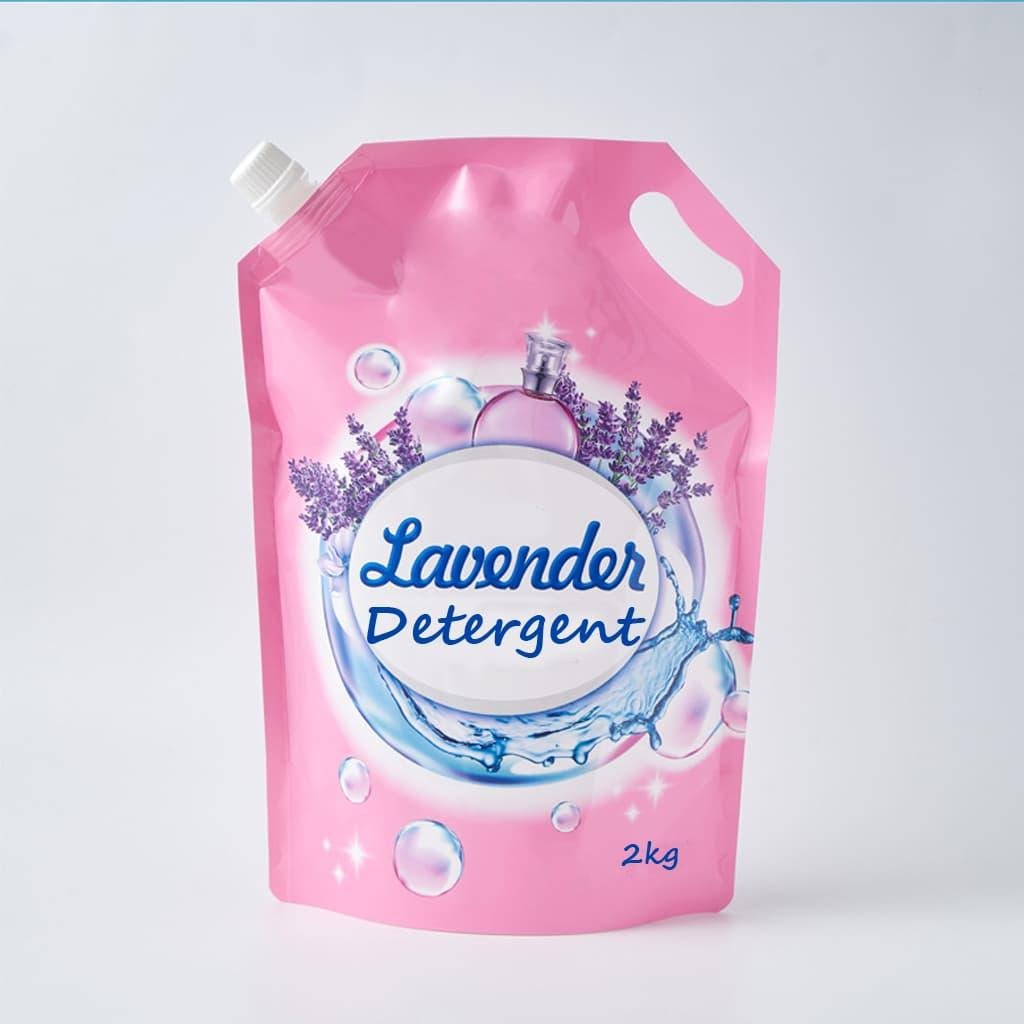
A daily chemical bag is a flexible, multi-layer laminate pouch engineered to safely contain, dispense and protect aggressive household and personal-care formulations — liquid laundry detergent, fabric softener, dishwasher liquid, shampoo, body wash, hand soap, surface cleaners, bleach and disinfectants. Unlike food packaging, daily chemical packaging must withstand surfactants, enzymes, oxidizers, solvents, essential oils and pH extremes without seal creep, delamination, stress-cracking or aroma loss.
What you can expect from our factory
- ISO 9001:2015, BRCGS, FDA and SEDEX audited production — not a trading company
- Chemical-compatibility engineering — we select sealant and structure against your exact formula, not a generic film
- Up to 10-colour gravure with computer-controlled ink dispensing and CMYK + Pantone matching
- Free pre-production samples in 3–5 days for compatibility and fill-line testing
- MOQ from 5,000 pieces with lead times of 12–20 days after artwork approval
- 30+ country export experience with full documentation (REACH, RoHS, Prop 65, UN transport)
Bag Formats & Selection Matrix
The right format is dictated by product viscosity, fill volume, retail channel and dosing behaviour. This matrix maps the seven core daily chemical bag formats to their best-fit applications — use it to shortlist before you spec a film.
| Format | Best For | Key Features | Typical Volume |
|---|---|---|---|
| Stand-up pouch (SUP) | Laundry detergent, fabric softener, hand soap | Self-standing, high shelf impact, optional spout / zipper | 100 ml – 2 L |
| Spout pouch | Liquid detergent refill, shampoo, shower gel | Precise dosing, resealable cap, tamper-evident | 100 ml – 2 L |
| Flat-bottom / box pouch | Premium detergent, laundry pods | Rigid 5-panel base, maximum shelf presence | 200 ml – 3 L |
| 3-side seal pouch | Sachets, samples, wet wipes | Low cost, high speed, single-use | 5 – 100 ml |
| Side-gusset pouch | Bulk refill, dishwasher tablets | High volume, stable, reinforced bottom | 500 ml – 5 L |
| Back-seal / fin-seal pouch | Powder detergent, cleaning agents | Smooth continuous seal, high-speed filling | 100 g – 5 kg |
| Roll film | Automated VFFS / HFFS lines | Form-fill-seal on your line, lowest material cost | Per machine |
| Easy-peel film | Pre-dosed pods and tablets | Precise controlled opening, high barrier | n/a |
Film Structure & Barrier Engineering
Barrier performance is the single biggest determinant of shelf life, aroma retention and leak resistance. The diagram below shows the workhorse 4-layer foil laminate — the structure that holds oxygen, moisture, light and fragrance better than any transparent alternative. The table quantifies the oxygen transmission rate (OTR) and water-vapour transmission rate (WVTR) you should demand per structure.
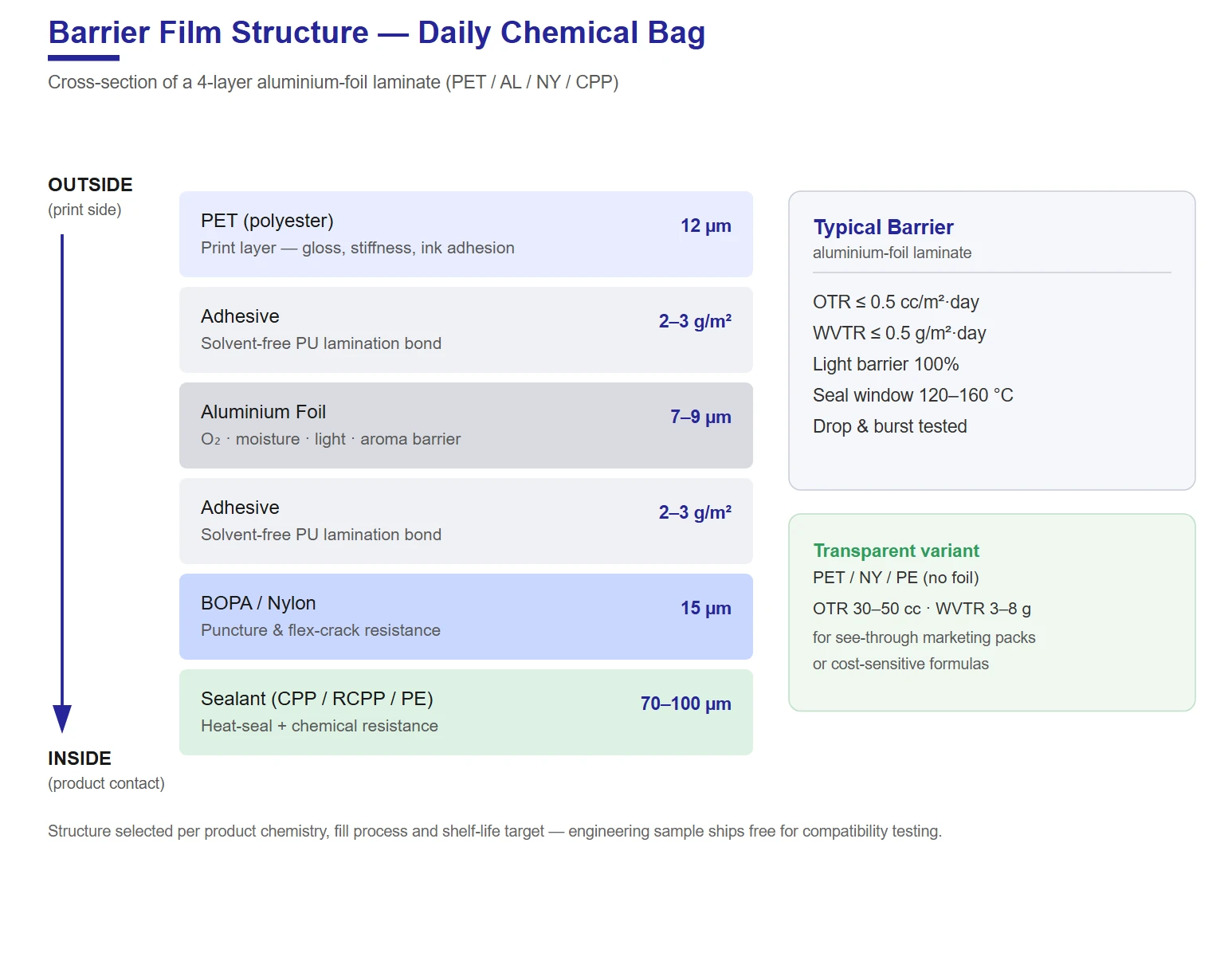
| Film Structure | OTR (cc/m²·day) | WVTR (g/m²·day) | Best For | Notes |
|---|---|---|---|---|
| PET / AL / NY / CPP | ≤ 0.5 | ≤ 0.5 | Liquid detergent, bleach, fragrance | Full barrier + puncture resistance; retortable with RCPP |
| PET / AL / NY / RCPP | ≤ 0.5 | ≤ 0.5 | Retort 121–135 °C, aseptic | Hot-process / long ambient shelf life |
| PET / VMPET / PE | 1 – 2 | 1 – 2 | Shampoo, conditioner, hand soap | Metallized, cost-effective mid barrier |
| PET / NY / PE | 30 – 50 | 3 – 8 | Transparent detergent, body wash | See-through, no foil — marketing-led |
| PET / PE | 100 – 120 | 10 – 15 | Powders, low-barrier needs | Economical, moisture-only protection |
Engineering rule: spec the sealant (CPP / RCPP / PE) from the product chemistry, the barrier (foil / metallized / transparent) from the shelf-life and aroma target, and the nylon layer from the puncture and flex-crack requirements of your logistics chain. Never let a supplier default all three — that is how expensive, over-specified or under-protected bags happen.
Chemical Compatibility Matrix — The Daily Chemical Difference
This is the section most competitors do not publish, and it is the reason a food-grade bag can still fail on a detergent line. Daily chemical actives attack packaging through specific, predictable mechanisms. Match your formulation to the right sealant and structure — or your pouch leaks on shelf, delaminates in transit, or loses its fragrance within 90 days.
| Active Ingredient | Attack Mechanism | Primary Risk | Recommended Sealant | Recommended Structure |
|---|---|---|---|---|
| Anionic surfactants (SLS / SLES / LAS) | Swell and soften LDPE at elevated temperature | Seal creep, delamination | CPP or high-density PE | PET / NY / CPP or PET / AL / NY / CPP |
| Enzymes (protease, amylase, cellulase) | No direct film attack; residue risk | Odour / colour from residue | CPP | PET / AL / NY / CPP |
| Sodium hypochlorite (bleach) | Oxidizes polyolefins over time | Pinholing, embrittlement | Oxidation-resistant high-MW PE | PET / AL / NY / PE |
| Organic solvents (glycol ethers, ethanol) | Soften sealant, extract additives | Seal failure, migration | Solvent-tolerant CPP | PET / AL / NY / CPP |
| Essential oils & fragrance | Aggressive penetrants, swell PE | Aroma loss, seal softening | Foil or EVOH barrier + CPP | PET / AL / NY / CPP |
| High-alkali (NaOH, KOH) | Hydrolyze PET if exposed at interface | Interfacial delamination | CPP / PE | PET / NY / CPP (foil optional) |
| Acid descalers (citric, sulfamic) | Minimal on polyolefins | Low | PE / CPP | PET / PE or PET / NY / PE |
| Cationic softeners (quats) | Adsorb to surfaces, affect seal | Seal contamination | CPP | PET / NY / CPP |
We run a 14–28 day immersion compatibility test at 40–60 °C on your actual product before approving any structure. Send a 500 ml reference sample with your inquiry and we return a compatibility report with the pre-production sample.
Spout & Fitment Engineering
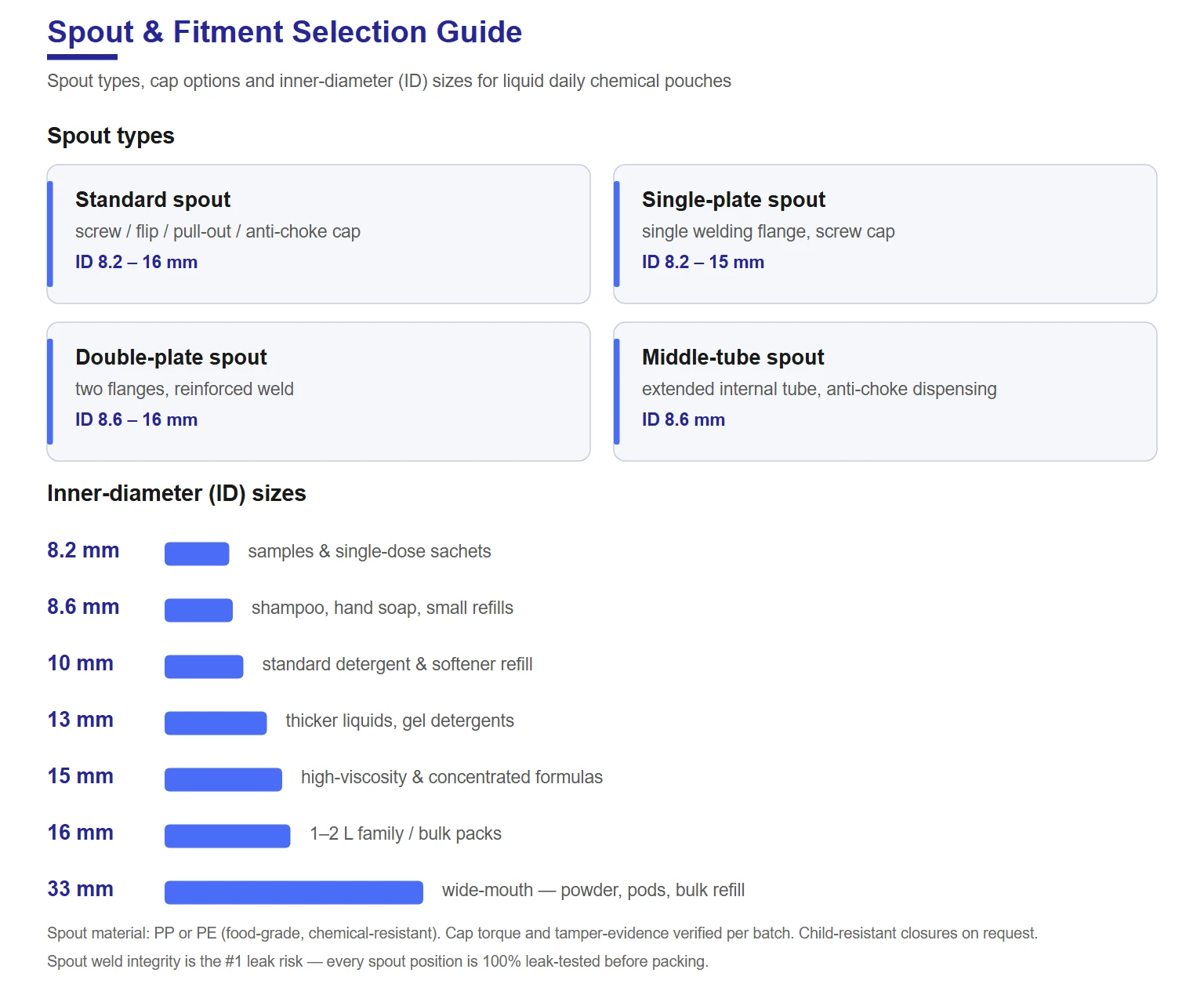
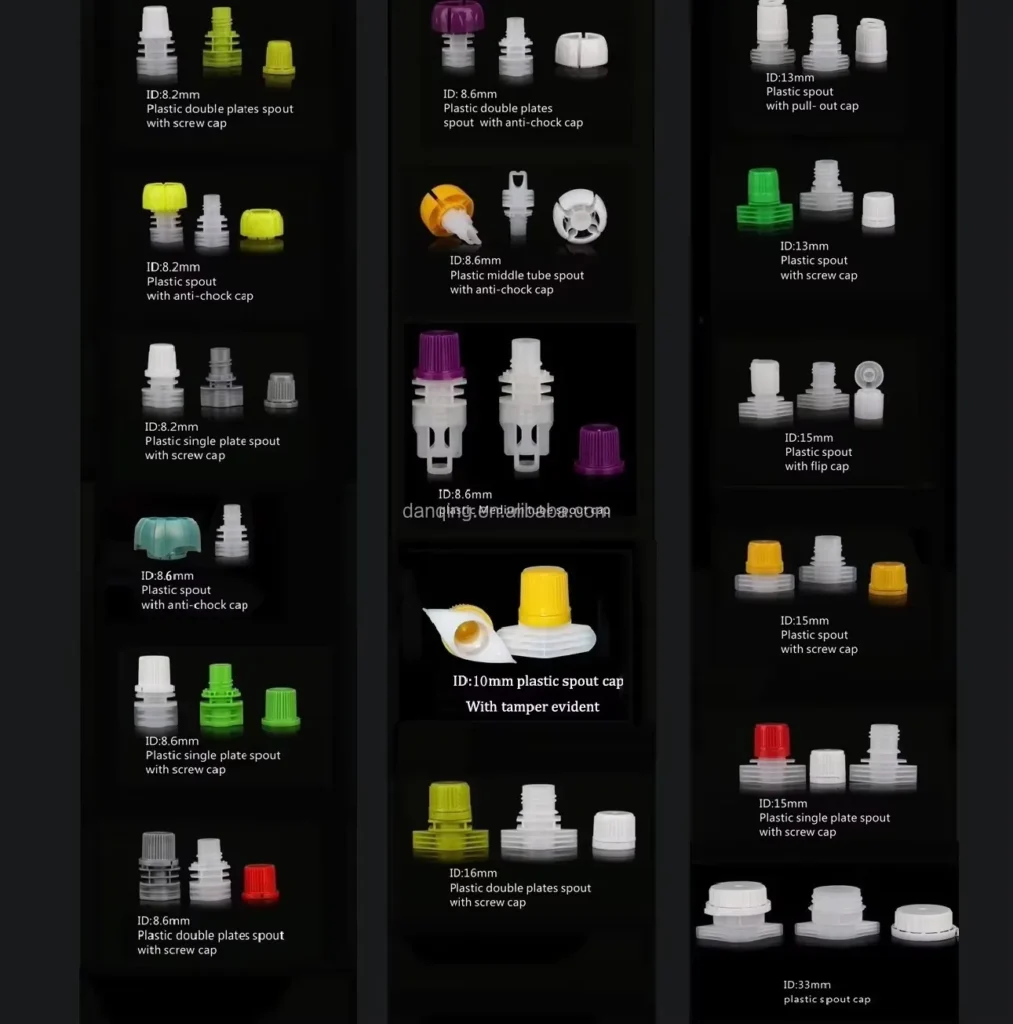
The spout is the highest-stress point on any liquid daily chemical pouch — it is where leak and dosing failures concentrate. Spout inner diameter (ID) controls flow rate and dosing precision; flange configuration controls weld strength; cap type controls child-resistance, tamper-evidence and single-hand dispensing.
| Spout Parameter | Options | Selection Logic |
|---|---|---|
| Inner diameter (ID) | 8.2 / 8.6 / 10 / 13 / 15 / 16 / 33 mm | Match to viscosity and dose: 8.6 mm for shampoo, 10 mm for standard detergent, 15–16 mm for gel / concentrated, 33 mm wide-mouth for powder and pods |
| Flange configuration | Single-plate / double-plate / middle-tube | Double-plate for reinforced weld on heavy or high-viscosity fills; middle-tube for smooth anti-choke dispensing |
| Cap type | Screw / flip / pull-out / anti-choke | Flip for one-hand use; anti-choke to prevent clogging; screw for security |
| Tamper evidence | Tear-off ring / induction seal | Mandatory for retail; signals first-use integrity |
| Child resistance | Push-and-turn / squeeze-lock | Required for hazardous or concentrated actives in most jurisdictions |
| Material | PP / PE (food-grade) | Chemical-resistant, weld-compatible with the CPP/PE sealant layer |
Spout weld integrity is the #1 leak risk in spout pouches. Every spout position is 100% leak-tested before packing — and we validate weld temperature, pressure and dwell on a per-batch basis, not just at first article.
Key Product Parameters
Reference specifications for a standard daily chemical spout pouch. Any value marked customized is engineered to your product and fill line — these are starting points, not fixed limits.
| Parameter | Specification |
|---|---|
| Bag formats | Stand-up, spout, flat-bottom, 3-side seal, side-gusset, back-seal, roll film |
| Film structure | PET/AL/NY/CPP · PET/AL/NY/RCPP · PET/VMPET/PE · PET/NY/PE · PET/PE (customized) |
| Total thickness | 60 – 180 µm (customized) |
| Volume range | 5 ml – 5 L |
| Spout ID | 8.2 / 8.6 / 10 / 13 / 15 / 16 / 33 mm (PP / PE) |
| Printing | Up to 10-colour gravure, CMYK + Pantone, 175 LPI |
| Surface finish | Matte / gloss / soft-touch / spot UV / metallized (customized) |
| Closure | Screw / flip / pull-out / anti-choke cap, tamper-evident ring |
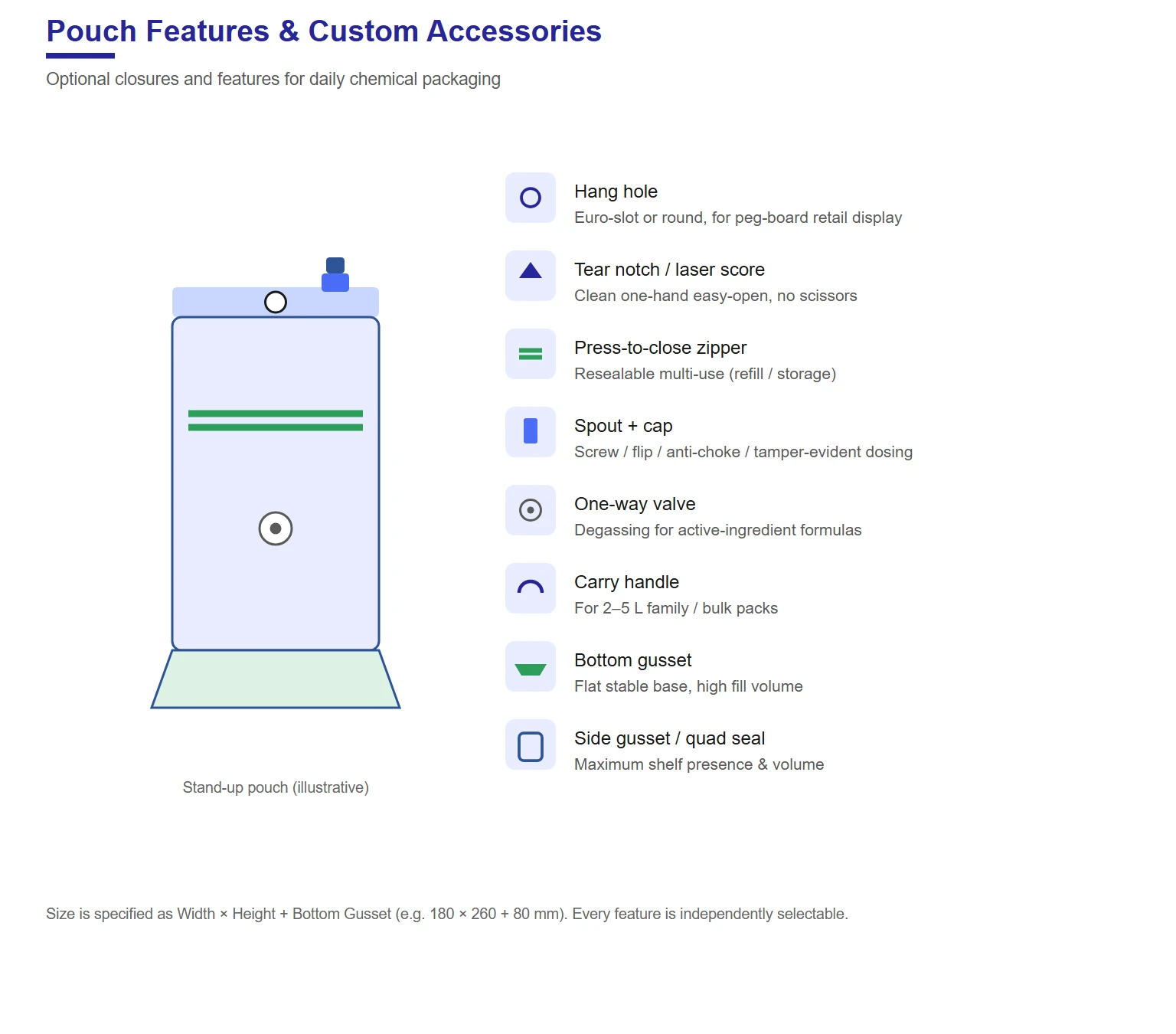
| Features | Zipper, hang hole, tear notch, one-way valve, carry handle, bottom gusset |
| MOQ | 5,000 pieces (spout pouch) — customized by size |
| Sample lead time | 3 – 5 days (pre-production) |
| Production lead time | 12 – 20 days after artwork approval |
| Certifications | ISO 9001, BRCGS, FDA, SEDEX, REACH, RoHS, Prop 65 |
| Shelf-life support | 12 – 36 months depending on structure and fill |
Process Compatibility — Fill, Seal & Sterilization
The film structure must survive not just the product but the fill process — hot-fill, pasteurization, retort or aseptic. Specifying the wrong sealant for your process temperature is the most common cause of post-fill seal failure.
| Process | Temperature / Time | Required Structure | Notes |
|---|---|---|---|
| Cold fill | Ambient | PET/NY/PE, PET/AL/NY/CPP | Standard for most liquid detergents |
| Hot fill | 60 – 90 °C | PET/AL/NY/CPP, PET/NY/CPP | Sealant must resist heat distortion |
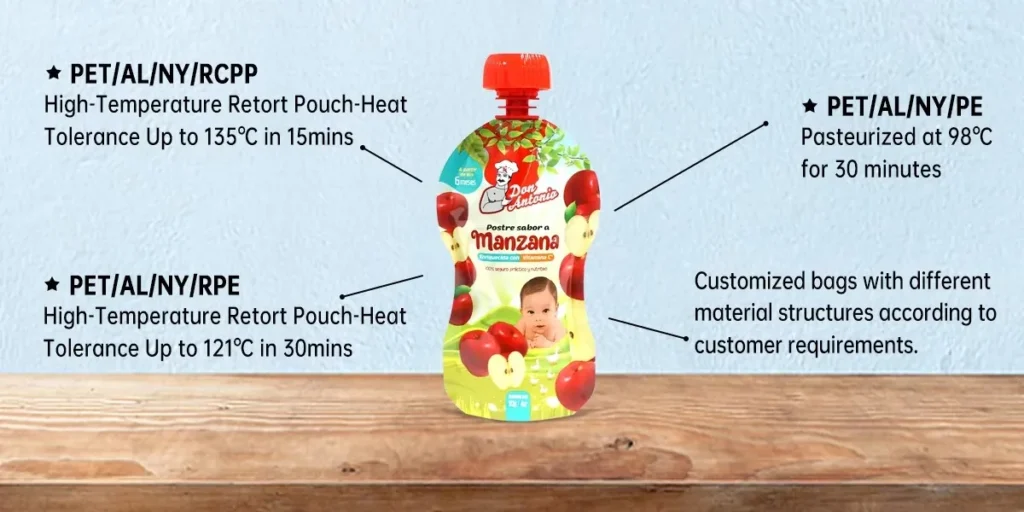
| Pasteurization | 98 °C / 30 min | PET/AL/NY/PE | Verified per our material chart |
| Retort | 121 °C / 30 min | PET/AL/NY/RPE (RCPP) | Retortable sealant required |
| High-temp retort | 135 °C / 15 min | PET/AL/NY/RCPP | Full in-pack sterilization |
| Aseptic (UHT) | Sterile fill | PET/AL/NY/CPP (aseptic) | Long ambient shelf life, no cold chain |
Regulatory & Compliance Matrix
Daily chemical packaging carries obligations food packaging does not — detergent-specific biodegradability rules, hazard labelling, and chemical registration. This matrix is the compliance checklist we maintain for every export shipment.
| Regulation / Standard | Scope | What It Covers |
|---|---|---|
| FDA 21 CFR 177.1520 / 177.1630 | USA | Polyolefin film resin compliance for personal-care contact |
| EU Detergents Regulation (EC 648/2004) | EU | Surfactant biodegradability & ingredient declaration |
| CLP / GHS (EC 1272/2008) | EU | Hazard classification and labelling of the packaged chemical |
| REACH (EC 1907/2006) | EU | SVHC-free materials and chemical registration |
| California Proposition 65 | USA (CA) | No listed chemicals above safe-harbour limits |
| ISO 22716 | Global | Cosmetics GMP for manufacturing hygiene |
| BRCGS Packaging | Global | Packaging safety and quality management audit |
| ISO 9001:2015 | Global | Quality management system |
| ISO 22000 | Global | Food safety (HACCP) where applicable |
| UN TDG / IMDG | Global | UN-certified packaging for dangerous-goods transport |
Sustainability & Refill Pouch Structures
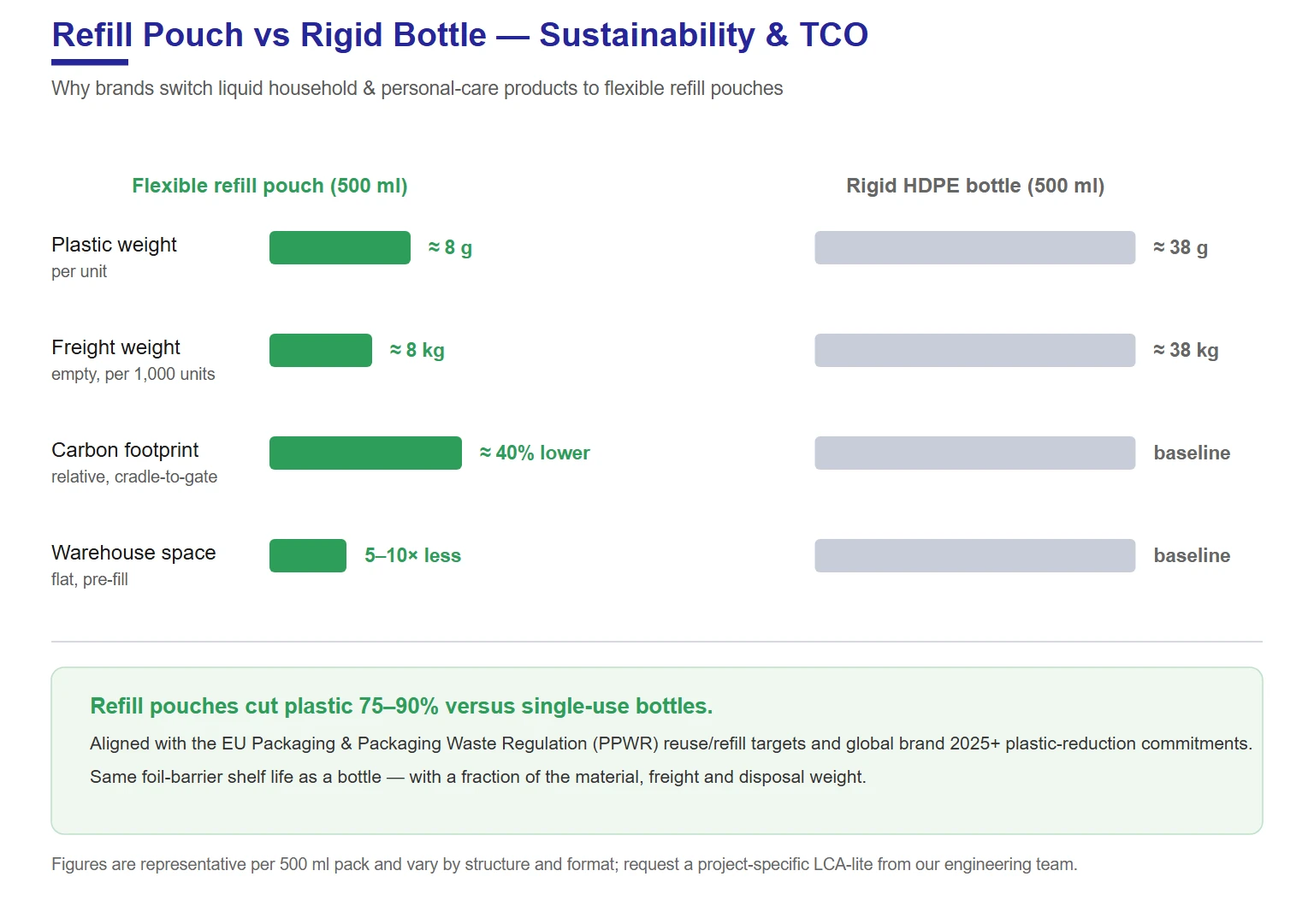
The refill pouch is the fastest-growing format in daily chemical packaging, driven by the EU Packaging & Packaging Waste Regulation (PPWR) and brand plastic-reduction commitments. A refill pouch uses a fraction of the plastic of a single-use bottle — and, in a foil or metallized structure, delivers the same barrier and shelf life.
| Structure | Recyclability | Barrier | Best For | Trade-off |
|---|---|---|---|---|
| Mono-material PE (MDO-PE/PE) | Store drop-off / flexible PE | Moderate | Refill pouches | Narrower seal window |
| Mono-material PP | Curbside (varies) | Moderate | Stand-up pouches | Stiffness, cost |
| PCR content (30 – 50%) | Partial | Per base structure | Sustainability-led brands | Colour / batch consistency |
| Metallized mono PE | Store drop-off | High | Transparent + barrier | Cost |
| Compostable (PLA / PBAT) | Industrial compost | Low – moderate | Niche eco brands | Moisture sensitivity |
| Foil laminate (PET/AL/PE) | Not recyclable, lowest cost | Very high | Long shelf life | End-of-life |
Total Cost of Ownership vs Rigid Bottles
Procurement teams compare pouch against bottle on unit price — and miss the real story. When freight, warehousing, carbon and disposal are included, the flexible pouch wins on every axis except, in some cases, filling-line capex. Run your own numbers against this table.
| Factor | Flexible Refill Pouch (500 ml) | Rigid HDPE Bottle (500 ml) | Pouch Advantage |
|---|---|---|---|
| Material per unit | ≈ 8 g | ≈ 38 g | ≈ 80% less plastic |
| Freight (empty, per 1,000) | ≈ 8 kg | ≈ 38 kg | ≈ 82% lighter |
| Carbon (cradle-to-gate) | ≈ 40% lower | Baseline | Lower CO₂e |
| Warehouse (pre-fill) | Flat, 5–10× less space | Bulky | Space saving |
| Filling line | Spout / FFS or pre-made | Blow-mould + fill | Capex trade-off |
| Shelf life | Equal (foil barrier) | Equal | No compromise |
| Retail & display | High impact, flexible | Standard | Brand story + sustainability |
Applications by Product Category
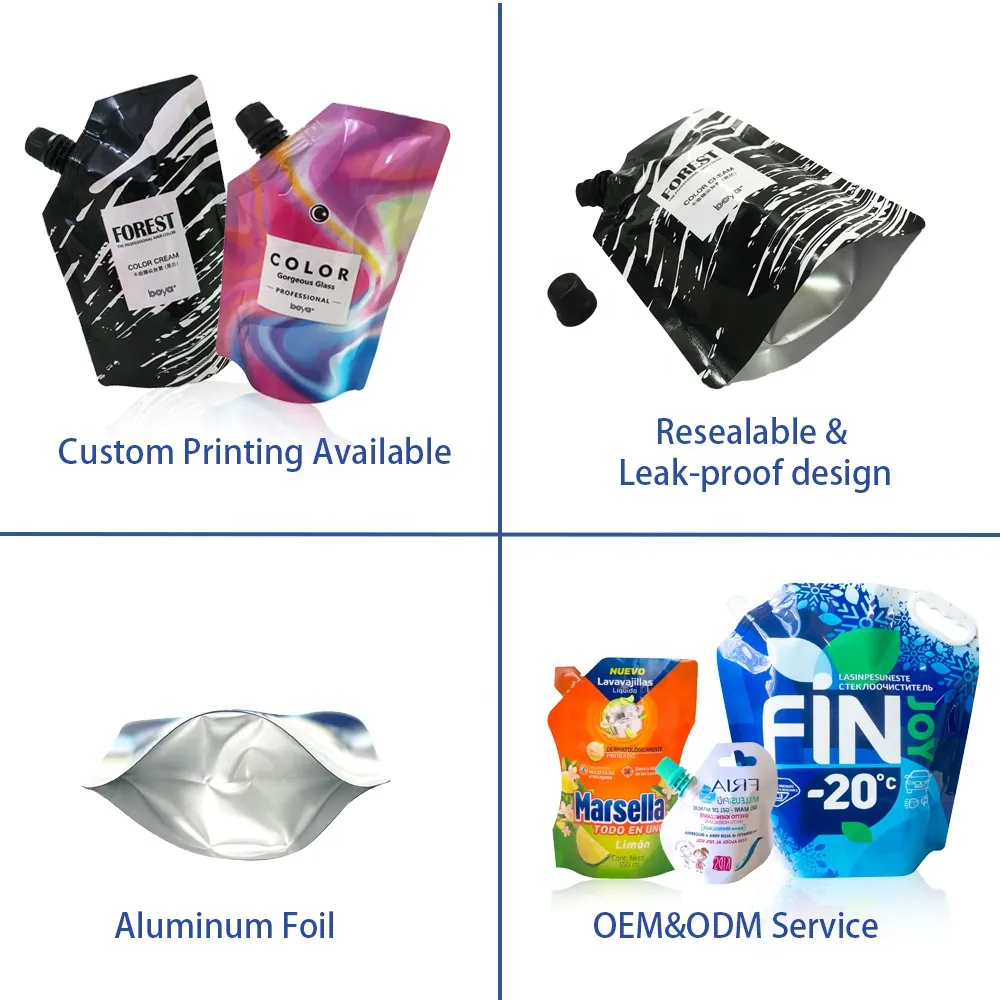
- Laundry care — liquid detergent, fabric softener, stain removers, laundry pods (spout, stand-up, flat-bottom, easy-peel)
- Dish care — dishwasher liquid, tablets, rinse aid, descalers (stand-up, side-gusset, easy-peel)
- Personal care — shampoo, conditioner, body wash, hand soap, shower gel (spout, stand-up, 3-side seal sachets)
- Household cleaning — surface cleaners, floor cleaners, glass cleaners, bleach (spout, stand-up, back-seal)
- Disinfection & hygiene — disinfectants, sanitizers, wet wipes, hygiene sachets (3-side seal, stand-up, flow-wrap)
- Fragrance & air care — perfume refills, diffuser refills, air freshener gels (high-barrier foil pouches)
Customization Options
Every daily chemical bag is built to your brand and fill line. We take a design file or a napkin sketch and return a print-ready proof with a physical pre-production sample.
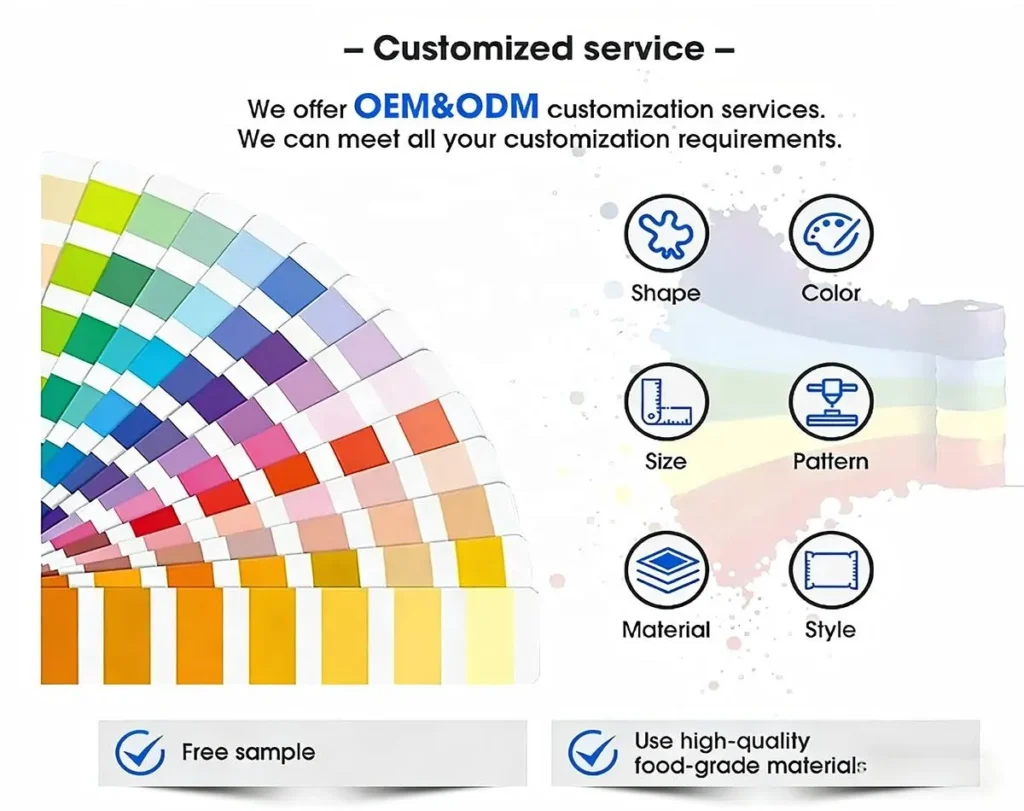
- Shape — stand-up, spout, flat-bottom, side-gusset, 3-side seal, custom die-cut silhouettes
- Size — any dimension from 5 ml sachets to 5 L family packs (specified Width × Height + Bottom Gusset)
- Colour — CMYK + Pantone spot matching up to 10 colours, 175 LPI gravure
- Pattern — full-bleed artwork, registered spot varnish, gradient and metallic effects
- Material — foil, metallized, transparent, mono-material, PCR, compostable structures
- Style — matte, gloss, soft-touch, spot UV, embossed or debossed finishing
Quality Control & Test Methodology
Every batch ships with a certificate of analysis tied to these tests. We test the film before lamination, the pouch after conversion, and the filled pack on compatibility — so a failure is caught in our lab, not on your shelf.
| Test | Standard / Method | What It Verifies | Specification |
|---|---|---|---|
| Seal strength | ASTM F88 | Heat-seal integrity | ≥ 20 N/15 mm (structure-dependent) |
| Leak / immersion | ASTM F2096 (bubble) | Pinholes, channel leaks | No leak at specified pressure |
| Drop test | ISTA 1A / in-house | Puncture & burst resistance | No rupture at 1.2 m |
| Burst strength | ASTM F2054 | Seal + film burst | ≥ 60 kPa |
| Oxygen transmission | ASTM D3985 | OTR barrier | Per structure spec |
| Moisture transmission | ASTM F1249 | WVTR barrier | Per structure spec |
| Chemical compatibility | Immersion 40–60 °C × 14–28 days | Seal / film integrity vs product | No delamination, seal intact |
| Odour / taint | Robinson sensory panel | Off-odour / taint transfer | No detectable taint |
| Cap / spout torque | ASTM D3470 | Closure torque | Per closure spec |
| Accelerated aging | 40 °C / 75% RH × 90 days | Shelf-life stability | Within spec |
Failure Modes & Prevention — Read This Before You Spec
Engineers: this is the table your supplier should be able to walk through line by line. If they cannot explain how they prevent each failure mode, keep looking. We publish it because preventing these eight failures is exactly what a daily chemical bag specialist does.
| Failure Mode | Root Cause | Detection | Prevention |
|---|---|---|---|
| Spout weld leak | Insufficient weld temperature / pressure, contamination | 100% leak test | Optimized weld profile + per-batch validation |
| Delamination | Aggressive surfactant / essential-oil attack | Immersion compatibility test | Correct sealant + compatibility testing |
| Seal creep (cold flow) | High-alkali / hot-fill softening the sealant | Seal strength over time | Higher-MW sealant resin |
| Stress cracking | Bleach / oxidizer + flex fatigue | Visual + microscopy | Oxidation-resistant PE |
| Pinholing | Foil flex-crack, filler abrasion | Leak test | Nylon reinforcement, correct gauge |
| Aroma loss | Insufficient fragrance barrier | GC headspace analysis | Foil or EVOH barrier layer |
| Odour transfer | Ink / adhesive migration | Robinson sensory test | Low-migration inks, fully cured lamination |
| Drop rupture | Thin gauge, sharp product geometry | Drop test | Nylon reinforcement, gauge increase |
How to Measure & Specify Your Bag
Get the spec right the first time. A daily chemical bag is dimensioned as Width × Height + Bottom Gusset — in millimetres, flat, unsealed. Getting the gusset wrong is the most common cause of a fill-line or shelf-display mismatch.
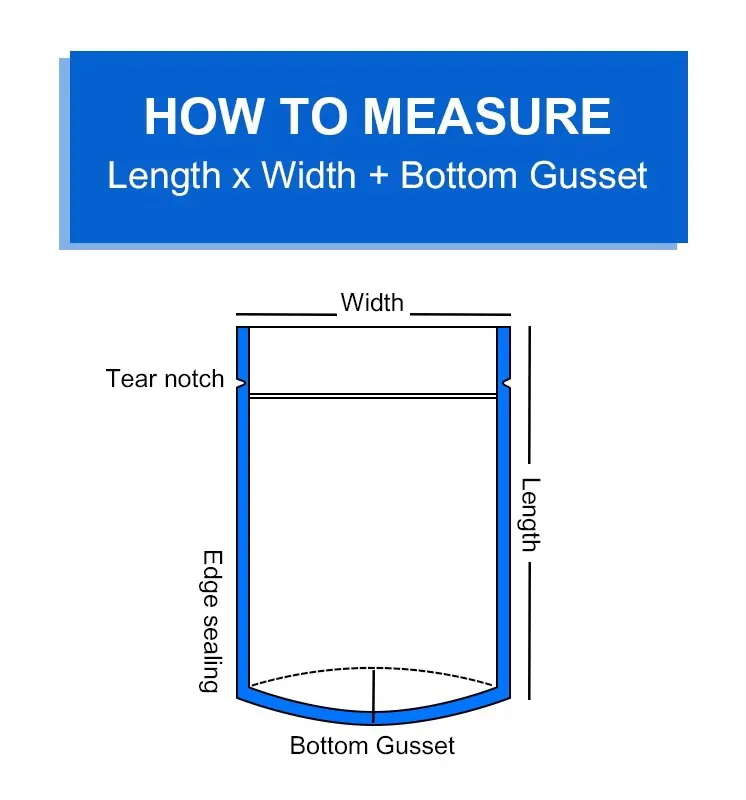
- Measure the width across the flat bag face (mm).
- Measure the height from the top seal to the bottom edge (mm).
- Measure the bottom gusset depth when fully opened (mm) — add this after the height.
- Specify the tear notch and edge sealing position if required.
- State fill volume (ml), product viscosity, and fill temperature — these drive structure and spout ID.
- Confirm the hang hole, zipper, spout, valve or handle options from the feature list above.
MOQ, Pricing Factors & Lead Time
Price is a function of seven variables. Understand them and you can engineer cost out without compromising barrier or seal integrity — and you will never be surprised by a quote.
| Pricing Driver | Impact |
|---|---|
| Order quantity | MOQ 5,000 (spout pouch); volume breaks at 10k / 50k / 100k+ pieces |
| Film structure | Foil + nylon highest cost; PET/PE lowest |
| Print colours | Up to 10-colour; each additional colour adds a gravure cylinder |
| Spout & closures | Spout type, child-resistant and tamper-evident features add cost |
| Size & thickness | Larger / thicker packs consume more material |
| Surface finish | Matte, soft-touch and spot-UV are premium add-ons |
| Certification & testing | BRCGS / ISO audits included; per-order lab testing quoted separately |
Typical timeline: artwork proof 2–3 days → pre-production sample 3–5 days → mass production 12–20 days after approval. Rush orders available for re-orders with approved artwork.
Production Process
From artwork to carton, every daily chemical bag passes through nine controlled stages. Knowing the process is how you verify a supplier is actually a manufacturer, not a trading company reselling someone else’s film.
- Artwork & pre-press — file review, colour separation, cylinder engraving
- Gravure printing — up to 10-colour, computer-controlled ink dispensing for ΔE consistency
- Solvent-free lamination — Italian high-speed lines, low-migration adhesives
- Curing — controlled time/temperature for full adhesive cross-linking (kills odour transfer)
- Slitting — master roll to working widths
- Bag making — forming, sealing, gusseting, spout welding
- 100% leak & visual inspection — every spout position tested
- QC sampling — seal strength, burst, drop, barrier (ASTM methods above)
- Packing & export — cartons, palletized, full documentation
Supplier Evaluation Checklist — 18 Points
Use this checklist when vetting any daily chemical bag supplier — including us. A supplier that passes all 18 is rare; one that cannot answer the compatibility questions (9–12) is a red flag regardless of price.
- Are they a manufacturer with in-house printing and lamination (not a trading company)?
- Do they hold BRCGS Packaging and ISO 9001 — and can they show current certificates?
- Can they provide FDA / EU food-contact and REACH / RoHS declarations on request?
- Do they run solvent-free lamination, and can they prove low-migration adhesive curing?
- What is their actual gravure print capability — colours, LPI, and Pantone ΔE tolerance?
- Do they maintain a documented chemical-compatibility test protocol for daily chemical actives?
- Can they recommend a sealant and structure from your SDS, not just a generic film?
- Do they test OTR / WVTR in-house or via accredited lab, and share the certificates?
- What is their spout weld validation protocol — per batch or first-article only?
- Do they 100% leak-test spout pouches before packing?
- What is their failure-mode prevention documentation for delamination and stress-cracking?
- Can they supply a pre-production sample for your fill-line and compatibility testing?
- What is the real MOQ and volume-break pricing — and is it written?
- What is the lead time from artwork approval, and is it contractually guaranteed?
- Do they support mono-material / PCR / compostable structures if your roadmap requires them?
- What is their QC sampling plan and certificate-of-analysis policy per batch?
- Can they handle UN-certified dangerous-goods packaging if your product requires it?
- Do they have export references in your target market with verifiable client names?
Market Intelligence — Why Daily Chemical Packaging Is Moving to Pouches
The global flexible packaging market is worth roughly $290 billion and growing ~4.5% annually — but the daily chemical / personal-care segment is growing faster, pulled by the refill-pouch megatrend. Three forces are compounding:
- Regulation — the EU PPWR mandates reuse and refill targets, making flexible refill pouches the lowest-cost compliance path for liquid household products
- Brand commitments — P&G, Unilever and Henkel have public plastic-reduction and refill targets through 2025–2030, converting rigid SKUs to pouches
- E-commerce & concentration — concentrated formulas and online retail favour lighter, space-efficient, damage-resistant flexible packs
For Amazon sellers and distributors, the implication is direct: a foil-barrier refill pouch delivers bottle-grade shelf life at a fraction of the freight and storage cost — while the sustainability story differentiates the listing. Early movers are capturing both margin and search visibility in the daily chemical bag category.
Frequently Asked Questions
What is a daily chemical bag?
A daily chemical bag is a flexible, multi-layer laminate pouch engineered to contain and dispense household and personal-care products — liquid detergent, fabric softener, dishwasher liquid, shampoo, body wash, surface cleaners, bleach and disinfectants. Its film structure and sealant are selected to withstand aggressive ingredients (surfactants, enzymes, oxidizers, solvents, essential oils) that would attack ordinary food-grade film.
What material is used for detergent pouches?
Most liquid detergent pouches use a foil laminate such as PET/AL/NY/CPP, which delivers an oxygen transmission rate (OTR) below 0.5 cc/m²·day and water-vapour transmission rate (WVTR) below 0.5 g/m²·day. Transparent detergent pouches use PET/NY/PE. The sealant layer (CPP or PE) is chosen for chemical resistance to the specific formula.
How do I choose the right film structure for my liquid detergent?
Work backwards from three factors: (1) product chemistry — the sealant must resist your surfactants, solvents and fragrance; (2) shelf-life and aroma target — a foil or metallized barrier for long shelf life, transparent for marketing-led packs; (3) fill process — retort, hot-fill or pasteurization dictates the sealant grade. Provide your SDS and we return a recommended structure with a compatibility test.
What is the minimum order quantity (MOQ) for custom daily chemical bags?
Our MOQ starts at 5,000 pieces for spout pouches and can be customized by bag size and structure. Volume pricing breaks apply at 10,000, 50,000 and 100,000+ pieces. A free pre-production sample is provided before you commit to mass production.
How do you prevent leakage in spout pouches?
Leakage is prevented through four controls: correct spout-to-sealant material matching (PP/PE spout welded to a CPP/PE sealant), validated weld temperature/pressure/dwell per batch, 100% leak-testing of every spout position before packing, and a reinforced double-plate flange on heavy or high-viscosity fills.
Are daily chemical bags recyclable or sustainable?
Yes — we offer mono-material PE and PP structures that are store-drop-off or curbside recyclable, plus PCR-content and industrial-compostable options. A foil refill pouch still cuts plastic by 75–90% versus a single-use HDPE bottle even when the pouch itself is not mechanically recyclable, which is why refill pouches are the dominant sustainability format in the category.
What certifications do you hold?
ISO 9001:2015, BRCGS Packaging, FDA food-contact compliance, SEDEX (ethical audit), and REACH / RoHS / Proposition 65 declarations. We can also supply UN-certified dangerous-goods packaging where a product requires it.
How long does custom printing and production take?
Artwork proof takes 2–3 days, the pre-production sample 3–5 days, and mass production 12–20 days after artwork approval. Re-orders with approved artwork ship faster. We provide a guaranteed lead time in writing with every quotation.
Key Takeaways
- A daily chemical bag is an engineered laminate, not a commodity — the sealant must be matched to your surfactants, solvents and fragrance, or the pouch fails on shelf
- Barrier (OTR / WVTR), sealant chemistry and fill-process temperature are the three variables that determine shelf life and leak resistance
- The spout weld is the highest-risk point — demand 100% leak testing and per-batch weld validation
- A foil refill pouch delivers bottle-grade shelf life at 75–90% less plastic, lower freight and lower carbon
- We are an ISO 9001 / BRCGS-certified manufacturer with in-house 10-colour gravure and solvent-free lamination — MOQ 5,000, samples in 3–5 days
Start Your Daily Chemical Bag Project
Send your product SDS, target volume and a reference image, and our engineering team will return a recommended structure, compatibility test plan and quotation within 24 hours — plus a free pre-production sample for your fill line. Whether you are an established brand converting rigid SKUs to refill pouches, an Amazon seller launching a private-label detergent, or a distributor building a house brand, we treat your project as an engineering engagement, not a transaction.
You Also May Like

Ready to Improve Your Packaging Supply Chain?
Whether you are looking for a new packaging supplier, a backup manufacturer, or a trusted sourcing partner, We are ready to support your business.