
Custom NFC Wristband
— Engineered Contactless Credentials for Events, Access & Cashless Payment
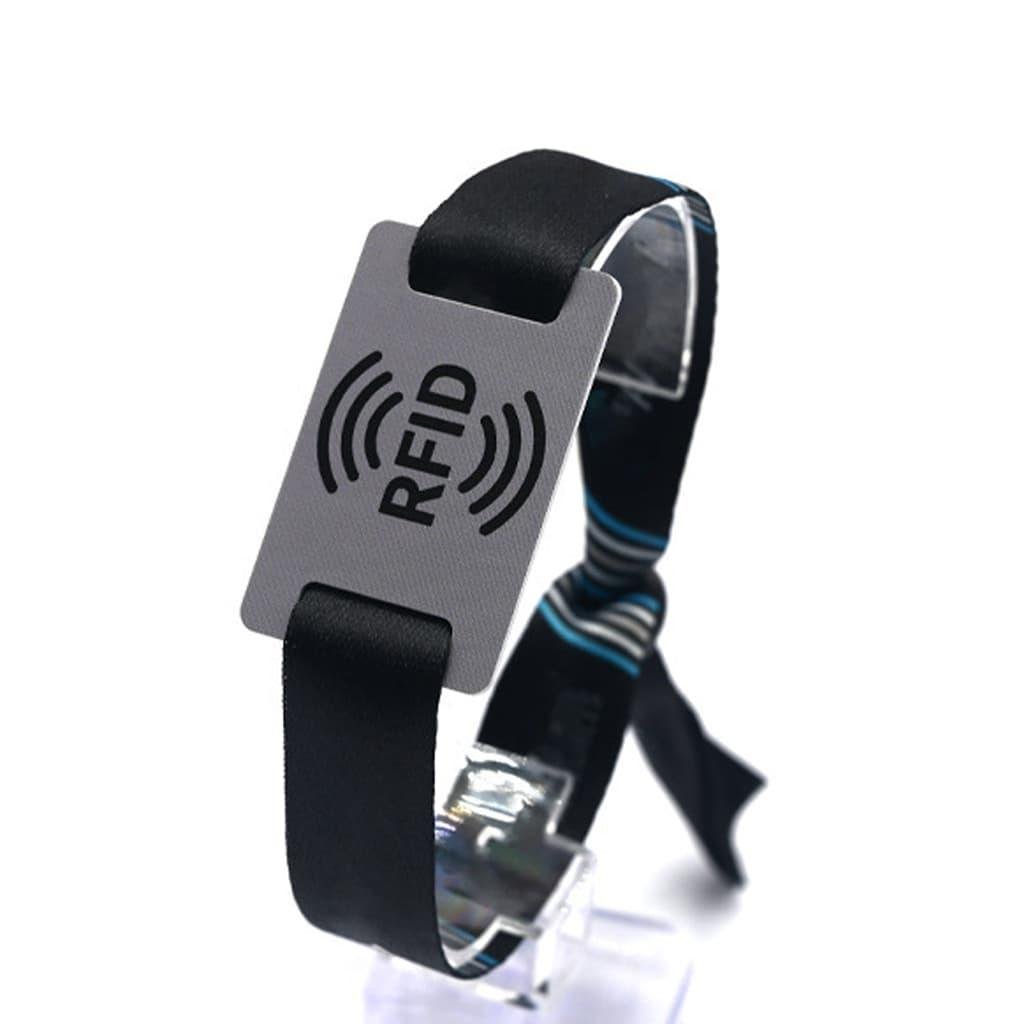
A custom NFC wristband is a wearable 13.56 MHz contactless credential — a passive NFC chip and tuned antenna sealed inside an elastic, silicone, vinyl or woven band. It replaces paper tickets and barcodes with tap-and-go entry, cashless payment and real-time attendee data.
What Is an NFC Wristband & Why It Replaces the Paper Ticket
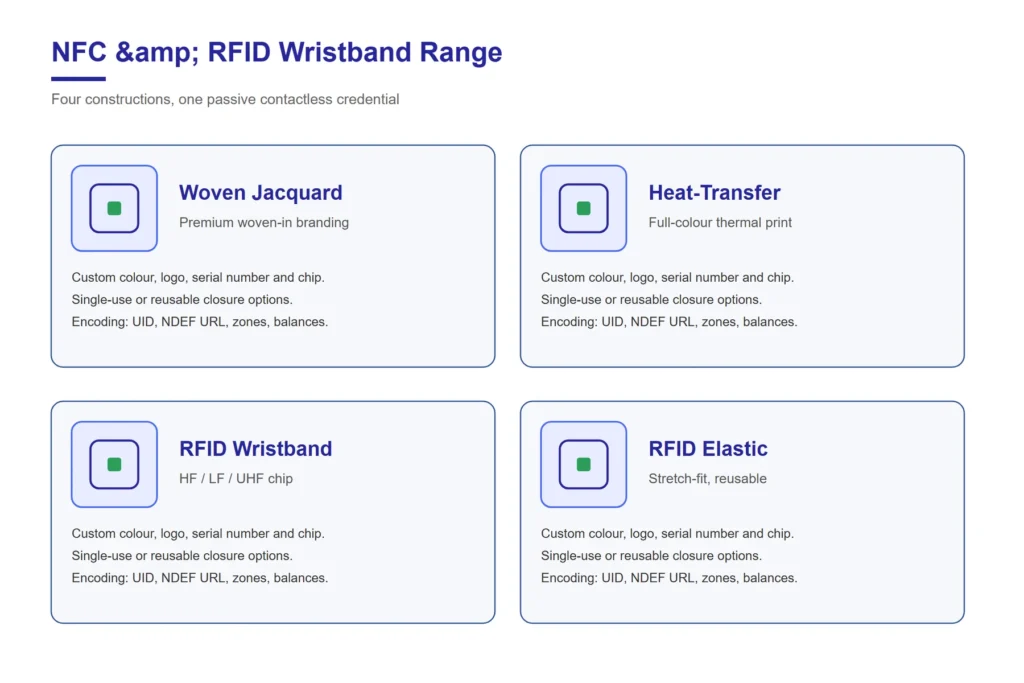
An NFC (Near Field Communication) wristband is a passive, battery-free wearable that stores a unique identifier and, optionally, a small amount of user data (a URL, ticket ID, cashless balance or medical record). Tapped against a phone or reader, it authenticates the wearer in under 100 ms — no line of sight, no barcode to smudge, no app to open. For event organizers and facilities managers, that single capability collapses admission, cashless payment, access zoning and attendee analytics into one credential, typically lifting per-head spend by 15–30% over paper-ticket events.
What you can expect from this factory
- ISO 9001:2015 quality-managed manufacturing with full material traceability
- Genuine NXP & STMicroelectronics chips (NTAG®, MIFARE®, ICODE®) — no refurbished or clone dies
- Compliance documentation on file: RoHS, REACH, FCC Part 15, CE RED, Prop 65
- 100% electrical test and read-back verification on every single unit before shipment
- Free pre-production sample in 3–5 days; MOQ from 500 pieces
- 12–20 day lead time with encoding, serialization and custom packaging
NFC Wristband Anatomy: What Is Actually Inside the Band
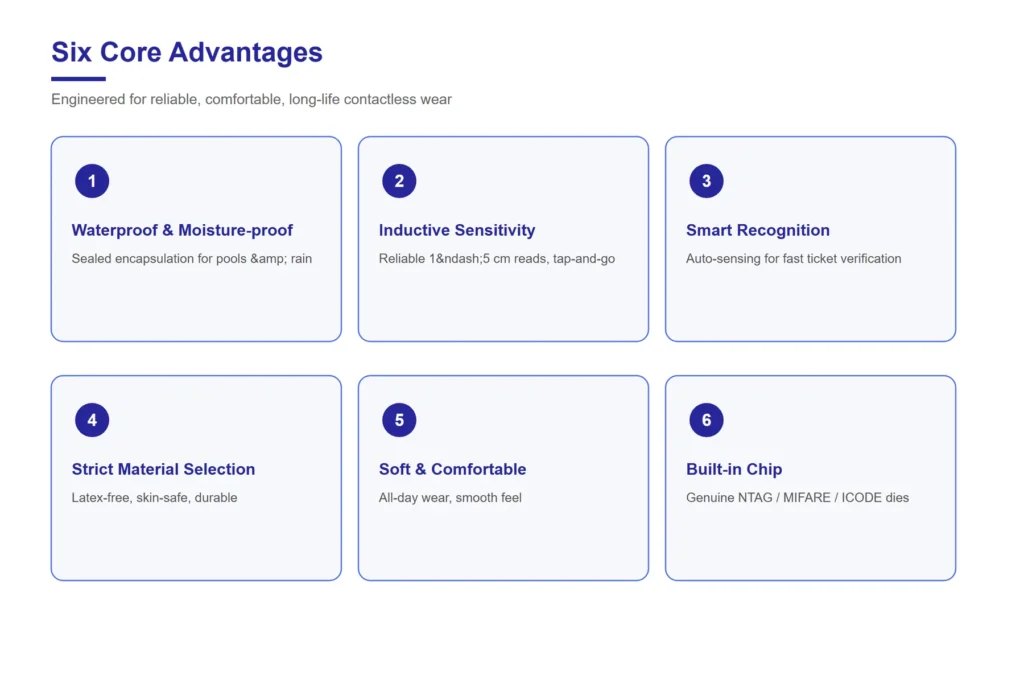
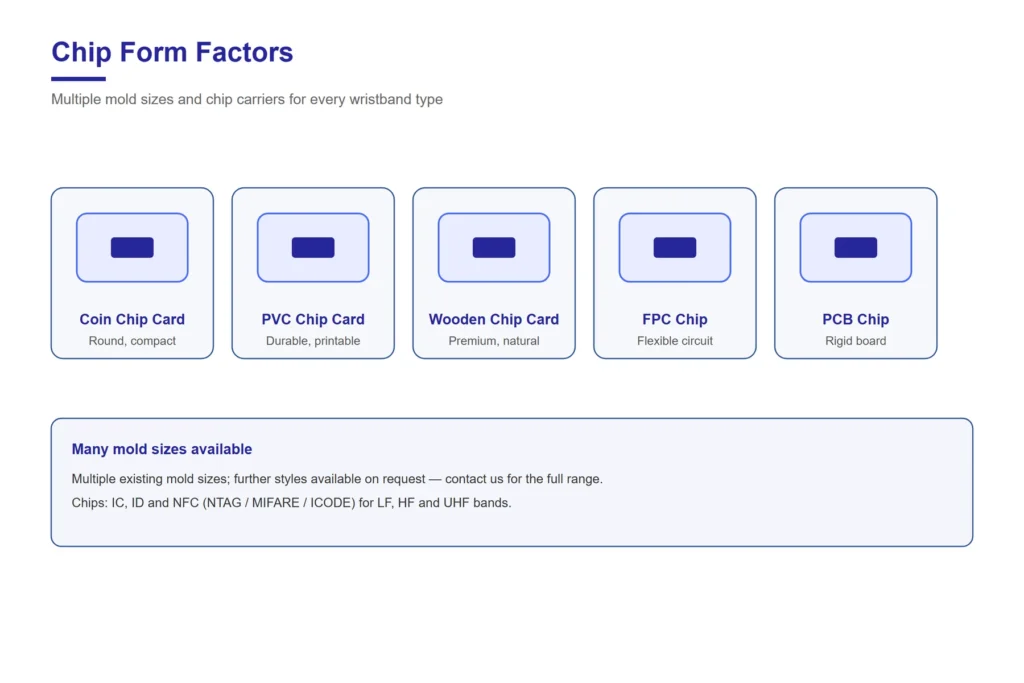
A wristband is not a “chip glued to a strap.” It is a layered RF assembly. Understanding the stack is the fastest way to specify a band that survives its event — and to avoid buying a band that reads perfectly on a bench but fails on a wrist. The four functional layers, plus the mechanical substrate and closure, determine read range, durability and cost.
| Layer / Component | Function | What to specify |
|---|---|---|
| NFC chip (die) | Stores UID + user memory; runs the ISO 14443-A air interface | Model (NTAG216, MIFARE Classic 1K, DESFire EV3…), memory size, security features |
| Antenna coil | Inductively couples to the reader field; powers the chip passively | Coil turns/geometry (drives read range), tuned to 13.56 MHz resonance |
| Inlay substrate | PET film carrier for antenna + chip (the “wet” or “dry” inlay) | Thickness, flex-crack resistance, strain-relief design |
| Encapsulation | PVC, TPU, silicone or resin overmold protecting the inlay from water, sweat and impact | IP rating, bonding method (lamination vs overmold), UV stability |
| Band substrate | Elastic, woven, silicone, vinyl or Tyvek strap the wearer feels | Material, width, comfort, allergen status (latex-free) |
| Closure / adjuster | Single-use lock, reusable slider or adjustable buckle | Tamper-evident vs reusable; one-way vs two-way |
| Print layer | Logo, sponsor, zone color, serial number | Thermal transfer, heat transfer, screen or laser — abrasion resistance |
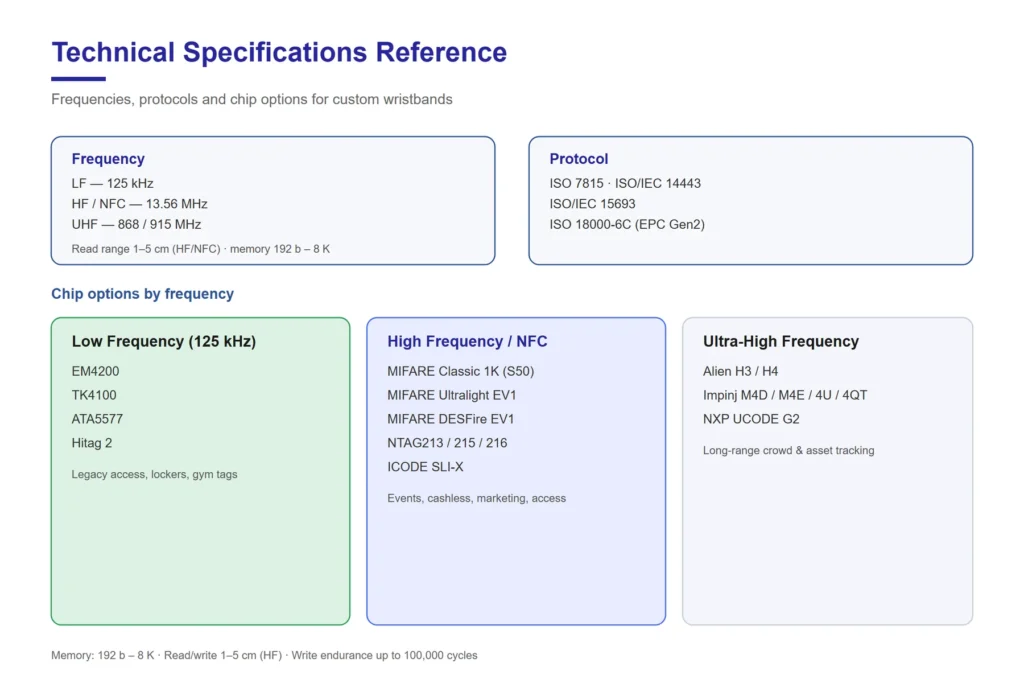
NFC Chip Selection Matrix: Memory, Security & Endurance
The chip is the single largest cost and capability driver. Choosing it wrong is the most common specification mistake we correct for buyers: an event needing only a tap-to-URL can use a 144-byte NTAG213, while a cashless-payment system with balance stored on-tag should step up to a MIFARE DESFire EV3 with AES-128 authentication. The matrix below gives the verified figures — note that user memory is not total memory (e.g. NTAG216 is 924 bytes total but only 888 bytes user-accessible).
| Chip | Protocol / Type | User Memory | UID | Write Endurance | Retention | Security | Best For |
|---|---|---|---|---|---|---|---|
| NTAG213 | ISO 14443-A / NFC Forum T2 | 144 B | 7-byte | 100,000 | 10 yr | Password + lock bits | Events, marketing, tap-to-URL |
| NTAG215 | ISO 14443-A / NFC Forum T2 | 504 B | 7-byte | 100,000 | 10 yr | Password + lock bits | Longer URLs, vCard, loyalty |
| NTAG216 | ISO 14443-A / NFC Forum T2 | 888 B | 7-byte | 100,000 | 10 yr | Password + lock bits | High-capacity content, multi-app |
| MIFARE Ultralight EV1 | ISO 14443-A | 80 B (128 B total) | 7-byte | 100,000 | 10 yr | Lock bits | Low-cost single-use access |
| MIFARE Classic 1K | ISO 14443-A | 1024 B (16 sectors) | 4/7-byte | 100,000 | 10 yr | Sector keys (CRYPTO1) | Legacy access-control readers |
| MIFARE DESFire EV2 / EV3 | ISO 14443-A | 2K / 4K / 8K | 7-byte | 500,000 | 25 yr | AES / 3DES / CMAC | Transit, campus, high-security payment |
| ICODE SLI-X | ISO 15693 (vicinity) | 112 B | 8-byte | 100,000 | 50 yr | Password | Longer-range HF, inventory |
| T5577 (LF) | 125 kHz | 330 bit | — | 100,000 | — | Password | Legacy LF readers, lockers |
| UCODE 8 (UHF) | EPC Gen2 / ISO 18000-6C | 128-bit EPC | — | 100,000 | 20 yr | — | Long-range crowd & vehicle tracking |
How to select the right chip (5-step method)
- Define the transaction — is the tag only an identifier (UID read) or does it carry data (URL, balance, ticket tier)?
- Confirm reader compatibility — match the chip to the readers/phonesthat will read it (ISO 14443-A, 15693, or EPC Gen2).
- Size the memory — leave ≥20% headroom over your largest NDEF record; never spec memory to the exact byte.
- Assess security — plain UID, password-protected write, or AES-authenticated (DESFire / NTAG424 DNA for brand protection).
- Lock the supply — require genuine NXP/ST dies with batch UID audit to block cloned or refurbished chips.
Frequency, Read Range & Why the Physics Matters
NFC wristbands operate in the 13.56 MHz high-frequency (HF) band and communicate by near-field inductive coupling: the reader’s coil generates a magnetic field that induces current in the tag’s antenna. Because coupling strength falls off sharply with distance, a compact wristband antenna yields a typical read range of 1–4 cm — short enough to be intentional (you must deliberately tap), long enough to be effortless. Two physics realities the buyer must respect: (1) a larger antenna coil gives more range, so a 15 mm inlay reads farther than an 8 mm one; and (2) the human body detunes the antenna — a band tuned in free air can lose 30–50% of its range once worn against skin, which is why qualified suppliers validate read range on a body phantom, not a bench.
| Frequency | Typical Range | Protocol | Strengths | Limits | Best For |
|---|---|---|---|---|---|
| LF 125 kHz | 1–10 cm | EM / proprietary | Immune to body & water; very cheap | Slow data, little/no encryption | Legacy access, lockers, gym tags |
| HF / NFC 13.56 MHz | 1–4 cm (wristband) | ISO 14443-A / 15693 / NFC | Phone-compatible, secure, multi-application | Short range by design | Events, cashless payment, marketing, access |
| UHF 860–960 MHz | 1–10 m | EPC Gen2 (ISO 18000-6C) | Long range, bulk/anti-collision reads | Detunes near body & liquids | Crowd analytics, parking, logistics |
Band Materials & Encapsulation: Matching Durability to the Event
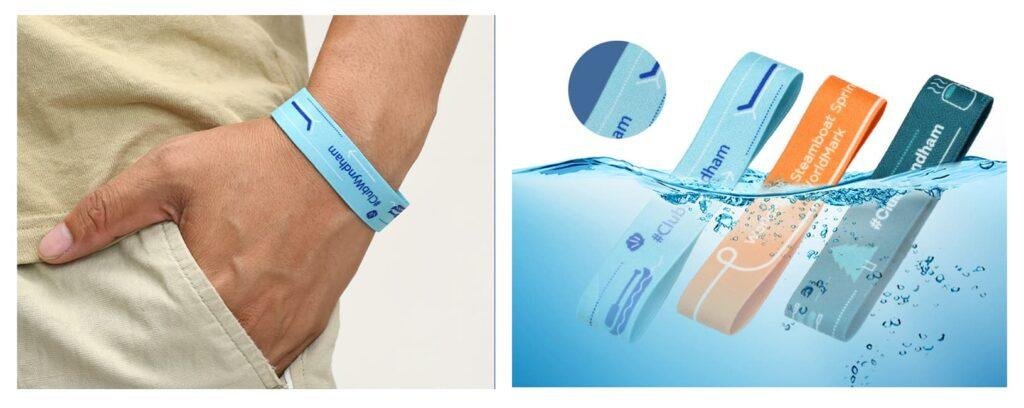
Material choice is a three-way trade between wearer comfort, durability and unit cost. A one-day festival can use an elastic or Tyvek band at the low end; a water park or multi-day resort needs a fully sealed silicone or PVC band rated IP67. The encapsulation method — flat lamination vs full overmold — is what separates a band that survives a shower from one that fails after 40 minutes in a pool.
| Material | Comfort | Water Resistance | Durability | Reusable | Print Method | Typical Use |
|---|---|---|---|---|---|---|
| Elastic (rubber/fabric) | High | Good | Medium | Yes | Thermal / heat transfer | Music festivals, conferences, gyms |
| Silicone | High | IP67 (sealed) | Very high | Yes | Laser + infill / pad print | Resorts, water parks, VIP access |
| PVC / Vinyl | Medium | Good | High | Yes | Thermal transfer / offset | Amusement parks, clubs, sports |
| Woven / polyester fabric | High | Good | High | Yes | Sublimation / woven-in | Multi-day festivals, hotels |
| Tyvek / paper | Medium | Low | Low | No (disposable) | Flexo / thermal | Single-day events, hospitals |
Regulatory, Compliance & Standards Matrix
For importers and enterprise buyers, documentation is a deliverable, not an afterthought. Below is the matrix we provide with every order; full declarations and test reports are issued on request. Passive NFC tags are treated as unintentional/passive devices under most RF regimes, but the active reader infrastructure you deploy alongside them carries its own certification burden — we flag the distinction so you do not get surprised at customs or in an auditor’s checklist.
| Standard / Directive | Scope | Relevance to NFC Wristbands |
|---|---|---|
| ISO/IEC 14443 (Type A/B) | HF proximity card air interface | Defines the NFC chip communication your readers must support |
| ISO/IEC 15693 | HF vicinity cards | ICODE-class chips for longer-range HF inventory |
| ISO/IEC 18000-6C (EPC Gen2) | UHF air interface | UHF wristbands for crowd & asset tracking |
| NFC Forum Type 2 / 4 / 5 | NFC tag platform spec | NDEF compliance so tags “just work” with phones |
| ISO/IEC 10373-6 | NFC conformance test methods | The test standard our QC lab executes on every batch |
| RoHS 2011/65/EU | Hazardous-substance restriction | Mandatory for EU / most global import |
| REACH (EC 1907/2006) | SVHC chemical registration | EU market; full declaration on file |
| California Prop 65 | Chemical exposure warnings | US market; material screening performed |
| FCC Part 15 | Unintentional radiators | Passive tags comply by design; readers need certification |
| CE RED 2014/53/EU | Radio equipment directive | Applies to the active reader; tags ship with CE declaration |
| EN 71 / CPSIA | Toy & child-product safety | Required for kids’ events and family venues |
Encoding, Data Structure & Security: What the Buyer Must Specify
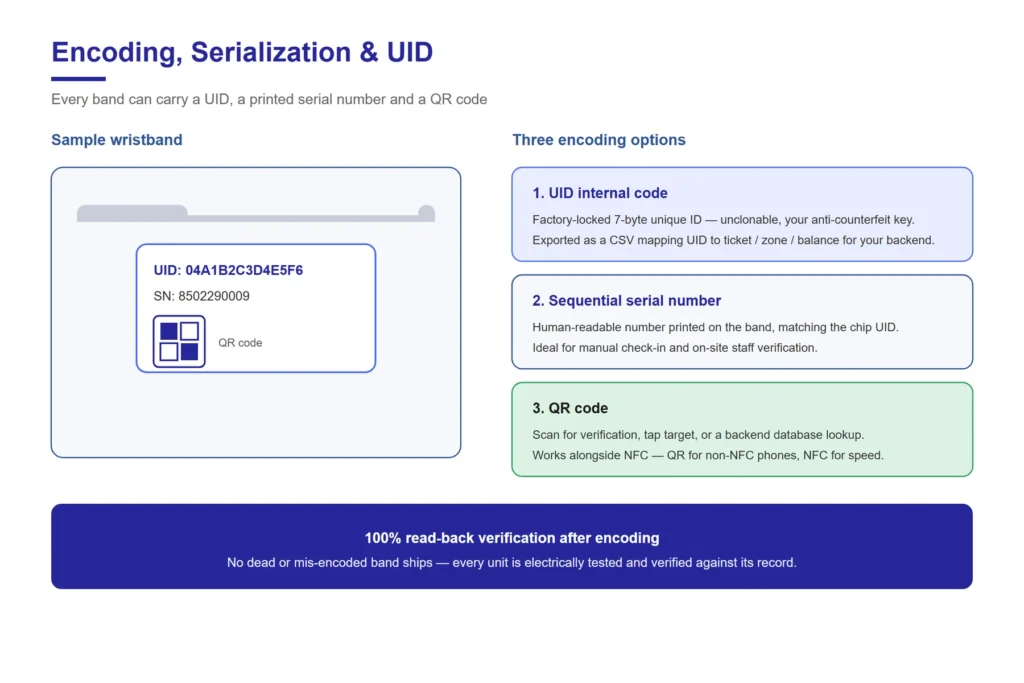
Most specification failures are not about the band — they are about what is written to it. Every NFC chip carries a factory-locked, globally unique 7-byte UID that cannot be cloned (this is your anti-counterfeit and database key). On top of that sits user memory, structured as NDEF records (URL, text, vCard, MIME) that any smartphone reads natively. The security controls below let you decide how the band behaves when someone tries to read or rewrite it.
| Feature | What It Does | Why It Matters to You |
|---|---|---|
| 7-byte UID | Factory-locked unique serial per chip | Anti-counterfeit, ticket-integrity, the key for your attendee DB |
| NDEF records | Standardized URL/text/vCard payloads | Tap-to-phone experiences with zero app install |
| Password protection | Blocks unauthorized writes (and reads, on DNA parts) | Prevents tampering with ticket tiers or balances |
| Lock bits | Permanently freeze memory pages | Makes data read-only and tamper-evident |
| Scan counter | Increments on every read | Engagement / sponsor-impression analytics |
| AES originality signature | Cryptographic proof of authenticity (NTAG424 DNA) | Brand protection & grey-market detection |
Encoding & serialization options we provide
- Sequential UID / number printing — human-readable serial matching the chip UID
- NDEF / URL encoding — pre-loaded tap targets (site, social, schedule, wallet)
- Database mapping — export a CSV mapping UID → ticket/zone/balance for your backend
- Remote deactivation — lost or voided bands flagged and blacklisted in your system
- Zone / tier programming — access levels and balances pre-loaded at the factory
Total Cost of Ownership: NFC Wristband vs Paper, QR, BLE & UHF
The unit price of a wristband is a small part of the real cost. A procurement director should compare credentials on total cost per attendee — including reader infrastructure, staff handling, fraud losses and the revenue upside of cashless & data capture. The table quantifies the trade-off; note the spend-uplift column, which is where NFC pays for itself many times over.
| Credential | Unit Cost | Reader Cost | Security | Data Capture | Spend Uplift | Reusable |
|---|---|---|---|---|---|---|
| Paper ticket + barcode | $0.01–0.05 | Low | Low (easily forged) | None | Baseline | No |
| Printed QR wristband | $0.05–0.15 | Low | Low–medium | Limited | Low | No |
| NFC wristband | $0.15–0.60 | Low–med (phone/reader) | High | Rich, real-time | +15–30% | Yes |
| UHF wristband | $0.20–1.00 | Medium–high | Medium | Bulk analytics | Moderate | Yes |
| BLE beacon | $3–10 | High | Medium | Rich | Moderate | Yes (battery) |
Why the uplift happens: removing the physical wallet and payment friction raises transaction speed and average spend; independent event-tech studies consistently report 15–30% higher per-head revenue at RFID-enabled events, with some large-festival operators citing up to 35%. That single metric usually justifies the switch before any operational saving is counted.
Applications by Industry
- Music festivals & concerts — multi-day access zoning, cashless bars, social-media taps
- Amusement & theme parks — rides access, locker keys, fast-pass, cashless concessions
- Conferences & exhibitions — badge-in-a-band, lead capture, session check-in
- Sports arenas & stadiums — season passes, VIP hospitality, contactless concessions
- Hotels & resorts — keyless room access, pool/spa, cashless dining, staff ID
- Gyms & clubs — member check-in, locker access, class booking
- Hospitals & patient ID — positive patient identification, allergy/medication records
- Corporate campuses & schools — staff/student access, attendance, cafeteria payment
- Water parks & cruise ships — fully sealed IP67 bands for wet environments
Customization Options
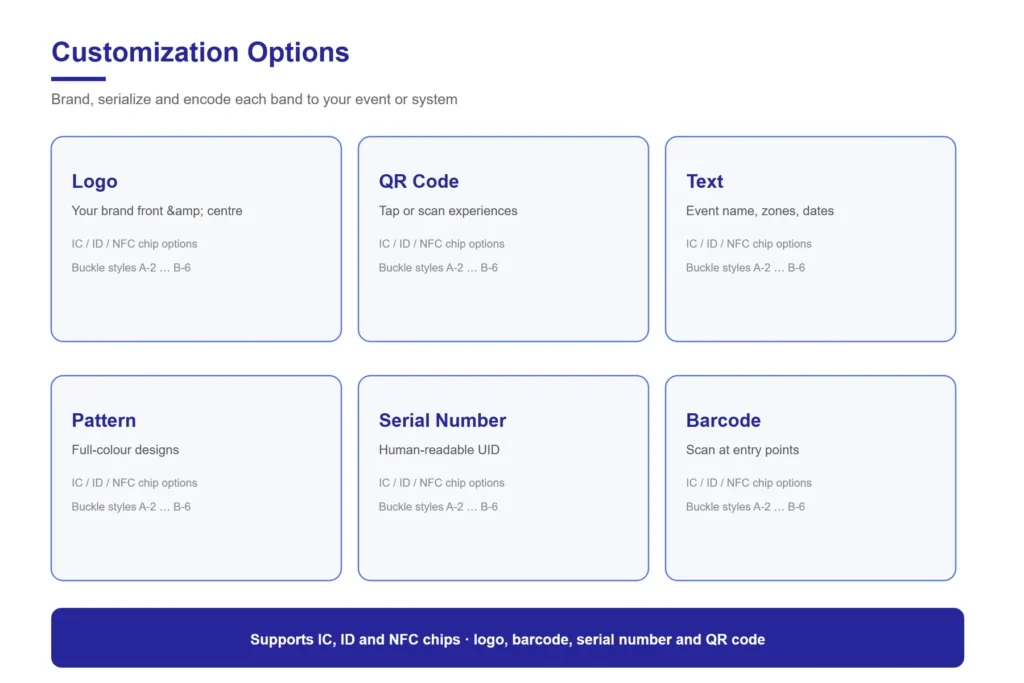
- Chip — NTAG213/215/216, MIFARE Classic / Ultralight / DESFire, ICODE, LF T5577, UHF UCODE
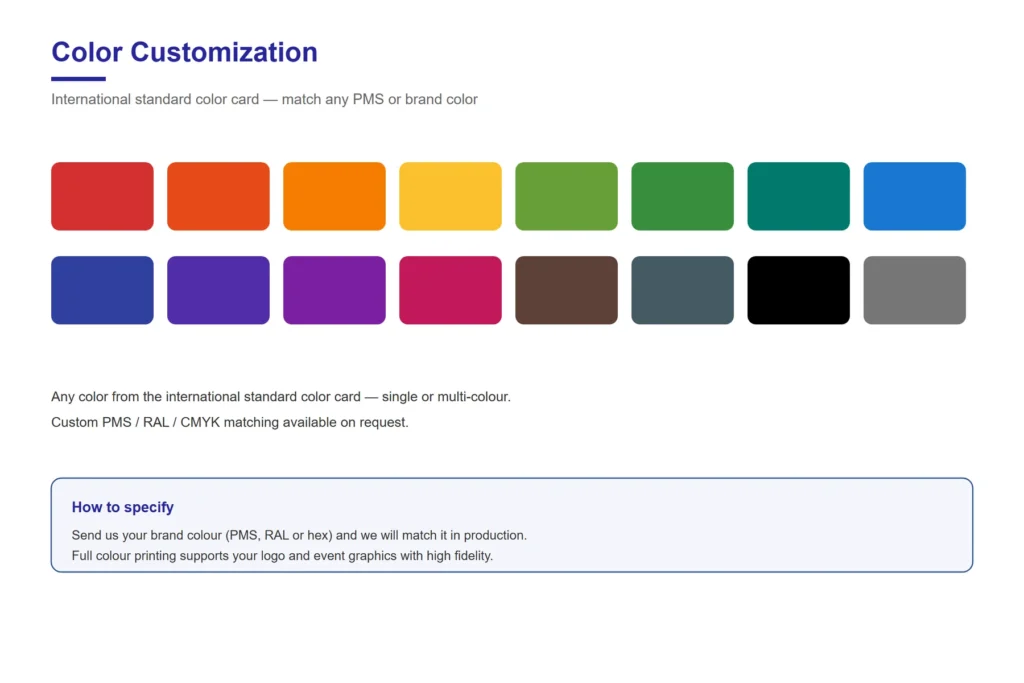
- Band material & color — elastic, silicone, PVC, woven, Tyvek; PMS-matched colors
- Printing — full-color thermal transfer, heat transfer, screen, sublimation, laser + infill
- Serialization — sequential numbering, barcode, QR, human-readable UID
- Encoding — UID mapping, NDEF URL/text, access zones, cashless balances
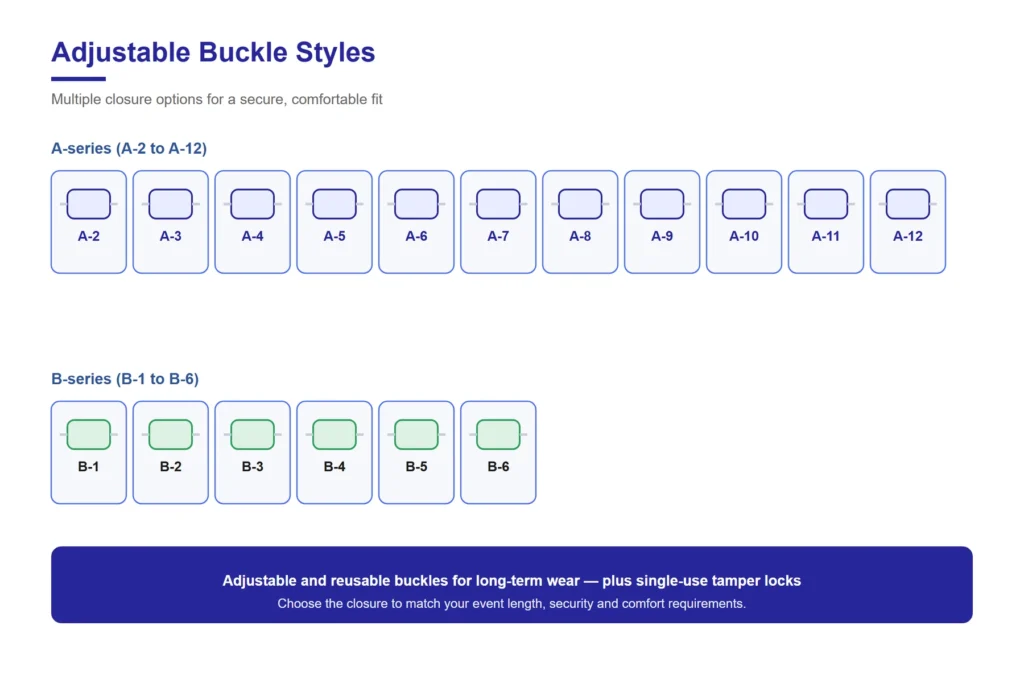
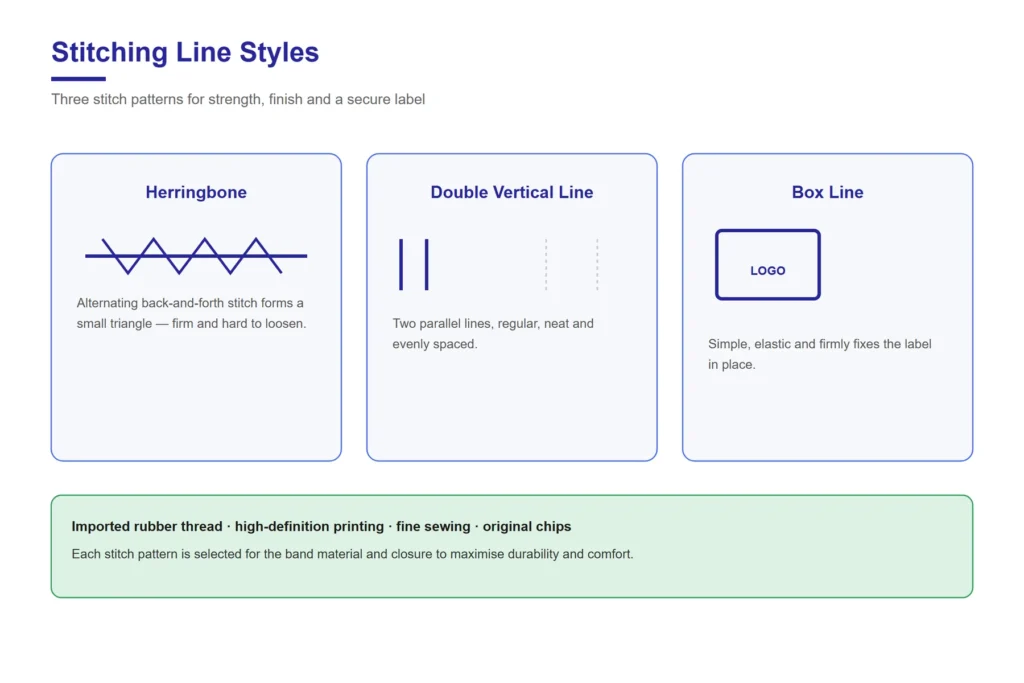
- Closure — single-use tamper lock, reusable slider, adjustable buckle, snap
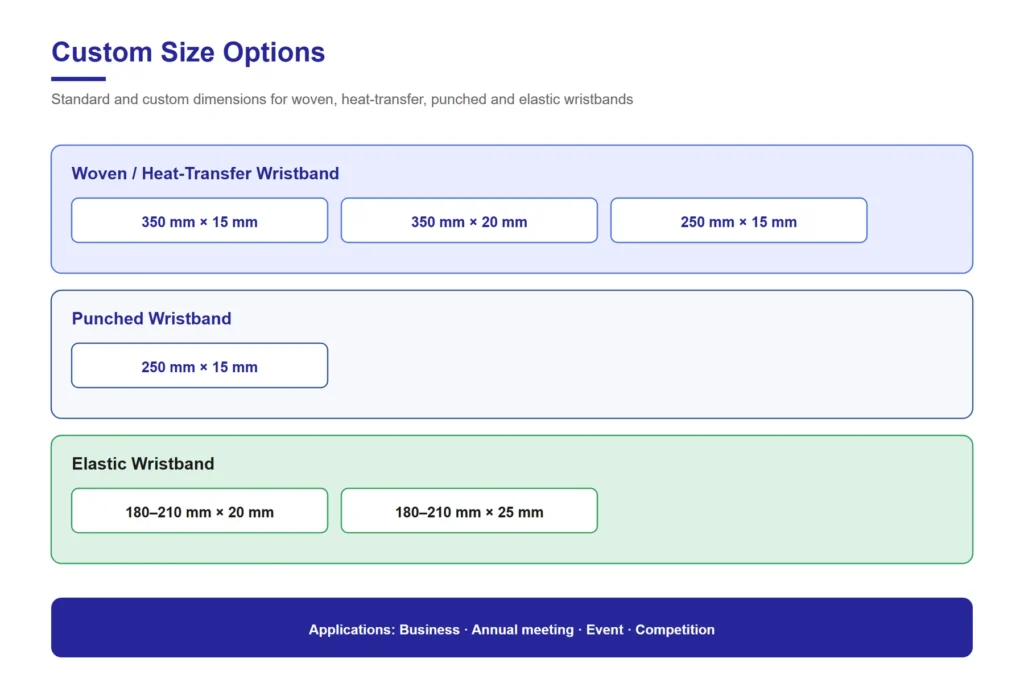
- Size — adult / child / adjustable one-size; custom widths
- Packaging — bulk, individually bagged, retail hang-tags, sponsor inserts
QC & Test Methodology (What We Verify & How)
Every batch ships only after passing the electrical and environmental tests below. Crucially, we execute 100% read-back verification on each encoded unit — not sample testing — so a dead or mis-encoded band cannot reach your event.
| Test | Standard / Method | What It Verifies | Acceptance Spec |
|---|---|---|---|
| NFC conformance | ISO/IEC 10373-6 | Air interface, anticollision, timing | 100% pass |
| Read range | In-house fixture + body phantom | 1–4 cm at 13.56 MHz on-wrist | Per product spec |
| UID uniqueness | Batch audit | No duplicate / clone UIDs | 100% unique |
| Encoding verify | Read-back after write | NDEF / UID / balance correct | 100% |
| Write endurance | NXP 100k-cycle spec | Memory integrity over life | Pass |
| Flex / fatigue | Repeated bend cycling | Antenna & inlay crack resistance | No failure |
| Water ingress | IP67 immersion | Encapsulation seal | Pass |
| Print adhesion | Cross-hatch / abrasion | Ink & overlaminate durability | Pass |
| Environmental | -20°C to +60°C, 85% RH | Temp & humidity tolerance | Pass |
| ESD robustness | HBM discharge | Static-damage immunity | Pass |
Failure Modes & Prevention (What We Engineer Out)
This is the section most suppliers cannot write — the honest list of how NFC wristbands fail in the field and what we do to stop each mode before it ships. If a supplier cannot discuss these failure modes in your language, they cannot prevent them in their factory.
| Failure Mode | Root Cause | Detection | Prevention |
|---|---|---|---|
| Reduced read range on wrist | Antenna detuning by body & fluids | On-phantom read-range test | High-Q antenna tuning, conservative coil design |
| Dead tag after bending | Flex crack in antenna / inlay | Flex-fatigue cycling | Strain-relief layout, thicker PET substrate |
| Moisture ingress | Poor encapsulation seal | IP67 immersion test | Full overmold / laminated seal, edge inspection |
| Intermittent reads | Weak die bond / cold solder | Thermal cycling + bend | Verified wire-bond / ACF process control |
| Chip killed by print heat | Thermal-transfer temp too high | Post-print read-back | Temperature-controlled printing, test after print |
| Duplicate UIDs | Cloned / refurbished dies | Batch UID audit | Source genuine NXP/ST, 100% UID check |
| Print abrasion | Wrong ink or no overlaminate | Cross-hatch / abrasion | UV-cured protective overlaminate |
| ESD damage | Static discharge during assembly | HBM test | ESD-safe production line & grounding |
MOQ, Pricing Factors & Lead Time
Pricing is driven by six levers: chip model, memory size, band material, print complexity, encoding requirements and packaging. The table gives realistic bulk ranges for an elastic/PVC NFC wristband with NTAG-class chip and single-color print; final quotes are confirmed after a sample is approved.
| Quantity | Typical Unit Price | Lead Time | Notes |
|---|---|---|---|
| 500 – 2,000 | $0.40 – 0.80 | 15–20 days | Setup & tooling amortized |
| 2,000 – 10,000 | $0.25 – 0.50 | 12–18 days | Standard configuration |
| 10,000 – 50,000 | $0.15 – 0.30 | 10–15 days | Volume pricing |
| 50,000+ | < $0.15 | 10–14 days | Negotiated; dedicated line |
- Free pre-production sample shipped in 3–5 days (you pay express freight only)
- MOQ from 500 pieces — ideal for pilot events and venue rollouts
- No hidden tooling fee — screen/plate cost quoted upfront and credited on reorders
- Exact-fit packaging — bulk, bagged or retail-ready, per your fulfillment flow
Production Process (From Antenna to Finished Wristband)
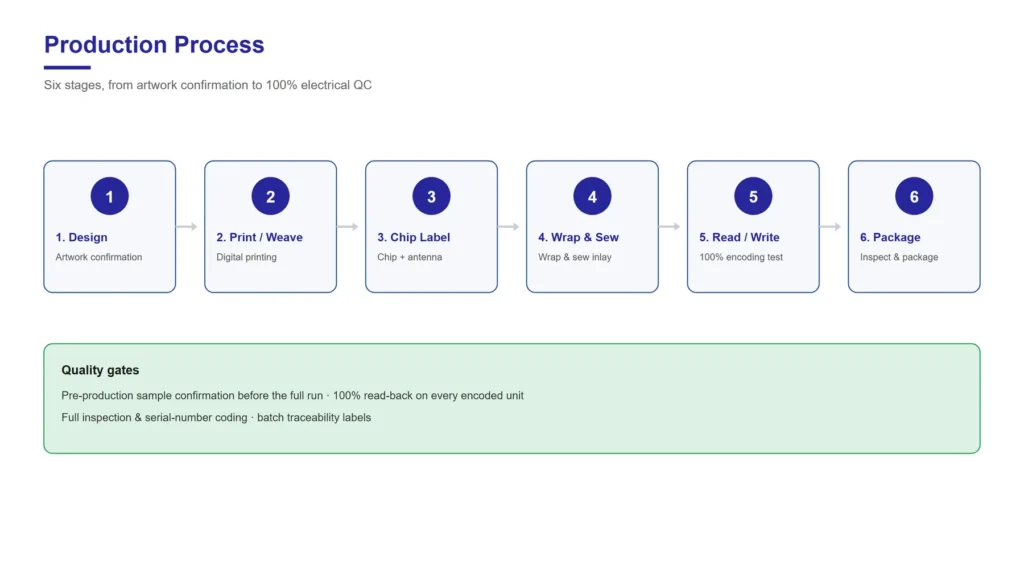
- Antenna manufacture — coil etched or printed onto PET inlay substrate
- Die bonding — NFC chip attached and wire/ACF-bonded to the antenna
- Inlay lamination — protective PET layers sealed over chip and coil
- Encapsulation — PVC/TPU lamination or silicone overmold forms the waterproof housing
- Band assembly — inlay fused to elastic/vinyl/woven strap; closure fitted
- Printing — thermal transfer, heat transfer, screen or laser decoration
- Encoding & serialization — UID mapping, NDEF/URL, zone and balance programming
- 100% electrical QC — every unit read-tested and verified against spec
- Packaging & labeling — bulk, bagged or retail; batch traceability labels
15-Point Supplier Evaluation Checklist
Use this as a scorecard when shortlisting NFC wristband manufacturers — it exposes the difference between a trading company and an actual production partner.
- Do they source genuine NXP / STMicroelectronics dies, and can they prove it with batch UID audits?
- Is there a ISO 9001 quality system with real process control, not just a certificate?
- Can they encode and serialize in-house, or do they outsource (a delay & quality risk)?
- Do they run 100% read-back verification, or only sample testing?
- Can they provide read-range test data measured on a body phantom, not a bench?
- Do they hold RoHS, REACH and FCC/CE documentation ready for customs and auditors?
- Will they share flex-fatigue and IP67 test reports for the exact material you are buying?
- Is the free pre-production sample a production sample or a best-case mock-up?
- What is the real MOQ and lead time, including encoding and packaging?
- How do they guarantee UID uniqueness and prevent duplicate or cloned chips?
- Is print durability validated (abrasion/cross-hatch) for your decoration method?
- Do they support NDEF / URL / zone programming and export a UID→data mapping CSV?
- Are they responsive in clear, technical English with a named engineer on the account?
- Will they sign an NDA and IP agreement protecting your design and data schema?
- Can they provide references from event organizers or venue operators of similar scale?
Market Intelligence (For the Decision-Maker)
The contactless-credential market is expanding on a structural shift, not a fad. Market research firms project the global RFID market at USD 14.58 billion in 2025, reaching USD 30.47 billion by 2034 (8.5% CAGR), with the RFID wristband segment valued near USD 1.2 billion in 2025 and on track for roughly USD 2.7 billion by 2034 (9.8% CAGR). High-frequency (HF / NFC) remains the dominant segment at 57% of 2024 revenue, and Asia-Pacific is the fastest-growing region.
- Cashless economics — RFID/NFC events lift per-attendee spend 15–30%; the single strongest ROI argument
- Contactless permanence — post-pandemic hygiene expectations made touchless the default
- Phone compatibility — NFC works with every modern smartphone, cutting reader capex
- Data gravity — organizers now value real-time traffic & spend analytics as much as the credential itself
- Regulatory tailwind — GDPR-compliant, tokenized identity favors encrypted NFC over barcode
- Regional growth — Asia-Pacific leads at >10% CAGR on urbanisation and cashless retail ecosystems
Frequently Asked Questions
What is the minimum order quantity for custom NFC wristbands?
Our MOQ is 500 pieces, which is low enough for a pilot event or single-venue rollout. Quantities below 500 are possible at a small premium, but unit economics and setup amortization favor 500+. For a large festival or multi-site deployment we recommend ordering in tiers of 5,000–10,000 to capture volume pricing.
Which NFC chip should I choose for cashless payment?
For closed-loop cashless with a balance stored on-tag, we recommend MIFARE DESFire EV2/EV3 for its AES-128 authentication and 2K–8K memory, or NTAG216 for simpler, lower-value tap-to-pay where the balance lives server-side. We will map your reader infrastructure first and select the chip that is 100% compatible with it.
Will the wristband work with smartphones?
Yes. NTAG- and MIFARE-class chips are NFC Forum Type 2/4 compliant and read natively by iOS and Android devices with no app required. This is what enables tap-to-URL marketing, social sharing and digital ticketing on top of your reader-based access control.
How do you guarantee no two wristbands share the same ID?
Every chip carries a factory-locked 7-byte UID from NXP or ST that is globally unique by manufacture. On top of that we run a batch UID audit before shipment, and we can add human-readable sequential numbering and a CSV mapping export so your backend can cross-check every credential.
Can the wristband be reused or is it disposable?
Both. Elastic, silicone and woven bands are designed for multi-event reuse with 100,000-cycle write endurance and 10-year data retention; Tyvek/paper bands are single-use. We will recommend the structure based on your event length and whether the band is a keepsake or a consumable.
Are the wristbands waterproof?
Silicone and fully overmolded PVC bands are sealed to IP67 for pools, water parks and wet environments. Elastic and fabric bands are splash- and sweat-resistant but not immersion-rated. Tell us where the band will be worn and we will specify the correct encapsulation.
What data can you pre-encode before shipping?
We can pre-load NDEF URL/text/vCard records, access zones, ticket tiers and cashless balances, plus sequential UID/numbering and a database-mapping CSV. Pre-encoding at the factory removes the need for on-site programming and its associated error rate.
What is the production and delivery lead time?
Standard lead time is 12–20 days depending on quantity, print complexity and encoding. A free pre-production sample ships in 3–5 days for approval before the full run, and we provide a confirmed delivery date before you commit.
Key Takeaways
- An NFC wristband is a passive 13.56 MHz credential — no battery, no line-of-sight, <100 ms reads
- The chip (NTAG / MIFARE / DESFire / ICODE / T5577 / UCODE) is the key cost-and-capability driver
- Read range is 1–4 cm by design and must be validated on a body phantom, not a bench
- Encapsulation and material determine water resistance and multi-event durability
- Specify encoding, serialization and security (UID, NDEF, password, lock bits, AES) explicitly
- Total cost favors NFC when you count +15–30% spend uplift and fraud reduction, not just unit price
- Demand 100% read-back QC, genuine-chip sourcing and compliance documentation from any supplier
Specify Your NFC Wristband
Send us your event profile — attendee count, event length, cashless requirements and reader infrastructure — and our engineers will return a chip, material and encoding recommendation with a sample and quotation within one business day. We ship a free pre-production sample in 3–5 days so you can validate read range, comfort and durability on real wrists before you commit.
Ready to Improve Your Custom Wristband Supply Chain?
Whether you are looking for a new packaging supplier, a backup manufacturer, or a trusted sourcing partner, We are ready to support your business.