
Custom Stand Up Zipper Pouch
— Engineered Reclosable Flexible Packaging
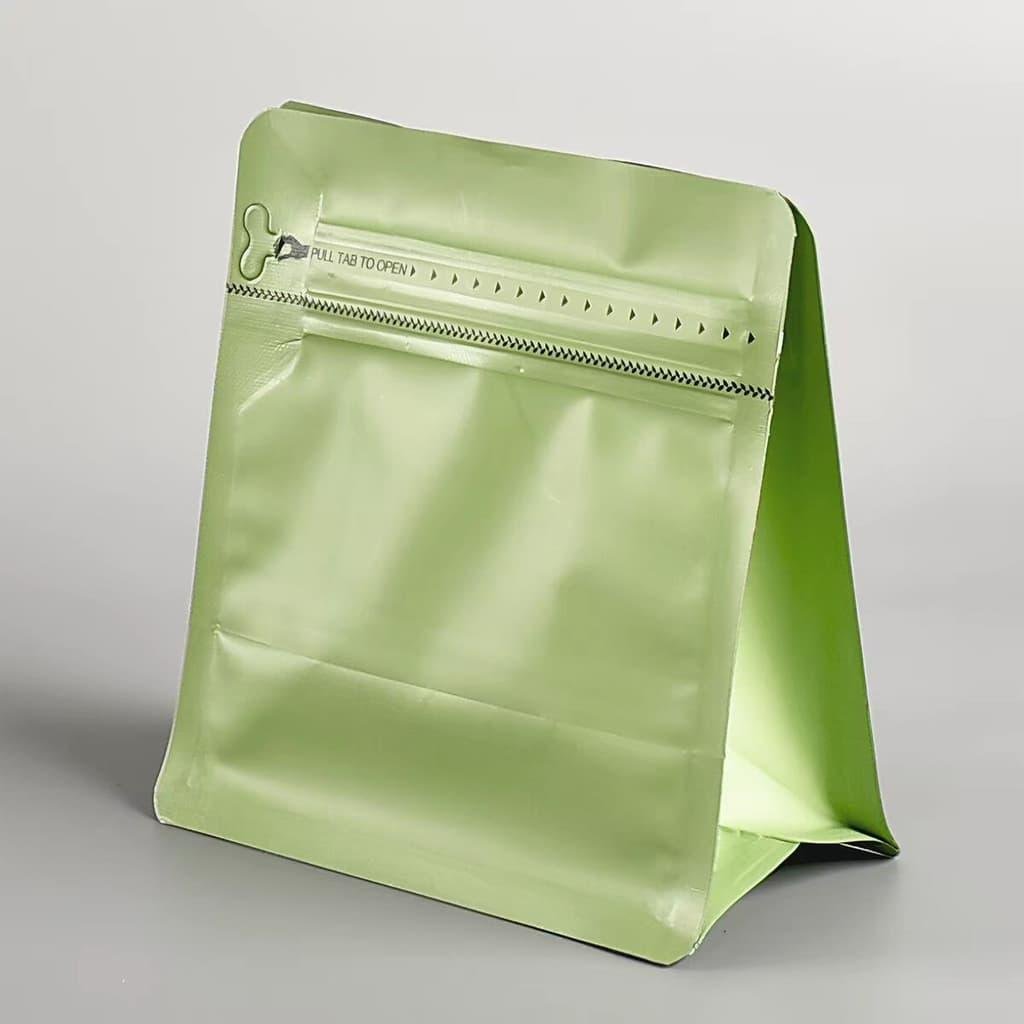
A stand up zipper pouch is a self-standing, gusseted flexible pouch with an integrated reclosable zipper. It protects the product from oxygen, moisture, and aroma loss while delivering a resealable, on-shelf experience.
What you can expect from our factory
- ISO 9001:2015 & BRCGS Packaging certified food-grade manufacturing
- Material compliance — FDA 21 CFR 177.1520 / EU 10/2011 / GB 4806.7 / REACH / Prop 65 documentation on file
- Quantified barrier data (OTR/WVTR) per film structure, with ASTM test conditions stated
- MOQ from 5,000 units; free pre-production sample in 3–5 days
- 7–15 day lead time; flexo, rotogravure & HP Indigo digital printing up to 12 colors
What Is a Stand Up Zipper Pouch?
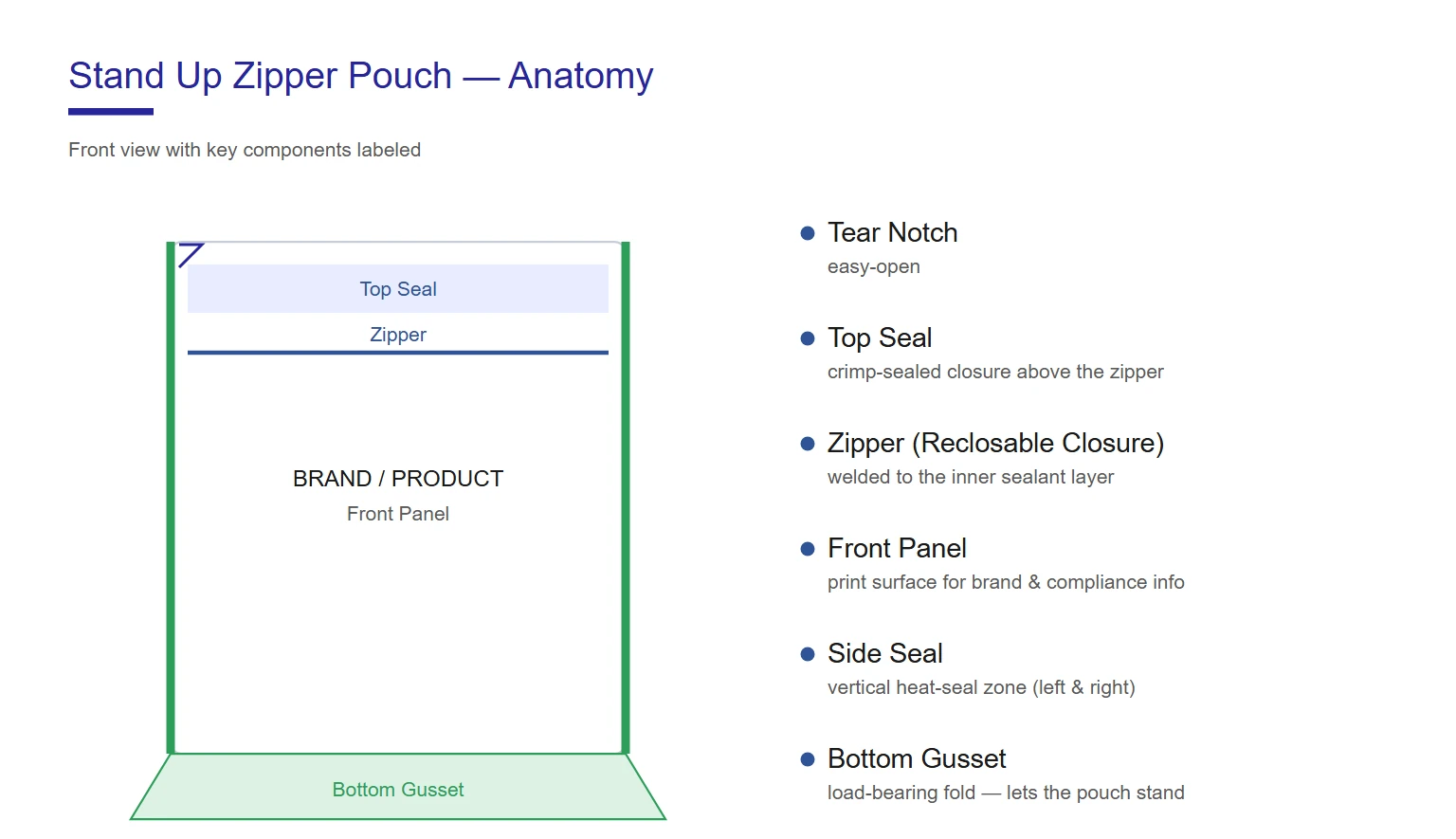
A stand up zipper pouch (also called a doypack with zipper or zipper stand-up bag) is built from a multi-layer laminate with a folded bottom gusset that allows it to stand upright on-shelf, and a zipper profile heat-welded to the inner sealant layer near the top. It combines the billboard surface area of a carton with the weight and cube efficiency of a bag, plus reclosability that rigid packaging cannot offer. The pouch anatomy breaks down as follows:
- Front & back panels — the printable surface for branding, nutrition and compliance information
- Bottom gusset (round / Doyen or flat K-seal) — the load-bearing fold that lets the pouch stand
- Integrated zipper — press-to-close, slider, pocket, or child-resistant, welded to the sealant layer
- Side seals — left/right vertical heat-seal zones that form the pouch body
- Optional features — tear notch, hang hole, one-way degassing valve, laser score, corner/euro-slot holes
Zipper Closure Types & Selection Matrix
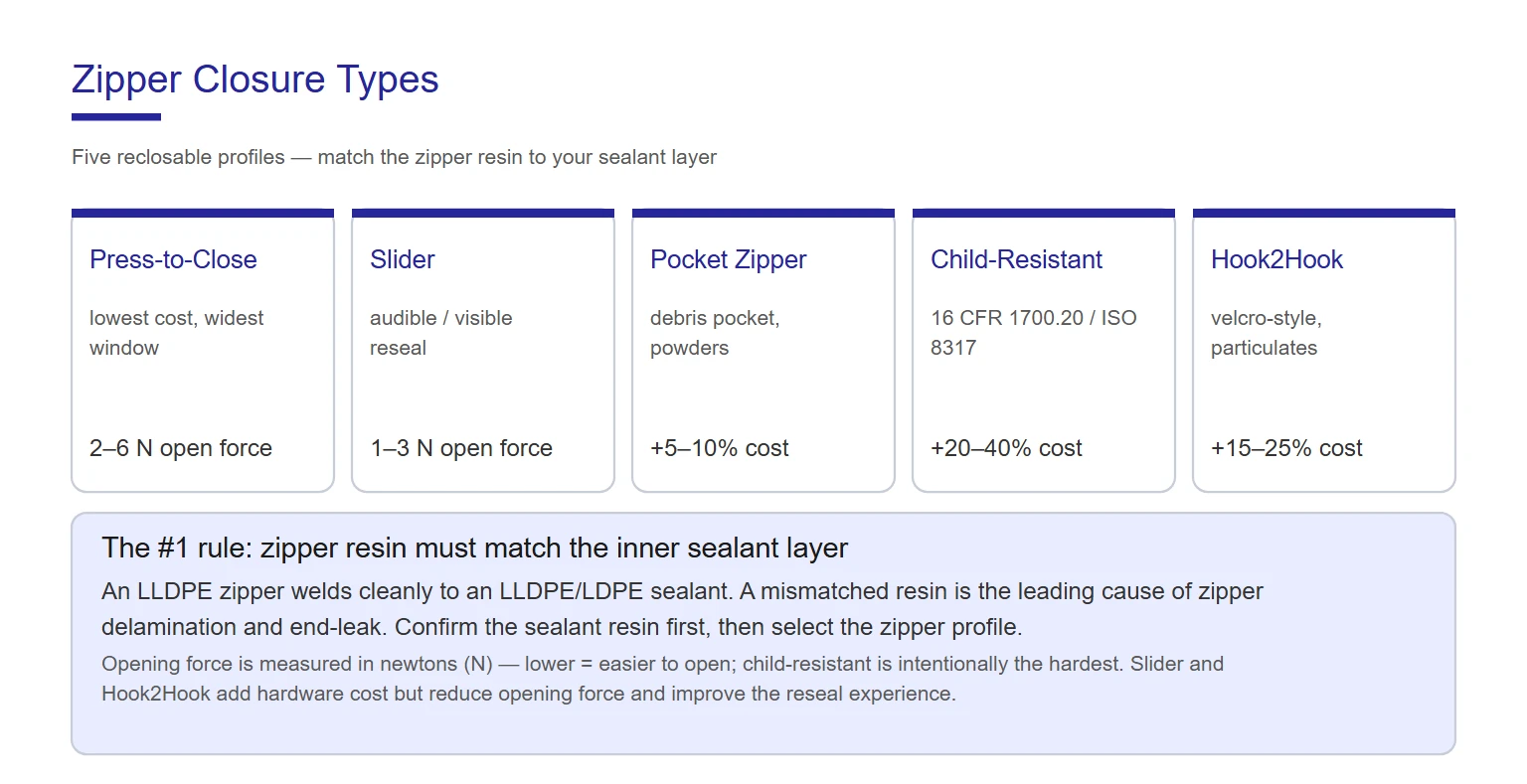
The zipper is the feature that differentiates this format from a plain stand-up pouch. The single most important rule: the zipper profile must be the same polymer family as the innermost sealant layer. An LLDPE zipper welds cleanly to an LLDPE/LDPE sealant; a mismatched zipper resin is the #1 root cause of zipper delamination and end-leak. Select the sealant resin first, then the zipper.
| Zipper Type | Mechanism | Best For | Opening Force | Relative Cost | Notes |
|---|---|---|---|---|---|
| Press-to-close (press & seal) | Profile ribs interlock under finger pressure | Snacks, coffee, dried fruit, general FMCG | Low (2–6 N) | Lowest | Most common; widest machine-speed window |
| Slider zipper | Slider mechanically engages/disengages the profiles | Pet food, premium & large formats | Lowest (1–3 N) | +10–15% | Audible/visible reseal; easiest for elderly & one-hand use |
| Pocket zipper | Press-to-close with a debris pocket under the profiles | Powders (protein, flour, supplements) | Low | +5–10% | Pocket catches particulates so the zipper stays clean |
| Child-resistant (CR) | Push-down slider or dual-tab press-to-close | Supplements, cannabis, nicotine | High (two-step) | +20–40% | Certified to 16 CFR 1700.20 / ISO 8317 |
| Hook2Hook / velcro-style | Hook-loop polymer fastening | Powders, large particulates, yeast | Very low | +15–25% | No alignment precision needed; easy reseal |
Film Structures & Barrier Performance (Quantified)
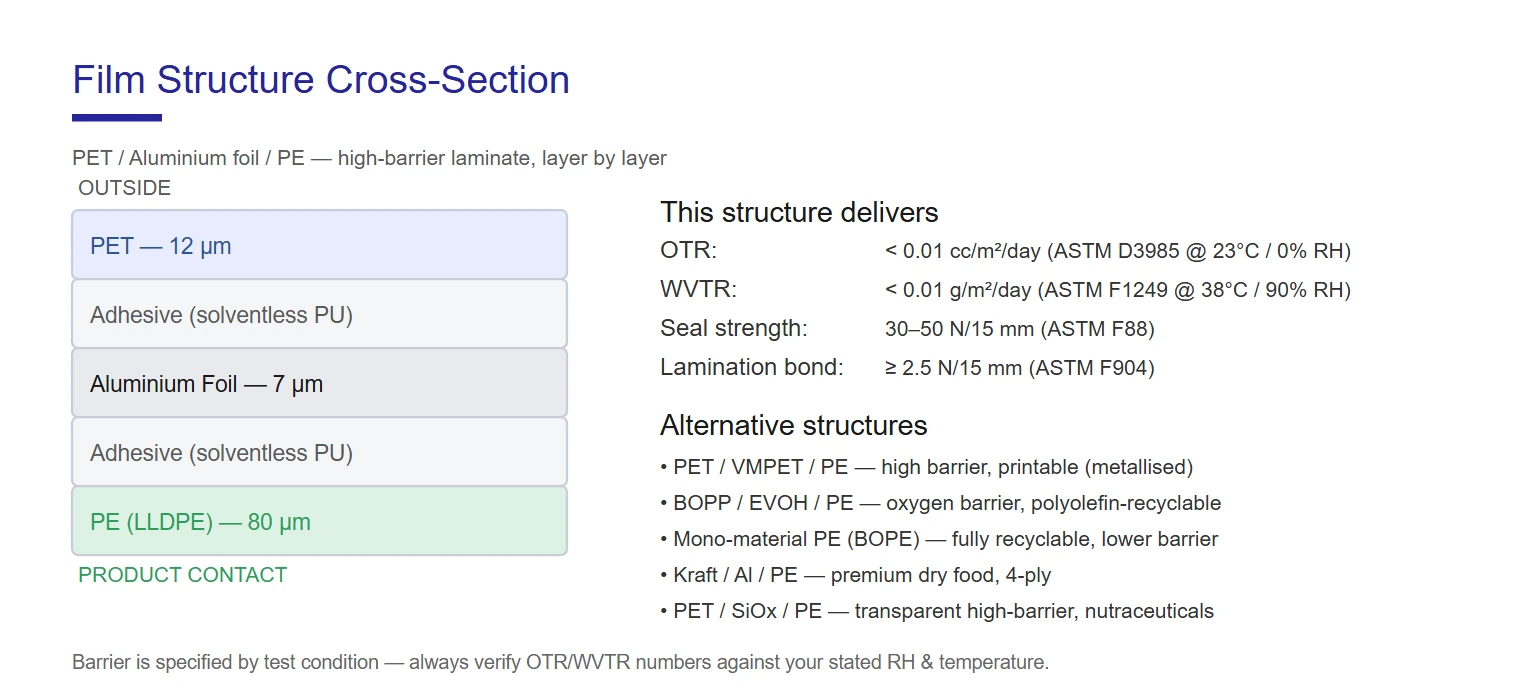
Barrier is specified by two numbers — OTR (oxygen transmission rate, cc/m²/day, ASTM D3985 @ 23°C / 0% RH) and WVTR (water-vapour transmission rate, g/m²/day, ASTM F1249 @ 38°C / 90% RH). Always state the test conditions: the same film can read up to 3× higher OTR at 50% RH than at 0% RH. A structure that looks “high barrier” on paper may not be, if the conditions are cherry-picked.
| Structure | OTR (cc/m²/day) | WVTR (g/m²/day) | Seal (N/15 mm) | Recyclability | Typical Application |
|---|---|---|---|---|---|
| PET / Al foil / PE (3-ply) | < 0.01 | < 0.01 | 30–50 | Non-recyclable | Coffee (with valve), pharma, retort, cannabis |
| PET / VMPET / PE (3-ply) | 0.5–2.0 | 1.0–3.0 | 25–40 | Limited | Snacks, coffee, dry food, supplements |
| BOPP / EVOH / PE (3-ply) | 0.1–0.5 | 3.0–8.0 | 20–35 | Recyclable (polyolefin) | Dairy, produce, sauces, beverages |
| Kraft / LDPE / Al / PE (4-ply) | < 0.05 | < 0.05 | 28–45 | Non-recyclable | Premium dry food, pet food, coffee |
| Mono-material PE / BOPE | 5.0–15.0 | 4.0–10.0 | 15–30 | Fully recyclable | Ambient snacks, mailers, EPR-driven SKUs |
| PET / SiOx / PE (3-ply) | 0.3–1.5 | 0.5–2.0 | 25–40 | Better than foil | Nutraceuticals, medical, premium |
How to select the right structure
- Define the shelf-life target (months) and storage condition (ambient / refrigerated / frozen)
- Identify the barrier-sensitive ingredient — oxidation points to OTR, moisture/agglomeration points to WVTR, aroma loss points to both
- Select the lowest-cost structure that meets both requirements with a ≥20% safety margin
- Confirm the zipper resin matches the sealant layer, and that the heat-seal window fits your filling line
- Add a puncture layer (PA/nylon 15 µm) between the print film and sealant for sharp products like kibble or granola clusters
Lamination bond should be ≥ 2.5 N/15 mm (ASTM F904, T-peel) using solvent-based PU adhesive for foil/EVOH. Allow a 10% barrier-degradation margin on metallised structures to account for flex-cracking.
Pouch Styles, Bottom Geometry & Dimensional Optimization
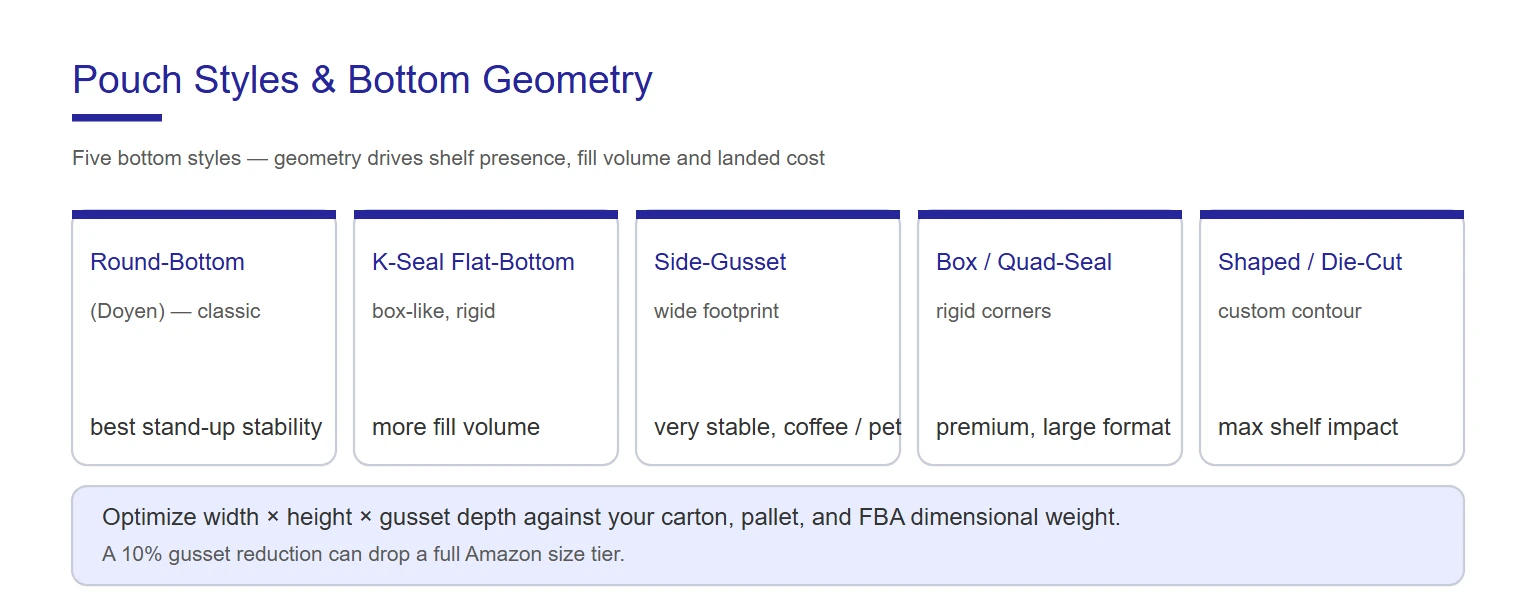
- Round-bottom (Doyen) — the classic; best stand-up stability and the most common format
- K-seal / flat-bottom — box-like shelf presence, stands rigid, more fill volume per footprint; standard for coffee
- Side-gusset — wider footprint, very stable, common for coffee and pet food
- Box pouch / quad-seal — rigid corners, premium look, larger formats
- Shaped / custom die-cut — maximum shelf differentiation for hero SKUs
Geometry drives landed cost, not just shelf appeal. Optimize width × height × bottom-gusset depth against your carton, pallet pattern, and — critically for Amazon sellers — FBA dimensional weight. A 10% reduction in gusset depth can drop a large-format pouch by a full FBA size tier (see the Amazon section below).
Material Thickness & Gauge Selection
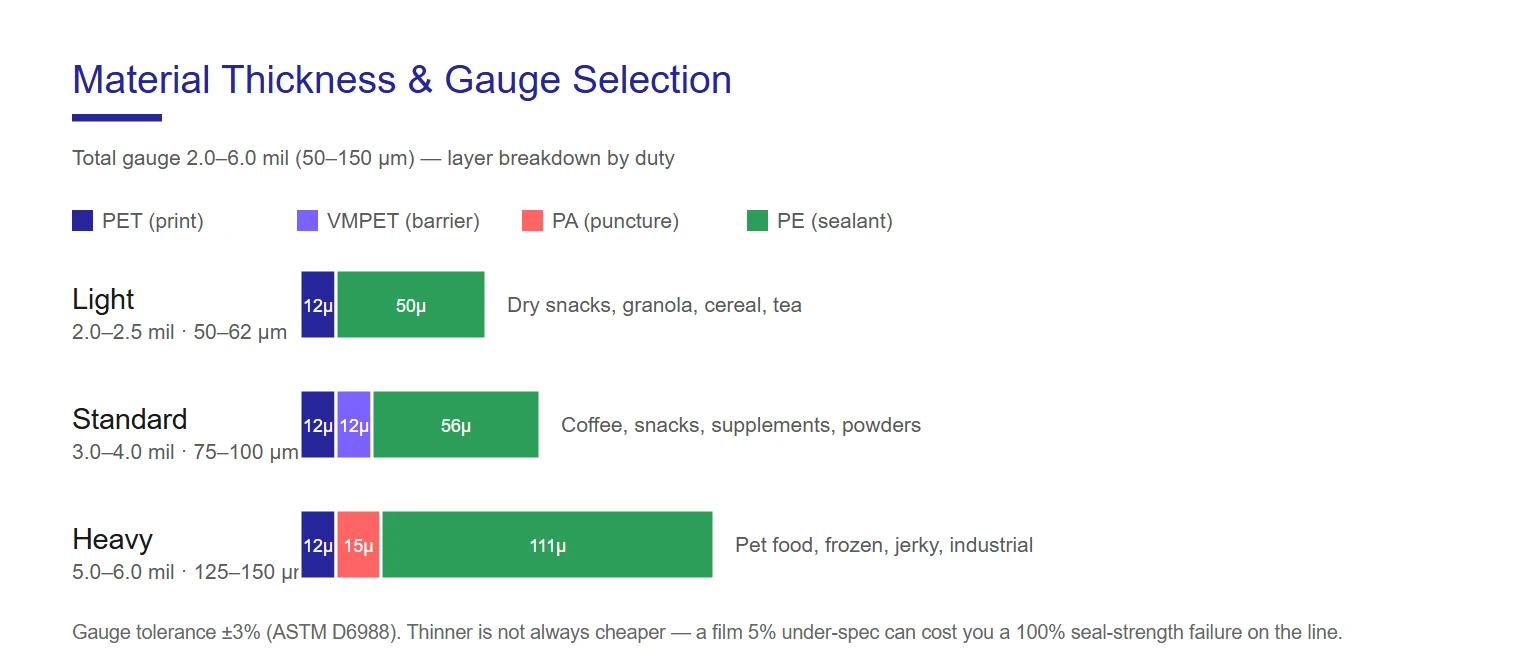
Total gauge for stand up zipper pouches typically runs 2.0–6.0 mil (50–150 µm) across all layers. Gauge is specified per-layer and summed: the sealant layer carries seal strength, the middle layers carry barrier, and the outer layer carries print quality and stiffness.
| Duty | Total Gauge | Typical Layer Breakdown | Application |
|---|---|---|---|
| Light | 2.0–2.5 mil (50–62 µm) | PET 12 µm / PE 50 µm | Dry snacks, granola, cereal, tea |
| Standard | 3.0–4.0 mil (75–100 µm) | PET/VMPET/PE or BOPP/EVOH/PE | Coffee, snacks, supplements, powders |
| Heavy | 5.0–6.0 mil (125–150 µm) | + PA 15 µm puncture layer | Pet food, frozen, jerky, industrial |
Gauge tolerance per ASTM D6988 is ±3%. Thinner is not always cheaper — a film 5% under-spec can cost you a 100% seal-strength failure on the filling line.
Process Compatibility: Fill, Seal & Run on Your Line
| Fill Process | Temp / Pressure | Required Structure | Key Notes |
|---|---|---|---|
| Ambient / gas flush (MAP) | RT, 1.0–1.5 bar | PET/PE, PET/VMPET/PE | MAP extends shelf life; confirm residual O2 <1% |
| Hot fill | 85–95 °C | + heat-resistant sealant, BOPP/EVOH/PE | Sealant must withstand fill temp without creep |
| Retort | 121 °C / 0.3–0.5 bar overpressure | PET/Al/PE or NY/CPP | Foil mandatory; zipper must be retort-grade |
| Vacuum | Negative pressure | Stiffer structure | Round-bottom preferred for conformity |
| Frozen | −18 °C and below | + cold-crack resistance (LLDPE, C8) | Test dart drop at −20 °C (ASTM D1709) |
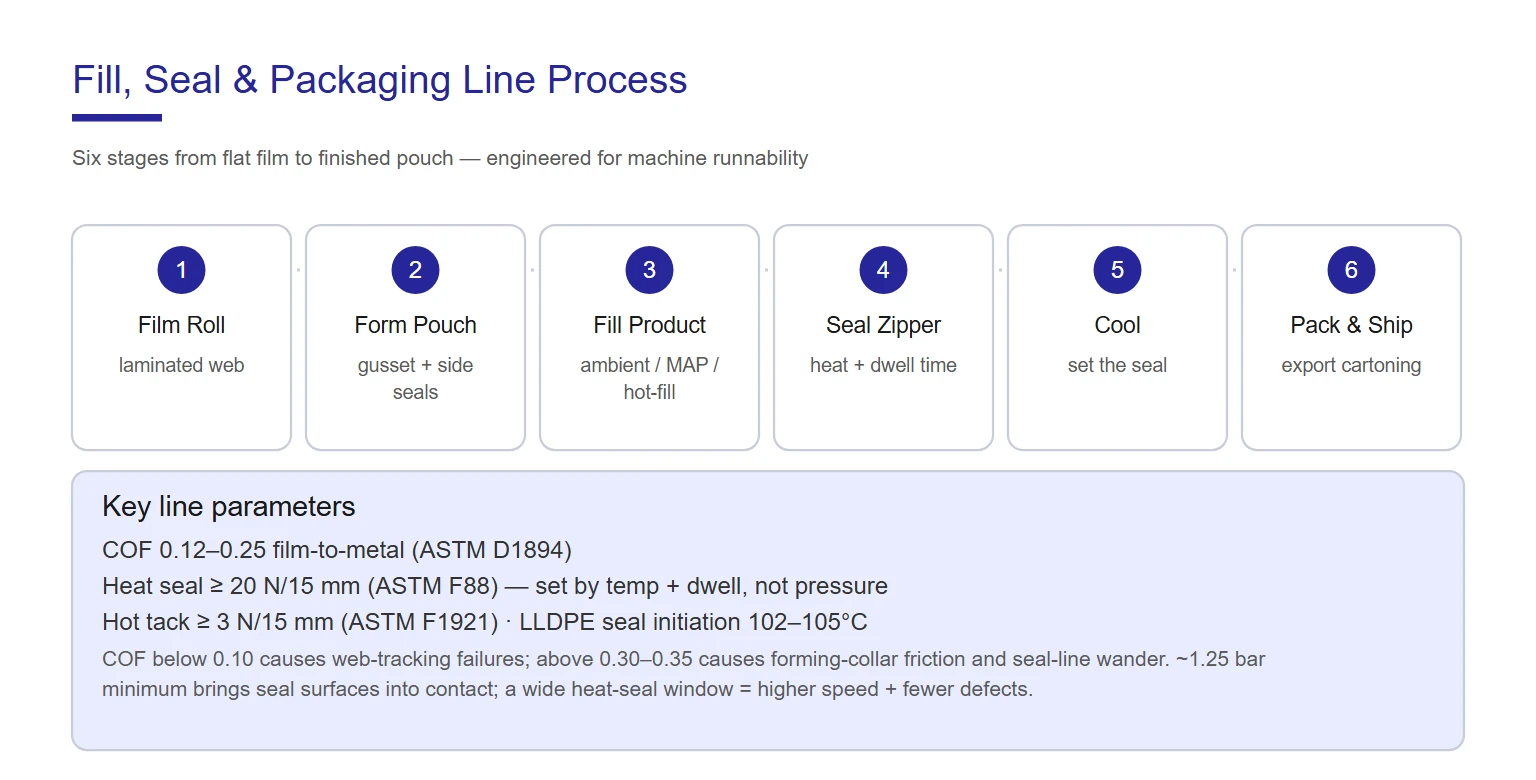
Machine runnability is set by the coefficient of friction: kinetic COF of 0.12–0.25 (film-to-metal, ASTM D1894) is the operating window for VFFS/HFFS. Below 0.10 causes web-tracking and registration failures; above 0.30–0.35 causes forming-collar friction, tension spikes, and seal-line wander. Seal strength is set primarily by temperature + dwell time, not pressure — ~1.25 bar minimum brings the surfaces into contact.
Regulatory & Compliance Matrix
| Regulation | Scope | Requirement | What It Means for You |
|---|---|---|---|
| FDA 21 CFR 177.1520 / 177.1390 | US food-contact olefins & adhesives | Material on the approved list | Passes US import & retailer audits |
| EU 10/2011 (EC 1935/2004) | EU plastics food-contact | Overall migration ≤ 10 mg/dm² | Passes EU border & retailer audits |
| GB 4806.7 / GB 9685 | China food-contact plastics & additives | Migration limits + positive list | Domestic China compliance |
| REACH (EC 1907/2006) | EU SVHC | No SVHC > 0.1% w/w | EU market access |
| California Prop 65 | US (CA) | No phthalates/lead/BPA above limits | Avoids CA litigation exposure |
| 16 CFR 1700.20 / ISO 8317 | Child-resistant packaging | CR zipper passes panel test | Mandatory for cannabis/supplements (US) |
| BRCGS Packaging Issue 6 | Food-safety management | Audit-grade traceability + HACCP | Retailer vendor approval |
| ISO 22000 / ISO 9001 | Food-safety & QMS | Certified management system | Reduces your audit burden |
| EN 13432 / PPWR (EU 2025/40) | Compostability / recyclability + EPR | Recyclability rating, EPR fees | EU sustainability roadmap |
Child-Resistant & Specialty Closures
For supplements, cannabis, nicotine, and any product that must not be opened by a child, the zipper is a compliance feature, not a convenience feature. In the US, child-resistant packaging is regulated under 16 CFR 1700.20 — the closure must resist opening by 80% of children under 5 in panel testing, while remaining usable by 90% of adults. Internationally, ISO 8317 and ISO 28862 apply.
- Push-down slider — must press while sliding (two simultaneous actions)
- Dual-tab press-to-close — two opposing actions required to open
- Combined with foil barrier + tamper-evident tear strip for full protection
- Certified CR zippers carry the panel-test documentation your retailer or regulator will ask for
Sustainability & Recyclable Structures
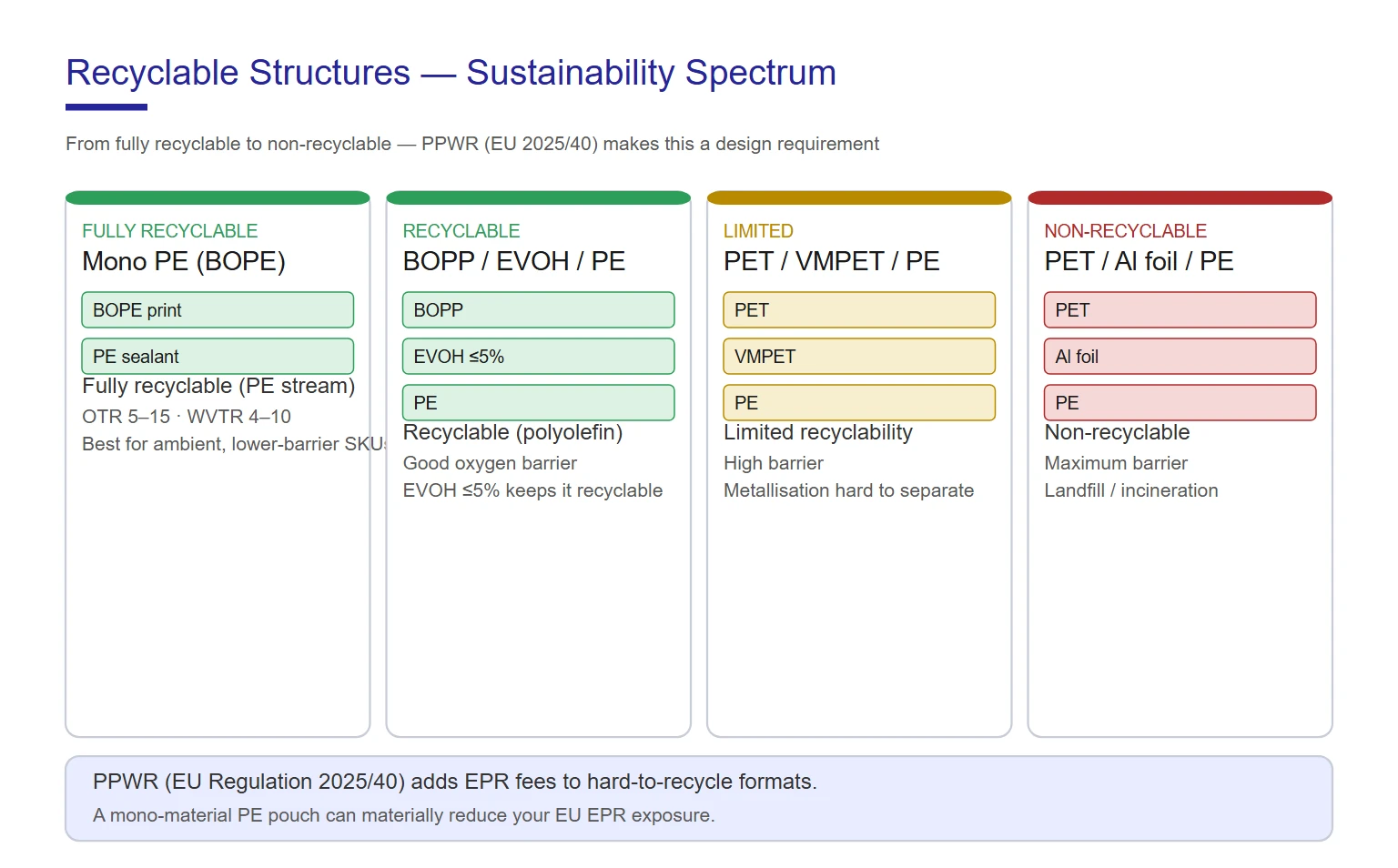
| Structure | Recyclability | Barrier Trade-off | End-of-Life |
|---|---|---|---|
| Mono-material PE / BOPE | Fully recyclable (PE stream) | OTR 5–15, WVTR 4–10 | Store drop-off / curbside where accepted |
| BOPP / EVOH / PE (EVOH ≤5%) | Recyclable (polyolefin) | Good barrier | Recyclable with compatibilizer |
| PET / VMPET / PE | Limited | High barrier | Metallisation hard to separate |
| PET / Al / PE | Non-recyclable | Maximum barrier | Landfill / incineration |
| Compostable PLA / PBAT | Industrially compostable | Poor moisture barrier (WVTR 100–200) | EN 13432 facility only |
The PPWR (EU Regulation 2025/40) makes recyclability a design requirement and adds extended-producer-responsibility (EPR) fees to hard-to-recycle formats. A mono-material PE stand up zipper pouch can materially reduce your EU EPR exposure — but confirm the product’s barrier needs first: an EVOH layer at ≤5% keeps the structure recyclable while restoring oxygen barrier.
Total Cost of Ownership vs Rigid Packaging
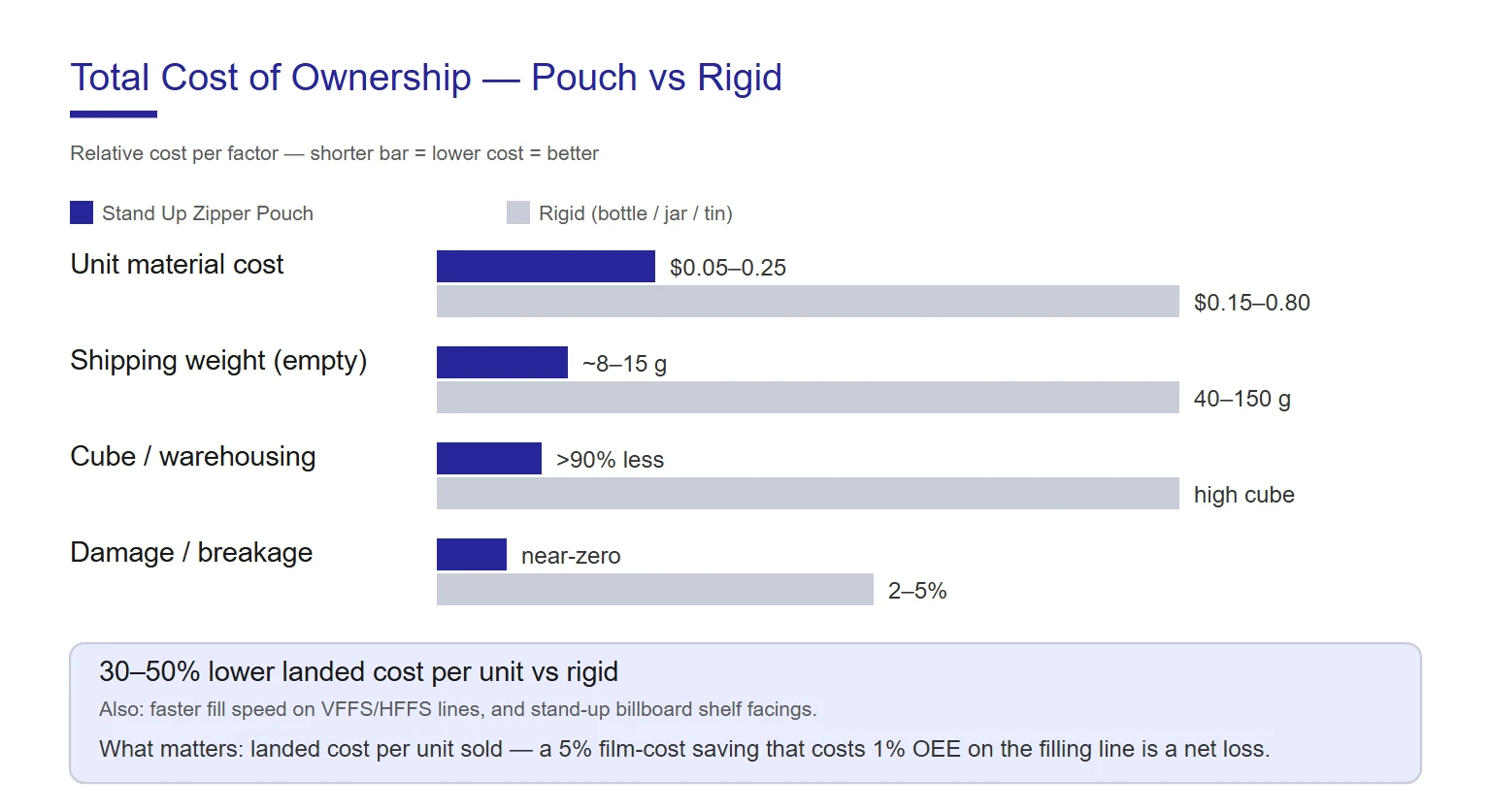
| Cost Factor | Stand Up Zipper Pouch | Rigid (Bottle / Jar / Tin) | Impact |
|---|---|---|---|
| Unit material cost | $0.05–0.25 | $0.15–0.80 | 60–80% lower |
| Shipping weight | ~8–15 g empty | 40–150 g empty | Freight + FBA fee savings |
| Cube / warehousing | Flat or pre-formed, >90% less cube | High cube | Warehousing + FBA storage savings |
| Damage / breakage | Near-zero (no shatter) | 2–5% breakage | Fewer returns, cleaner reviews |
| Fill speed | High (VFFS / HFFS) | Moderate | Throughput-dependent |
| Shelf facings | High (stand-up billboard) | Lower | Retail-facing value |
| Recyclability | Structure-dependent | Often higher | Sustainability trade-off |
For high-volume CPG, the pouch routinely wins on landed cost by 30–50% against rigid equivalents — but the number that matters is landed cost per unit sold, not per unit purchased. A 5% film-cost saving that costs 1% OEE on the filling line is a net loss. Evaluate the total system, not the material price.
Applications by Industry
- Coffee & tea — high oxygen barrier with one-way degassing valve
- Snacks & confectionery — chips, nuts, dried fruit, jerky
- Pet food & treats — puncture-resistant structure + slider zipper
- Supplements & nutraceuticals — child-resistant zipper, high barrier
- Cannabis — child-resistant zipper + UV-blocking foil
- Protein & powders — pocket zipper + gas flush
- Frozen foods — cold-crack-resistant sealant
- Personal care & household — resealable wipes, detergent pods
- Industrial & chemical — solvent-resistant, UN-certified where needed
- Electronics — ESD-safe variants
For Amazon FBA Sellers
Stand up zipper pouches are the most FBA-friendly flexible format. Four levers decide your landed economics: dimensional weight, storage cube, damage rate, and — often overlooked — the review tail driven by reclosability.
- Dimensional weight — optimize W×H×gusset to stay inside the smallest FBA size tier; gusset depth is the hidden cost driver
- Storage & inbound — flat-shipped pouches occupy ~90% less cube than rigid, cutting FBA storage fees
- Damage — near-zero breakage vs glass/jars → fewer refunds, better Account Health
- Frustration-free packaging — zipper pouches pass Amazon’s SIOC (Ships in Own Container) more easily than fragile rigid
- Reclosability drives reviews — a zipper that keeps product fresh earns the “resealable” review language that lifts conversion
- Child-resistant compliance — supplements/cannabis require CR zippers (16 CFR 1700.20); non-compliant ASINs get suppressed
- Unit economics — at 5,000+ units, total landed cost (pouch + fill + ship) is typically 30–50% under rigid
Customization Options
- Printing — flexo (up to 8 colors), rotogravure (up to 12, photo-real), HP Indigo digital (no plates, variable data, ΔE < 2)
- Finishes — matte, gloss, soft-touch, paper-look, metallic, spot UV, embossing
- Windows — clear PET/PE window for product visibility
- Valves — one-way degassing (coffee), placed 35–55 mm below the top seal
- Closures — tear notch, hang hole, laser score, corner holes, euro-slot
- Zipper extras — slider, pocket, child-resistant, double zipper, colored zipper for brand
- Variable data — QR codes, batch/expiry, serialization for traceability
QC & Test Methodology (What We Verify & How)
| Test | Standard | What It Verifies | Pass Spec |
|---|---|---|---|
| Coefficient of friction | ASTM D1894 / ISO 8295 | Machine runnability | Kinetic 0.12–0.25 film-to-metal |
| Heat seal strength | ASTM F88 | Seal integrity | ≥ 20 N/15 mm |
| Hot tack | ASTM F1921 | Seal strength while still hot | ≥ 3 N/15 mm |
| Oxygen transmission | ASTM D3985 | Oxygen barrier | Structure-specific (see §3) |
| Moisture transmission | ASTM F1249 | Moisture barrier | Structure-specific (see §3) |
| Lamination bond | ASTM F904 | Layer adhesion | ≥ 2.5 N/15 mm T-peel |
| Tensile & elongation | ASTM D882 | Film strength | Structure-specific |
| Puncture resistance | ASTM F1306 / D5748 | Puncture (sharp product) | Structure-specific |
| Dart drop | ASTM D1709 | Impact (frozen / transit) | Structure-specific |
| Burst | ASTM F2054 | Whole-package integrity | No burst below spec pressure |
| Leak (bubble) | ASTM F2096 | Gross leak detection | No continuous bubble stream |
| Dyne level | ASTM D2578 | Print / lamination adhesion | ≥ 38 dyn/cm print side |
| Zipper open force | Internal / customer spec | Reclosable experience | Per zipper type (see §2) |
| Gauge | ASTM D6988 | Thickness tolerance | ± 3% |
Failure Modes & Prevention (What We Engineer Out)
| Failure Mode | Root Cause | Detection | Prevention |
|---|---|---|---|
| Zipper delamination | Zipper resin ≠ sealant resin; low dwell | T-peel at zipper/film interface | Match polymer family; verify seal window |
| End-leak at zipper | Zipper not sealed to film at ends; seal void | Vacuum decay / dye penetration | Wider end-seal; hot-tack check |
| Seal leak (channel) | Contamination in seal (product dust), low temp | Bubble test (ASTM F2096) | Clean seal area; gas-flush to keep dust out |
| Flex-crack (metallised) | Repeated flexing of VMPET | Visual + OTR re-test | Allow 10% barrier margin; adjust structure |
| CAF / retort blow | Overpressure during retort | Burst test | Retort-grade zipper + foil + overpressure control |
| Slider jam | Wrong slider-to-profile match; particulate | Functional test | Match slider to profile; pocket zipper for powders |
| Off-registration | Print repeat drift; film tension | AOI / camera inspection | Tension control; plate-mount calibration |
| Poor COF (jams) | Slip/stick surface, wrong additive | COF test | Slip additive to target 0.12–0.25 |
| Pin-hole / puncture | Sharp product, thin sealant | Dart drop + puncture | Add PA 15 µm layer; up-gauge sealant |
MOQ, Pricing Factors & Lead Time
| Factor | Typical Range | Notes |
|---|---|---|
| MOQ | 5,000–10,000 units (digital); 50,000+ (rotogravure) | Digital has no plate fee, higher per-unit cost |
| Unit price | $0.05–0.25 | Scales with volume, structure, print |
| Plate / cylinder fee | $0 (digital) – $300–800/color (rotogravure) | Amortizes over volume |
| Sampling | 3–5 days (digital), free pre-production sample | Confirm structure before mass run |
| Production lead time | 7–15 days | +7–10 days for rotogravure cylinders |
| Shipping | Sea 15–30 days / air 3–7 days | FOB / CIF / EXW terms |
Price is set by five levers: film structure, total gauge, print method + color count, zipper type, and order volume. The largest single lever is volume — moving from 10k to 50k units typically drops unit cost 20–40% as cylinder fees amortize and material runs lengthen.
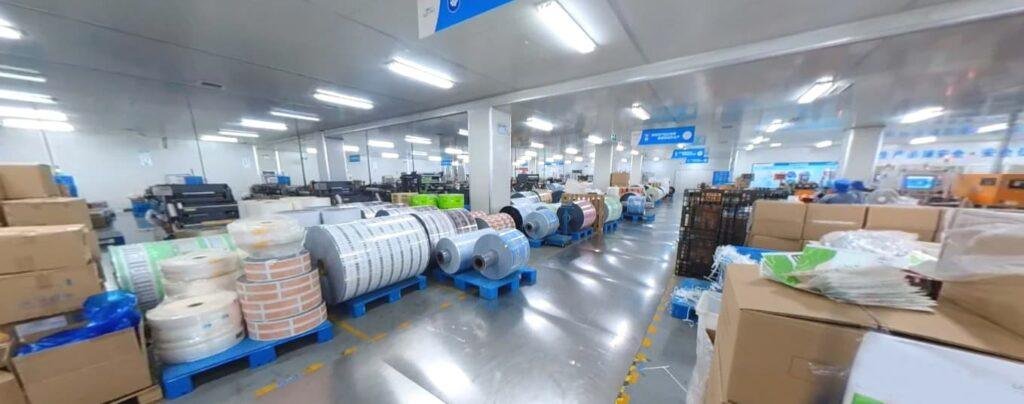
Production Process (From Film to Finished Pouch)
- Film lamination — barrier / print / sealant layers bonded (solventless or solvent-based adhesive)
- Printing — flexo / rotogravure / digital on the outer web
- Slitting — master roll cut to working widths
- Pouch forming — gusset fold + side seals + bottom shape (round or K-seal)
- Zipper insertion — zipper heat-welded to the sealant layer at the top
- Optional finishing — valve, tear notch, hang hole, window, laser score
- Inline QC — camera inspection, seal-strength, leak, barrier sampling
- Packing — flat or pre-formed, export-grade cartoning + palletizing
15-Point Supplier Evaluation Checklist
- BRCGS / ISO 22000 food-safety certification — current and in your product scope
- Material compliance documentation — FDA, EU 10/2011, REACH, Prop 65 on file
- In-house lab with OTR/WVTR / seal / leak test capability
- Zipper compatibility testing against your sealant resin
- Color management — Delta E target + Pantone matching proof
- Sample policy — free pre-production sample with your exact structure
- MOQ that matches your launch stage (digital vs rotogravure)
- Lead-time commitment with penalty / remedy clause
- Plate / cylinder fee transparency + amortization terms
- Third-party audit scorecard (SGS, Intertek, TÜV)
- Child-resistant zipper certification (if applicable)
- Traceability — lot-level raw-material trace to the film supplier
- Contingency capacity — a second line for peak season
- Logistics — FOB/CIF/EXW + Incoterms clarity + freight partner
- IP protection — NDA, no reuse of your artwork or dieline
Market Intelligence (For the Decision-Maker)
Flexible packaging is a ~$284–301B global market growing at 4.2–4.9% CAGR (2025), with plastic films at ~53% of material share and food & beverage at ~53.7% of application share. APAC is ~40% of demand and the fastest-growing region — China leads. Stand-up pouches are the fastest-growing flexible format, driven by:
- Shelf impact — stand-up billboard presentation beats lay-flat bags on retail facings
- E-commerce — FBA-friendly cube/weight + reclosability (Amazon growth)
- Sustainability pressure — lightweighting vs rigid, and recyclable mono-material R&D
- Convenience — resealable formats command a premium on-shelf
- Premiumization — coffee, supplements, and pet food moving to high-barrier stand-up pouches
The strategic implication: stand up zipper pouch is a growth format, not a commodity format. Brands that specify it correctly (barrier, zipper type, geometry) capture margin; those that treat it as a commodity lose it to breakage, leakage, and returns.
Frequently Asked Questions
What is the minimum order quantity for custom stand up zipper pouches?
Digital printing starts at 5,000 units with no plate fee; rotogravure becomes cost-effective from 50,000+ units. We provide a free pre-production sample in 3–5 days so you can validate the structure and print before committing to a full run.
What film structure should I use for coffee?
Roasted coffee needs a high oxygen barrier plus a one-way degassing valve. Use MOPP/VMPET/PE or PET/Al/PE (OTR <1.0 cc/m²/day). The valve is heat-sealed 35–55 mm below the top seal, and a K-seal flat-bottom is standard for 250 g and 500 g pouches.
Do you offer child-resistant zippers?
Yes. CR zippers are certified to 16 CFR 1700.20 (US) and ISO 8317 (international), available as push-down slider or dual-tab press-to-close, combined with tamper-evident tear strips and foil barrier for supplements and cannabis.
What is the difference between press-to-close and slider zippers?
Press-to-close interlocks the profile ribs under finger pressure — the most cost-effective and machine-friendly option. A slider mechanically engages the profiles, giving the lowest opening force and an audible/visible reseal; it is preferred for pet food and premium/large formats, at roughly +10–15% cost.
How do I know my pouch will run on my filling machine?
Confirm kinetic COF (0.12–0.25 film-to-metal), the heat-seal window, and hot tack against your line. We test your exact structure on a simulated sealing profile and provide seal-strength (ASTM F88) and hot-tack (ASTM F1921) data before production.
Are recyclable stand up pouches available?
Yes — mono-material PE (BOPE) structures are fully recyclable, and BOPP/EVOH/PE with ≤5% EVOH remains polyolefin-recyclable while restoring oxygen barrier. Recyclable structures trade some barrier for sustainability; we recommend them for ambient, lower-barrier SKUs under EU PPWR pressure.
What certifications does the factory hold?
ISO 9001:2015, BRCGS Packaging, and ISO 22000-aligned food-safety systems, with material compliance documentation for FDA 21 CFR 177.1520/177.1390, EU 10/2011, GB 4806.7, REACH, and Prop 65 available on request.
How long does production and delivery take?
Pre-production sample in 3–5 days (digital); production in 7–15 days; rotogravure adds 7–10 days for cylinder making. Sea freight 15–30 days, air 3–7 days, shipped FOB/CIF/EXW.
Key Takeaways
- The zipper is the differentiator — match its resin to your sealant layer or risk delamination and end-leak
- Specify barrier by test condition (OTR ASTM D3985 @ 0% RH; WVTR ASTM F1249 @ 90% RH), not by marketing claims
- Geometry drives landed cost — optimize gusset depth against carton, pallet, and FBA dimensional weight
- Child-resistant (16 CFR 1700.20) is a compliance feature for supplements and cannabis — not optional
- A 5% film-cost saving that costs 1% OEE is a net loss — evaluate total landed cost, not material price
- Stand up zipper pouch is the fastest-growing flexible format — specify it as an engineered system, not a commodity
Specify Your Stand Up Zipper Pouch
Send your structure, dimensions, and volume — or your shelf-life target and product type — and receive a quantified barrier recommendation, a free digital pre-production sample, and a landed-cost quote within 24 hours.
You Also May Like

Ready to Improve Your Packaging Supply Chain?
Whether you are looking for a new packaging supplier, a backup manufacturer, or a trusted sourcing partner, We are ready to support your business.